Monday, July 3

I Need Your Help, Please!

If you read this blog regularly you are among my biggest fans - thank you very much for your support over the last 11 years of my game design career. As a regular reader (you're not? Ok, start here and then continue until you're up to date!), you'll know I'm about to get into self-publishing hand-made games again. I've got previous for this - the first two very successful years of Reiver Games from July 2006 until July 2008 when I made 400 games by hand (Border Reivers and It's Alive!). But things have changed. There was no kickstarter back then, and certainly in year two I had built up a bit of a fanbase and had a mailing list of interested gamers.

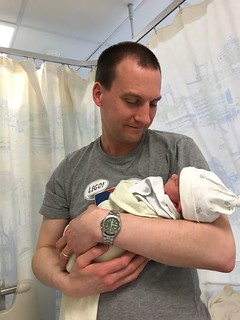
This time round there's a lot more competition through kickstarter and as the father of two young (one's only five weeks old!) girls I'll be busier than I was first time around. So I need your help to be successful. If you're interested, here's a few ways you can help my second board games publishing effort be a success:

Do you own Zombology, and have played it?

Please provide an honest rating and comments on BoardGameGeek, please also download the second edition rules and introduce it to new people and let them know I'll be making another hand-made run of it shortly if they'd like a copy of their own.

Do you own Zombology but you haven't played it?

Please also download the second edition rules and introduce it to new people and let them know I'll be making another hand-made run of it shortly if they'd like a copy of their own. Then please provide an honest rating and comments on BoardGameGeek.

Do you own one of my hand-made games?

If you have a copy of Border Reivers, It's Alive! first edition (grey box) or Zombology, please could you provide a quote I can put on my website about the build quality of my hand-made games?

You don't own Zombology?

You can still provide feedback on the new rules, if you know anyone who likes zombies, mad scientists, fillers, semi- co-operative games, card-drafting, and/or hand-made and rare games to the Zombology BGG page or this blog. Tell them there's a new version coming shortly and they can pre-order a copy of the world's only game about curing the zombie plague using healing crystals and magnets from me for only £10 + P&P.
Thanks in advance for spreading the word!

Monday, June 26

First Steps Again

It's been another busy week as I embark on setting up my second board games publishing company. I've a Trello board of all the things I need to do as part of that process, and this week I've ticked a few of those off (and added a few more!).

Last week's post about the Zombology art garnered some good feedback, so I'm incorporating that, I also ran a couple of polls (one on twitter and one on Google+) about what people would want or expect from a hand-crafted game as market research. There were some interesting differences between the two results (although the sample of Google+ was much bigger, so it might be closer to the truth).

On Thursday I'd taken the morning off to go to register Daughter The Second's birthday, so I squeezed in a trip to a small business adviser and the bank too. I prepared a business case for year one in preparation for the small business adviser, but he wanted me to send it to him in a different format, so I'm now re-jigging it - still a worthwhile effort as I have to add in some extra information that makes it more useful.

On top of all of that, I've been obsessing about a game idea that Paul and I had last summer. This week I've had another idea for that (as yet un-prototyped) game. My sister-in-law and her husband visited on the weekend, so I tried a very rough test using a few cobbled together components including toy food made out of MDF! I think the game has loads of potential - I just need to start prototyping and testing it properly!

FlickFleet early prototype

Monday, June 19

Feedback Wanted on New Zombology Look

As I mentioned a couple of weeks ago, I've been working on the Zombology artwork for the next version I'm making. The picture below shows the art for the version I released in November 2015 as part of NaGa DeMon. Along the top are an example of each of the therapy cards (one of each number and suit) and along the bottom are the Guru, Pay Rise, Overrun, Army Perimeter cards and the back images for the two decks:


There were a few things I wanted to improve for the next version. The art was pretty rushed for the NaGa DeMon version - it was essentially prototype art, compounded by the fact that I'm not actually a very good artist and I couldn't afford to hire one either. In particular I was unhappy with the Army Perimeter card and although I quite liked the scientist icon on the back of the Epidemic cards, it was not in keeping with the rest of the art.

In addition, a few things came up during testing:

  • the Homeopathy background was a bit too dark, 
  • the Guru cards were too similar to the corresponding therapy cards, 
  • it was easy to confuse the Pay Rise and Overrun cards,
  • the Psychotherapy suit was confusing as it was the only real therapy included.
To address these issues, I've spent a decent chunk of time over the last few weeks trying to improve the art to fix these problems and just give it a better look:


I'd really appreciate any feedback on the new versions. Are they better or have I made things worse? Anything specific you like or don't like?

Monday, June 12

Zombology: A Game in Three Acts

After reading very positive reviews on BGG and getting agreement on Twitter I bought the Kobold Guide to Games Design by Mike Selinker. It's a series of essays by gaming giants (Richard Garfield, Steve Jackson, Dale Yu, Rob Daviau, Andrew Looney and several more I'd never heard of, but should have!). I've only just started it, but already I've coming across an essay by Jeff Tidball (designer of Pieces of Eight) about how games should be formed in three acts, like a story, book or film.


Jeff's conceit is that the three stages of a game correspond to:
  1. Setting the stage: The first act sets the boundaries of the conflict, allowing players to work out how and where to focus their efforts,
  2. The meat of the gameplay: The players will be competing trying to get into position for a push for victory,
  3. The push for victory: The player's will be attempting to strike for a game win, or stop others doing the same.

It struck me while reading the essay that that description neatly fits the way a game of Zombology plays out, despite the fact it only lasts ten minutes!

The first act is the first couple of hands - you're playing the game blind at this point - you've no idea which therapies the players are supporting, or even which ones could possibly lead to a victory. At this point you have a crazy optimism of a crackpot scientist who believes it is possible to cure the Zombie Plague with Homeopathy, or A Nice Cup of Tea. With everyone in the same position, it feels like a co-operative game - we can do this! We can cure the plague.

This phase can last a different length of time for different players - in a game with fewer players someone might start with the Cure for Healing Crystals, and hence know this is a good therapy to back, while others might not see a high valued card for several rounds.

As new and better cards come into the draft you start to build an understanding of what is possible in this game - which suits are being backed and, as you start to see the 4s, 5s and 6s going round, which suits have the potential to lead to a victory. In the next five or six rounds the battle lines are drawn. It's very unlikely that you can win the game as the only player to have played the winning therapy - you have to work together to get the evidence required to cure the Zombie Plague. As the game develops you start to see teams forming, as two or more players back one therapy while others back different therapies. Some therapies may not have been backed at all, or only by a single player - these will wither and die as the players focus on the therapies most likely to effect a cure.

You now have shifting alliances - it has morphed into a team game (where the teams are changing as people get into therapies that have potential). Players will work together to help a cure they can win in, or fight tooth and nail to scotch a cure that will lose them the game. Players will be keeping track of who has the Cures they've seen and whether a player is likely to play one this turn. If so, can they share that victory? Or do they need to try and stop it?

As the game nears the eighth round and the prospect of total annihilation of humanity looms the pressure builds - is it possible to cure the plague? Can you win, or must you doom seven billion souls to save face?

The final act is the when a player has the Cure in hand and is in a position to play it and win. They may have already done what they can to protect themselves from another player's spoiling, or they may be relying on others to help protect them for the shared victory. Others might be trying to stop them, ride on their coattails to victory or trying to see if there's a double (or triple) Cure that they can back sufficiently to also share in the success. The player with the Cure is excited - can the card be successfully played? Is there too much risk (you might know who has the ability to stop you with a well-timed zombie attack)? Could you even feint and play a different card, trying to draw out the attacks early while passing the Cure to the next player who would also play it?

The three acts analogy is an interesting lens to view a game through, and I'll definitely be considering it when I return to working on Vacuum.

Monday, June 5

Zombology Art Upgrade

So I'm one week into my paternity leave and one week into parenting a newborn (again). This week has been school holidays in the UK, so The Eldest (nearly five!) has been off school all week and we've had my parents here for the week to help with the new baby (and childcare during the birthing hospital visit).

As you can imagine (or if you're a parent, vaguely remember through the sleep deprived haze), we've been pretty busy, but in the evenings I've managed to snatch a few minutes to work on improving the Zombology artwork for the second limited edition.

To my mind, the priorities were:

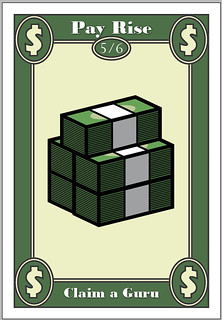
  • differentiate Pay Rises from Overruns
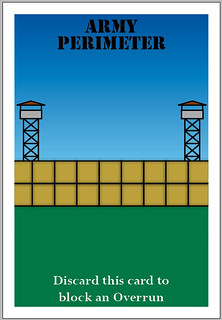
  • improve the Army Perimeters
  • and, make the Guru/scientist more in keeping with the zombie.


I started with the first two of those and this is the progress I've made so far:

PayRise
Army Perimeter

Any thoughts or feedback?

Monday, May 29

Levelled Up!

I'm now a father of two :-D

Dad Level Two

Last Thursday The Wife gave birth to our second daughter, Elina Sophie Pope. She weighed 5lbs 13oz (2.64kg) and everyone is now home and doing well. She is currently nocturnal, and with The Eldest off school during the days this week, I'm going to be way too tired to achieve anything games design related.

All I will say is that before she arrived I did a bit of work on the Zombology v2 graphic design and started a new AI for the Zombology test harness. It's currently winning 25.6% of the games it plays, so it's better than my two demo players (risky and conservative). I've a few more things to implement in it though - I think I can push that win ratio up. No other takers so far in the AI competition, looks like I might win it myself :-/

Monday, May 22

Zombology AI Competition

There's been some interest in the AI competition, so I'm going ahead with it - thanks very much for your offers to help me test the balance of Zombology.

Purpose

I'm trying to test the balance of my card game Zombology after some rules changes in the second edition which I will be releasing later this year. To properly test the game I need to play it hundreds of times, which I'm struggling to do in the flesh around a full-time job, young family and imminent second child! So I've written a game harness that will play the game on a computer and I want to test it using reasonably realistic human-mimicking AIs. The aim is to write a AI to play Zombology, and have it be the best at winning the game across numbers of players. Your AI will not be used for any purpose other than the competition and the testing of the game's balance.

Rules

The test will be based on the Zombology second edition rules.

You will need to download the game solution and then implement a subclass of the Player class in the solution in C#. You can use the ConservativeSciencePlayer and RiskySciencePlayer examples for inspiration. Your class must obey the following rules:

  1. You must implement all of the abstract methods on the Player class which describe your choices and return your chosen option.
  2. You cannot change any game state (the base Player class will do this on your behalf).
  3. You cannot share state between multiple instances of your player in a game (i.e. no static members).
  4. You can only use information that would be available to a human player in your position (this should be enforced by the GameState and PlayerState classes - feel free to remember things from previous rounds, but no looking at cards you haven't seen, etc.).
  5. All entrants must provide their Player-derived class to me by the end of 30th June 2017 BST (UTC+1), entrants received after this time will not be included.
  6. In the event that a bug in your class results in the game harness crashing, I will give you as much information as I can about the crash and give you one week to fix it before re-running the test.
If you need to make any changes/fix bugs to my existing classes please detail them in the comments to this post and I'll incorporate them and re-share the solution so everyone has the same information. Please comment below and subscribe to the comments on this post if you are entering, so I know who you are, how many entrants there are and you get notified if I have to change anything. I will copy your player class (and any ancillary classes you've created) into my solution for the test, any changes you've made to the existing classes will not be preserved.

The Test

I will have the harness play 60,000 games, 10,000 each with 3, 4, 5, 6, 7 and 8 players. For each game the harness will pick a random player from my ConservativeSciencePlayer, my RiskySciencePlayer and all the entrant's players for each slot in the game. I will record each player class' total games played and games won stats and will sum these across all sizes of games. The class with the best win/play ratio across all games will be declared the winner. In the event that the top two or more entrants are within 0.01% of each other, I will repeat the test just using the 'tied' entrants - the winner of the second test will be declared the winner, even it if is still within 0.01%.

Remember it's a semi- co-op game: the best result is you are sole winner, the second best result is you are a shared winner, third best is everyone loses and the worst outcome is that you lose but others win.

Prize

The winning AI gets huge kudos, plus I'll give you a free, signed and numbered copy of the second edition of Zombology, including free postage worldwide.

Monday, May 15

Bot-Loads of Data!

As I've mentioned over the last couple of weeks, I've been working on a framework to play Zombology automatically, with AI players making all the decisions. On Friday night, I finally got a basic version of the application working.

The whole point of this is that I need more data about the relative difficulty of the new rules of the game and how well they scale by number of players. I drew a graph a couple of months ago of how I wanted it to look, with the chance of winning in each round being twice as high as the previous round, and the chance of all players losing being 50% (when the game is won there are winners and losers - it's semi-co-operative):

To build a graph that looks like that I need to play at least 128 games with each number of players (3-8), so 768 in total. So far I've managed 33:

While this is looking alright, there's still nowhere near enough data - I've not lost a 7- or 8-player game yet with the new rules (but we've only played it twice each with those numbers of players). Clearly waiting around for me to play it enough with real people is a non-starter.

The AI idea was a way to get more data, but with very little free time (and soon to be even less with Daughter The Second at most 10 days away) I'm not going to be able to come up with a hyper-realistic player AI. So I've opened it up as a competition, which I'll elaborate more on next week.

For the moment, I've started collecting data with an entirely random player - it figuratively rolls a die for every decision it's faced with. I've run the simulation 60,000 times, 10,000 times for each of the numbers of players from three up to eight.

The good news is that Random McRandomface is pretty crap at Zombology. The chances of a single instance of him winning a game varies between 0.2% (in a 3-player game) and 1.5% (in an eight player game). The chances of the game being won varied between 0.5% (3-player again) and 11% (8-player again). Both of these are way south of the 50% I'm aiming for, but I'm very happy that the game is usually lost when played at random. Out of 60,000 games, only one of them was won in round 3 (of 8). Also, if you exclude the loss bar (it's so large you can't see the others!), then the wins by round graph looks pretty good too:

The bad news is the variation by player count. 3-player is hard. 4- and 5-player pretty hard, 6- and 7-player much easier and 8-player twice as easy as 6 & 7. This might disappear once I have a more realistic AI, but it's a potential concern.

My (and your?) next task is to write a more realistic AI...


Monday, May 8

AI Competition Early Info

So I had a few takers for the Zombology AI competition, so here's an early cut of what I'm thinking. I will write a game harness that plays the game and calls into the Player class periodically for state changes and decisions. I will write an abstract Player class that does all of the state change stuff - the entrants will need to subclass the Player class and implement the decisions however they see fit. I will try to make it so that they only have the information a human player would have at that point, so it's fine to remember cards you've seen earlier in the draft, but you shouldn't be able to see cards you've not yet received in the draft. If you wish to remember any state between decisions and turns, that's fine, but you are NOT allowed to make any state changes at all (I've implemented all of that in the base class).

Here's a link to the latest rules of the game, and a link to a zip file containing all the classes you need to implement your subclass of Player, including an example subclass RandomPlayer that will just act entirely at random! In a couple of weeks I hope to share the full code of the solution (once I've written it!) including unit tests for the methods you have to implement in the derived class.

That should be enough to get started with, and is enough for you to get thinking about it, and ask any questions you have (and potentially spot all my bugs!).

Thanks to everyone who has shown an interest in this!

Monday, May 1

Interest in an AI Competition?

As I mentioned a couple of months ago, I need to play Zombology a lot to work out whether I have the balance right for each different number of players. At least 768 times, probably many times that number. At the moment I'm at 29. Clearly, there's some work to be done!

This week I've started another programming project - I'm going to make a very simple app which can play thousands of games of Zombology and record the win/loss ratio and the round in which the game was won.

It will let me quickly find out whether the game is balanced by number of players and potentially tweak the rules to make it more balanced. To play thousands of games it's going to need some AI - I don't want to be playing thousands of games by hand (especially not soloing trying to pretend I don't know what's in the other hands and what the 'other' player is going to do. So I'm going to need some AI that can play Zombology. 

Thankfully it's a pretty easy game - there's only four decision points per round:
  1. If I have a Guru, and there are matching Science cards in the central display, do I want to swap a Science card from my hand for one of them, and if so, which for which;
  2. Choose a card from my hand to play this turn;
  3. If I chose an Overrun, which player do I want to overrun;
  4. If I chose a Guru, which Guru do I want to claim;

So, the first thing I'm doing is writing all the plumbing that runs the game - then I need to write some AIs that can play the game. My current thought is that I'll write an entirely random one first that just lets me test that the plumbing is working. Then I need a few different AIs that play the game with different styles to see how the game works out.

Seeing as I know there's a bunch of programmers who read this blog I'm wondering if there's any interest in a competition to see who can write the most successful Zombology AI? Let me know in the comments if you'd be interested in that!

Monday, April 24

Hand-Crafting Games

So I mentioned in my last post that I'm thinking of making hand-made games again. It's been a long time since I properly made hand-made games, so I thought I'd post on how I go about hand-crafting a game.

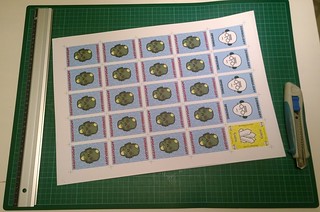
It starts by getting the cards professionally printed in a 5x5 grid on a sheet of A3 card. I get the printers to professionally laminate the sheets too, so each side is covered in an incredibly thin layer of plastic that gives the cards a nice smooth finish and protects the ink from damp fingers and wear. These sheets look like this (note the crosshairs at the corners of each card):

The sheet ready to be cut

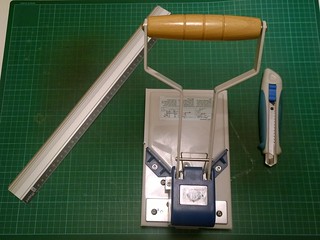
Before I can move to the next stage I need some tools - I use a craft knife with snap off blades and steel ruler (I've just bought a new ruler - a Maped Linea shown in the picture below about which I am very excited!) to cut out the cards. Although it's more work than a guillotine, I find it give me more precision, and doesn't kink the edge of the cards so much. The new ruler has three benefits over my old steel rule: a clearer scale for measuring, a non-slip backing and it's longer too. Also pictured is the corner rounding tool I bought back in my Reiver Games days. It can round the corners of a pile of cards that's about a centimetre deep, so you can quickly get through an entire deck.

Tools of the trade

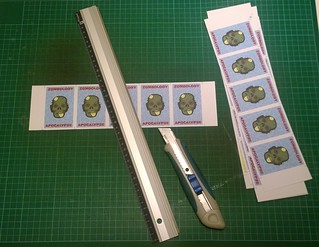
With trusty craft knife and steel ruler in hand I use the crosshairs in the corners of the cards to cut the A3 sheet into five strips of five cards:

Into strips

At this point I can still see half of the crosshairs, so I've still got guides to cut the strips into individual cards:

Into cards

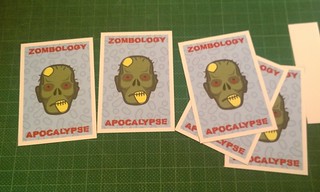
The last task then is to use the corner-rounding tool to punch off the corners, leaving me with a fairly professional-looking finished product:

Finished game

And that's how I make a hand-crafted game. There's a little more to it (making the box and the box wrappers) but I can cover that in another post.

Monday, April 17

Unique, Hand-Made Games

I've been thinking more and more about making games again and, in particular, returning to the glory days of Reiver Games when I made games by hand, selling out of print runs within a year.

The first couple of years of Reiver Games were very successful by any margin - my print runs sold out and I doubled my stake each year. With the sudden influx of cash from my life insurance I was able to reconsider my position so I quit my job and starting trying to run Reiver Games as a real publisher. I spent a couple of years doing that full-time, not drawing a salary and publishing games professionally. The games were manufactured by professional companies and I started selling through shops and distributors. In many ways I continued to be successful, getting my games picked up by twenty-one distributors on three continents, and selling thousands of games. But the sales were coming in too slowly and I hadn't invested enough capital to make two simultaneous print runs, so when the second edition of It's Alive! was delayed at the manufacturers I took out a bank loan to fund Carpe Astra. The bank loan fees, along with the costs of warehousing my games, were such a constant drain on my finances for the next few years that I eventually ran out of cash. In hindsight I should have delayed Carpe Astra, it needed more work and ended up being the least successful of my games.

The first couple of years of Reiver Games spanned July 2006-2008. Way before Kickstarter and the boom of social media. Many things have changed beyond recognition in the last eleven years. Not least my personal situation, I've gone from being a carefree young man to a father of one with another child on the way and from being a fit martial artist to having an incurable disease to being essentially healthy again thanks to a clinical trial of a new treatment.

Clearly I'm unable to just give up my job for a laugh these days - so that is not an option. With a baby on the way I'll have very limited time around my full-time job to spend on running a company - I'll certainly not be making games that take three hours to construct by hand like I did with Border Reivers - my first game.

I've learnt a lot about game design over that time, and I'm sure that both Zombology and the current version of Codename: Vacuum are better games than my other efforts (Border Reivers and Carpe Astra) and possibly even comparable to It's Alive!, the most successful game I published. I sold nearly 3,500 copies of that, so surely selling 100 copies of a hand-made run wouldn't be that difficult?

Eurydice Logo

With all these changes, especially the changes in the marketplace that have occurred since Kickstarter overhauled the way games are made, I wonder whether there's still a market for small runs of hand-made games. The biggest problem I foresee would be how do I make people aware of my games? How do I be heard over the endless clamour of Kickstarter announcements? With a young family and a full-time job, I'll have very limited time for marketing activities and I'll not be shlepping round shops and cons like I did the first time round. What about me and my games will pique peoples' interest enough to get them to take an interest in (and possibly buy) my games?

That's the question I would need to answer before I set things in motion. Any advice or help would be greatly appreciated!

Monday, April 10

More End Game Ideas

Last week was fairly busy, but I did manage to make it along to Newcastle Playtest after missing March (and possibly February?). It was a great night with a good turn out and plenty of games to try out. I ended up just playing my own games: initially a five player game of Zombology and then a three player game of Codename: Vacuum with Olly and Alex.

It was the first of two games of Zombology that week (we also had a three player game at the end of Games Night on Thursday) so I'm still slowly collecting the data I need to feel comfortable that the win/loss ratio is more or less where I want it in the new version and that it's well balanced across different numbers of players. I'm still considering a second hand-made run, though realistically this will have to wait until after the arrival of Daughter The Second at the end of May.

Vacuum also went well. I tried out the fixed number of rounds for the first time and as a result it went a big longer - the three player game with two first timers probably lasted a couple of hours including rules explanation. It worked as expected, Olly choose an end game condition fairly early in round 11 which allowed Alex and I to both adjust our strategies mid-game. In the end all three of us scored within one point of the maximum in that category, so it didn't contribute meaningfully to the scores. I chose in round 14, but that was still early enough for the others to catch up with my weak showing in that category. I'm still messing around with the end game and the scoring. I've had another idea over the weekend - allow each player to choose a (possibly non-unique) scoring condition and then score those conditions (possibly multiple times) at the end of the game. Maybe even give the person who chooses it a small bonus too (since they are giving up the chance to score more points in that category at the point when they choose it).

This week I'm unlikely to get much done - today I'm off to Manchester for work again and then Thursday we head down to Bristol for a big family get together. I'm all set when we get back though, I've bought replacement inks for the broken cartridge which stopped me printing a new version of Vacuum in time for Playtest last week (which in hindsight was just as well as I now have more changes to incorporate).

I've a load of work to do on the train this morning and probably this evening, but I'm hoping to tweak the Vacuum board before I get home.

Monday, April 3

Lots of Gaming!

It's been a fairly busy week again, with loads of gaming, if not much design and playtesting. March has been my joint best month (with last May when I went Beer and Pretzels with Terry) since I was stuck at home on my own during my radioactive period in January 2014. And this week contributed a lot to that - we played Taluva a couple of times at lunchtime games club, then another six games at Games Night on Thursday - when we also had our joint best attendance. We also had a game of Zombology. It was the first recorded game with six players, so now I've got at least one data point for each number of players. In a perfect world I'd have tens or hundreds of plays for each number of players, currently I have between one and eight plays per number of players. Three and six are least represented and four is most. Clearly I still need a lot more plays.

6-player Zombology

Finally, on Friday, a few of us ended up spending six hours on trains on the way to meetings in Manchester. We managed another eight games on those trains on my iPad.

I also spent a little time one evening working on some improvements to the Codename: Vacuum cards that were required after the last couple of weeks' tests. I intended to get those changes printed out over the weekend and cut out ready for Newcastle Playtest tomorrow. Sadly, the replacement ink cartridge I needed for my printer was broken so I couldn't print it out, let alone cut it out. I'll just have to take the last version along with me. I've missed the last couple of Playtests and obviously I'm going to struggle to make it along during the summer after the birth of daughter number two. I'm really looking forward to getting along tomorrow.

Unfortunately, ahead of that I've got to have my other wisdom tooth removed tonight. The other one was taken out about a month ago, so I know what to expect. Tonight is going to be not much fun.


Monday, March 27

All Good Things...

It's been a hectic and pretty stressful week at work, but once all the visitors left I managed to get another playtest of Codename: Vacuum in at the end of the week with Ian, who played it last week too.

We played exactly the same version (though with different decks) and the game came in under an hour including set-up, rules refresher and explanation of the new decks. So far so good. The game went well, we got into space, there was a couple of clear strategies being followed and at the end we both scored well. For the second time Ian beat me at my own game (need to change the rules again! ;-p).

One of the things I like about Vacuum, and one of the core tenets of the game is the scoring. There are five core decks in the game that you play with every game (in addition to a few extra decks that change every game). Each of those core decks (Military, Exploration, Population, Trade and Knowledge) has a victory condition that will score each player 0-30 points depending on how well they've followed that strategy. The game ends at the end of the round that the second (with 2-3 players) or third (with 4-5 players) victory condition is selected. Selecting a victory condition is key to the game - you want to hone your deck so that it will score big in a couple of conditions (particularly a lot bigger than your opponents!) and then select the appropriate condition. Since only two or three get chosen, it's very important that you get your choice in, so there's a lot of pressure to quickly get to the point where you can afford to select a condition and then select it - thereby hastening the end of the game.

Selecting a condition uses some of the cards that gain you points in that condition, so each turn you choose whether to gain points in your chosen condition (and risk leaving it too late to select a condition and missing your chance) or selecting a condition (thereby hastening the end of the game before you can maximise your score in that condition). It's part of what I like about the game.

Unfortunately, I think the pressure is too strong, at the moment the fear of missing your chance to select means that you rush the game to an early end, before it really gets into full swing.

I'm considering making the game fixed length - 15 turns (Ian and I have played 12 and 10 in our last two games). Everything else stays the same, except now selecting a condition doesn't prematurely end the game. This will have two effects I expect: the game lasts slightly longer and the game end dynamic changes.

Now you're not rushing to end the game, but to choose the scoring. If you select early, you guarantee that your chosen scoring will happen, but you give your opponents more turns to respond - adapting their strategy to maximise points in that condition. Choosing late means that you might miss your chance, but you keep your opponents guessing and can wait until the endgame and pick the one that finally ends up favouring you the most.

It'll be interesting to give it a try and see how it works...

Monday, March 20

It's All Go!

Another busy week. This time it's been Codename: Vacuum, Zombology and crazy ideas.

I didn't have any travel this week, so I managed to get a lunchtime playtest in with Ian on the new version of Vacuum. I'd made a bunch of changes since the fairly broken play at Games Night a couple of weeks ago, and we tried them out over lunch. I was pretty sure we could get a 2-player game done in under an hour, so I did a quick canvas and Ian signed up. He'd not played it before, so we had a 20 minute setup and rules explanation followed by a 58 minute game. Considering that was Ian's first play I was pretty happy with it coming in under an hour. He picked it up pretty well and ended up beating me 30-18 (time to change the rules!). The improvements I'd made last week fixed most of the problems, though there were a few graphic design/wording issues that I spotted during play. I'm happy to play that version again without changing it though, so a big step up on last time.

playtesting new Vacuum

Games Night was pretty epic, with the first visitation of Mal so far this year and an amazing six different games played. It was a great night, and we finished up with a Zombology (which we'd not played for a while) and I was telling them about the recent pre-orders I'd taken and how I was considering another print run - at which point I took another pre-order.

I'm really torn about it. I think Zombology is the best game I've designed, and with its silly theme (mad 'scientist' hippies trying to cure the Zombie Apocalypse), wide range of players (3-8) and short play time (10 minutes) it's also my most accessible game. I'd love to see it get a wider audience and the pre-order rate for a second edition (despite the fact I'm not yet making one) has been pretty high the few times I've introduced it to people recently.

I could try pimping it to publishers, but it turns out that I really enjoy the graphic design and hand-crafting of games, so I'd rather self-publish again.

The big stumbling block is time. I travel quite a lot for work, have a young family and I'm two months away from becoming a dad for the second time. I know from last time what a wreck that leaves you, and how little free time you have when you've a new baby and are so hideously sleep deprived that 7:30pm sounds like a reasonable bed time.

What to do?

Monday, March 13

Ding, Ding, Round 2!

After testing the new version of Codename:Vacuum a couple of weeks ago, I clearly needed to make a raft of minor changes. The game was so broken that the rules were evolving as we played (always a bad sign!), but I was generally pretty happy with the new version (once fixed!) compared to the last version of 2015.

My travels continued last week, with a trip to Manchester on Monday after work that concluded on Wednesday night, and despite being incredibly busy (I was working late into the night Monday and Tuesday), I did manage to get make some progress on Vacuum. Firstly finishing off the board on the train on Monday night and then printing and cutting out a new version on Thursday morning (which I had off work to go to the doctor). I finished the final cutting out on Saturday night - after the mental week and a few bad nights' sleep I was too knackered to make it to Newcastle Gamers unfortunately.

What I need to do now is try out the new version (and buy some more ink!), to see if the changes I've made improve things. I'd rather not play on Games Night on Thursday as the guys played it last time and they deserve to play something that works. That leaves a lunchtime playtest session or an additional evening for a playtest (either with Games Night mates or Newcastle Playtest chums). Next week is pretty busy (we've a big company meeting with a couple of evenings out) so it's this week, or not for several. I'll have to see what I can fit in.

Here's a sneak preview of the new board:

Monday, March 6

Gaming Extravaganza

It's been a great week for my gaming. Monday went exactly to plan with me printing and cutting out all 350 cards for new Codename:Vacuum, and hand-scrawling a quick board too - for the first time in two years I had a Vacuum prototype. Admittedly, Monday ended slightly worse with my dentist extracting a wisdom tooth that's left me eating very gingerly all week!

I got a lunchtime gaming session in at work on Wednesday (Coup) and then at Games Night on Thursday we played Vacuum! The lads had all played Vacuum before many years ago, so it wasn't complete fresh to them, but they'd all forgotten how to play.

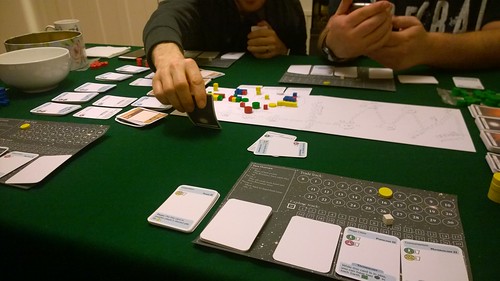
New Vacuum in Action

It was, as I expected, fairly broken - we hardly got off Earth due to a poorly shuffled deck and a far too slow explore mechanism, so there was no colonisation of the Solar System or vast space battles. There were a couple of other things that clearly didn't work as intended, so the rules were evolving as we played. In a perfect world the game would take around 15-20 mins per player once you know it, so I was reasonably pleased with just under 2.5 hours (including set-up and rules explanation) for a four player game where 3/4 of us were effectively beginners. Hopefully that will significantly shorten with experience (and rules that aren't in flux during the game and cards which accurately describe what they do!).

I was frantically scribbling notes during the game, so that on Friday night I could spend the 3.5 hours of train journeys to Bedford updating the cards and working on an improved board. Of course I now need to print and cut out another version!

Saturday I was in Bedford seeing Terry, Andrew and Graham who I used to game with weekly when I lived there during 2008-11, the latter half of my Reiver Games days. There were eight of us in total, so we started off with a couple of games of Zombology (five of the eight owned a copy), playtesting the new rules with large groups. It went well, with a couple of late wins and I ended up taking a couple more pre-orders from David and Richard, both of whom have bought a Reiver Game in the past I think. That's now five pre-orders from seven possible customers in the last month or so. That kind of conversion rate is filling me with a greater optimism than I previously had, if I can get to thirty-ish I may well push the button and make another hand-made run of a hundred or so. The clock is ticking though, The Wife and I are expecting a little sister for The Daughter at the end of May, so the amount of time I'll have for hand-crafting games in the evening will be severely limited by extra parenting duties and sleep deprivation!

After Zombology, we played another eight games, of which four were new to me, so it was a great day's gaming as well as a great chance to catch up with friends I see far too infrequently.

Saturday evening was also spent on trains (and replacement bus services) so I got a chance to do more work on the Vacuum board. I think the board brings a new element to the game that focuses you more on the exploration and conquest side of the 4X game, so I think that part is working as intended, what I need to do now is print out another version and see if my changes fix the issues we found. Thursday's playtesters are at least interested to play again!

Monday, February 27

Back in Boston: Naked but Productive

Oh, so not naked exactly, but unclothed. I spent last week in Boston, MA for work. I lived in Boston for the winter of 2000/01 and hadn't been back since. Despite many trips through Boston (my employer's head office is about 40 miles outside Boston), I'd not set foot in Boston since we lived there. So I was quite excited to be going to a meeting in the Boston harbour, a short water taxi ride away from old haunts.

The reality was a little different from what I expected. My luggage turned up 84 hours after I did (and only 11 hours before I left), so while I did get to go into Boston and Cambridge, the majority of that time was spent shopping for clothes.

On the other hand, as it often the case when I travel to the US, I was awake early most mornings, so I had a decent chunk of time each day to work on Codename: Vacuum.

I finished off the cards and got them all laid out ready to print today (I've a day off to recover from my travels). I'm hoping to have a playable prototype by the end of today. I'm sure it'll need a big chunk of improvement after I've tested it once or twice, but I've got a good feeling about this version at the moment.

Exciting times!

In other news, I'm off to Bedford this weekend to spend Saturday gaming with Terry, Andrew, Graham, Johan and a bunch of other gaming chums. I used to play weekly with Terry, Andrew and Graham and now see them once a year if I'm lucky - so it'll be a great chance to catch up.

Monday, February 20

Concrete Progress

I'm off to Boston this week for work (posting this from the airport!) so it's been a busy few days, but I've not let that get in the way of progress. Last week I was mostly focused on implementing some of the things recommended by my German language app beta testers and adding a bit more vocabulary in preparation for sharing it with another private beta tester. I'm hoping to have that ready to go not long after I get back from Boston.

The big news is on the Codename: Vacuum front. I placed an order for some wooden pieces from Spielmaterial.de which arrived on Friday (in my office, while I was working from home :-( ), and during my home day lunch break I made a new box for it (I gave mine to Konrad in Berlin when I was over there nearly two years ago). On Saturday I popped over to the office during a trip out and collected the Spielmaterial order and then bagged and stowed that in the box.

I've done most of the cards for the next version, I've just got the event cards left to do. Fortunately, I've got the jet lag hours of 3-6am every day this week to finish off the cards and get everything ready for printing.

I get back Saturday lunchtime, and then I've booked Monday off work to help recover from my jet lag. I can use that day to print out the cards, player mats and boards and then cut all the cards out. For the first time since I gave my copy to Konrad I'll have a copy of Vacuum ready to playtest again. And it will need testing - I've made some sweeping changes, which will likely need a decent chunk of fixing before they are ready for sharing with others.

I'll also try to get a blog post done in the jet lag hours, spelling out how the game works in a bit more detail.