Showing posts with label feedback. Show all posts

Monday, July 7

Resurrection

After the disappointment of yet another awesome game designed by a friend that they don't want us to publish I took one of my older designs to Newcastle Playtest last week.

Normally I take a bag with six or seven games, last week I took one.

And to be honest, I wasn't really looking to play it.

I'd not played it in about three years.

It was there as a fallback if we needed games to play.

As it turns out, we did.

So I got it out.

Tried to remind myself of the rules.

We had five players.

I had to tweak things as we went.

But there was some potential there.

And the great crowd of designers and playtesters gave me feedback.

Useful feedback.

And ideas.

My head has been fizzing with ideas all week.

I've been frantically crafting a new version since Tuesday.

I've got a slot at the Playtest Zone at the North East Tabletop Expo on Friday afternoon.

I was going to play Jotunsaga or Siren Song.

Now I think I'll play the new version of The Uprising: Saga instead.

Need to finish the prototype first!

Monday, April 23

Final Changes

This week has been all about tweaking FlickFleet. There are now three blindplaytesting copies in three different countries. Three sets of people trying to learn the game from my rulebook and then provide feedback on the rulebook and the game. The first set of feedback has come in with some great suggestions for improving the rulebook and some comments about the game.

The playtester found the game fundamentally fun and loved a few bits about it, but there were a couple of things he didn't enjoy. The biggest problem he has was that it is possible to get yourself into a situation where victory is impossible for one of the players. I'd seen this happen a few times - it's an asymmetric game, so the players often have different forces, and some of the ships need to be played in a particular way to be successful (e.g. carriers need to launch their fighters and bombers quickly as they are weak on their own) and the ramming rules were an attempt to dealt with this, but clearly for new players without my experience (or strategy advice) the problem was bigger than I realised.


Clearly this situation is no fun at all for the loser and not much fun for the winner, so it was something that needed addressing. The playtester had even volunteered a couple of suggestions that he thought might fixed the problem - which was great.

As a designer you will get a lot of suggestions about your game. Some will be great, some will be rubbish. Some will be great, but take your game in a direction you are unhappy with. One of the things you need to be good at is to take the suggestions (and where not spelled out work out the root issue) and then decide what to do with them. Are they a good idea? Do they take your game in a direction you are happy with? What's the problem the suggestion is trying to fix? Is there a better or different solution to that problem you should also consider? Is that problem just that the the game is not the suggester's type of game? Perhaps the suggester's perceived problem is not a problem in your eyes, or something you are happy to live with? As creator of the game, the editorial control lies with you until you sign it over to a publisher.

As it turns out the problems spotted by the playtester were an issue and something I wanted to address. Paul (my co-designer) and I talked it over and we had an alternative solution that we've been trying out this week (and over the weekend while Paul was visiting with his family). It seems at first blush that our solution improves the game and largely addresses the problem. As a result of this feedback the game has improved, despite the fact we didn't go with the playtester's suggestion. Hopefully, he will find our solution addresses the problem as he experienced it too.

Remember that playtesters suggestions are valid, and are shaped by their experience of your game. But the control lies with you. Are you happy to leave the problem they experience un-addressed? If not, is their suggestion the best resolution to the problem they experienced? It might be. Or it might not. You decide!

Monday, April 2

Crowdsourced Art Direction!

I'm currently on holiday in Bristol, so I'm auto-posting this post that I wrote last week. Over the last couple of weeks I've started to make a more 'finished' looking set of ship dashboards for FlickFleet. These dashboards serve two purposes - they remind you what actions each ship can take and they show the status of the ship in terms of whether the shields are still up and which bits of the ship are currently damaged and inoperable. There are three types of large ship in FlickFleet - destroyers, carriers and dreadnoughts. Each has different capabilities, strengths and weaknesses. Here are the latest versions of their dashboards, I would really appreciate any feedback you have on the look, and also the clarity of information.


The destroyer - a heavily armed but flimsy gun boat

The destroyer has two shields (damaged on a 1-10 die result), 3 guns (damaged on 1-3), plus shield generator (5) and engines (6). A result of four will destroy them once their shields are down. They can be moved by flicking the rear three surfaces, as long as the engines are not damaged. They also have an engineering location that cannot be damaged that allows you to repair a damaged location.


The carrier - weak by itself, but it carries a lot of fighters and bombers

The carrier has two shields (damaged on a 1-10 die result), a gun (damaged on 1), a fighter bay (damaged on a 2 or 3) that allows you to launch a couple of fighter wings during the game, a bomber bay (4) that allows you to launch a bomber wing, plus shield generator (5) and engines (6). They can be moved by flicking the rear three surfaces, as long as the engines are not damaged. They also have an engineering location that cannot be damaged that allows you to repair a damaged location.


The dreadnought - fear its might


The destroyer has four shields (damaged on a 1-10 die result), nuclear warheads (damaged on 1), two guns (damaged on a 2 or 3), a fighter bay (damaged on a 4) that allows you to launch a couple of fighter wings during the game, plus shield generator (5) and engines (6). They can be moved by flicking the rear three surfaces, as long as the engines are not damaged. They also have an engineering location that cannot be damaged that allows you to repair a damaged location or repair the hull. In addition to the locations above, dreadnoughts also have three hull points.

How clearly do you think that information is portrayed? Do you like the look? Any thoughts or comments?

Monday, July 17

Final Zombology Art Review

My parents have been up this week, so I've had a chance to pick the brains (how appropriate!) of my dad, a retired art teacher. I've been trying to finalise the artwork for Zombology ahead of getting a proof copy done by the printers to check the colours look OK and that the lamination works on top of the new art (if there's too much ink the lamination doesn't adhere). Over the last couple of weeks I've been crowdsourcing advice on the art/graphic design, from dad, The Wife, BGG, Google+ and twitter.

First up is the box designs. I've run three polls on BGG (1, 2 and 3). In the comments of the first and second I got some other ideas and JPotter came up with something that looked like this:


Which I really liked, so I tried to mimic it (see above). I've also adopted a similar style for the back of the box:


In addition to that, I've also updated the card art (after my last attempt here which got feedback here and on Google+). I tried to incorporate all the feedback I got, reducing the number of colours, swapping the icons on the Guru, making the text bolder on the sides of the cards, getting rid of the gradient fills and generally tidying things up a bit:


What do you think? Let me know any comments you have in the next couple of days - that way I can act on them before it goes to the printer.

Monday, June 19

Feedback Wanted on New Zombology Look

As I mentioned a couple of weeks ago, I've been working on the Zombology artwork for the next version I'm making. The picture below shows the art for the version I released in November 2015 as part of NaGa DeMon. Along the top are an example of each of the therapy cards (one of each number and suit) and along the bottom are the Guru, Pay Rise, Overrun, Army Perimeter cards and the back images for the two decks:


There were a few things I wanted to improve for the next version. The art was pretty rushed for the NaGa DeMon version - it was essentially prototype art, compounded by the fact that I'm not actually a very good artist and I couldn't afford to hire one either. In particular I was unhappy with the Army Perimeter card and although I quite liked the scientist icon on the back of the Epidemic cards, it was not in keeping with the rest of the art.

In addition, a few things came up during testing:

  • the Homeopathy background was a bit too dark, 
  • the Guru cards were too similar to the corresponding therapy cards, 
  • it was easy to confuse the Pay Rise and Overrun cards,
  • the Psychotherapy suit was confusing as it was the only real therapy included.
To address these issues, I've spent a decent chunk of time over the last few weeks trying to improve the art to fix these problems and just give it a better look:


I'd really appreciate any feedback on the new versions. Are they better or have I made things worse? Anything specific you like or don't like?

Monday, August 17

Produce / Consume

As I'm sure most of you are aware, the title is a reference to Race for the Galaxy, one of my favourite games and one which I've played exactly 150 times according to BoardGameGeek.

There's a sliding scale of producery-consumerness (a technical term, check out the Big Five personality traits) on which, I'm assuming, most people sit slightly nearer the Consumer end than the Producer end. Some people are happiest reading a great book, or watching a great film or shopping for new clothes. Some people however are happiest when making things, whether knitting cardigans for babies (thanks Mum!), writing novels or painting.

It turns out I'm definitely towards the producer end of that scale. By day I'm a computer programmer, and I love that I can type words and bend a computer to my will, creating programs and apps that are useful, interesting, attractive or just fun. By night, I'm just as bad. Historically it's been writing (bits of!) computer games, painting miniatures, designing worlds and stories as a DM and obviously designing board games.

It struck me this week that probably the bit I enjoy most about game designing is actually the graphic design. Working with a very limited set of artistic skills to make prototypes or hand-made games that are attractive, or at least functionally well designed. Don't get me wrong, I also enjoy trying to wrestle in my head with the game design to design something that's fun to play and there's something zen-like about cranking out well-made hand-made games, each one lovingly hand-crafted but done well. And the end result is satisfying too, when you hear from a gamer who has played one of your games and really enjoys it. I'm not a great game designer, so it's rare enough that I hear from a gamer who loves one of my games, but when it does it brings a smile to my face every time - I've brought pleasure to another human being, often someone I've never met (and probably never will). That's pretty cool.

Why this philosophical train of thought? I've been agonising over whether or not to do a hand-made run of Zombology for a couple of months now, after bravely/foolishly committing to doing it at the beginning of the year. The concerns that have given me most trouble are not having enough time to get to the conventions I need to attend to drum up sales and whether there's still a market for hand-made games now that everyone can make a professional run of a game they've thought of through KickStarter.

I've asked the question in a couple of places and the advice seems to be that I should embrace KickStarter and do what I plan through there. Assuming I was successful on KickStarter, most or all of the games would be pre-sold so convention attendance would be less critical, so that could be a plus point to going that way. Anyway, Im not leaning toward KickStarter, despite my earlier antipathy towards it. I'm flighty like that.

In other news, I've got some feedback from a couple of playtest groups. Both of them only played it three player (the weakest I think). The other Playtest UK group played it a couple of times, and didn't seem overly enamoured. In the second game they tried changing a couple of rules. They did however provide really good feedback which I need to go through and learn from. The other group had played it before (about a year ago) and really liked this new version, playing it eight times (though still only three player). They suggested a rules clarification that I'll have to make shortly.

This week is mostly about trains. I hope to make some good progress on the Zombology art upgrades on my way to and from my quarterly hospital visit to Sheffield on Wednesday.

Monday, April 20

Crowdsourcing / Market Research

It's been a good week. I've had my first Games Night for four weeks (and sadly last Games Night for another three due to work travel) and a few more good playtests of Zombology.

I'm now ready to call my first game that I hope to self-publish in my second innings as a board games publisher: It's Zombology.

Last week I made some changes to the scoring of Zombology, making it a true semi-co-op game along with tweaking the way the gurus work to make them more useful/interesting.

We played four games back-to-back at Newcastle Playtest. These guys have played it a lot. Over the last year and a half we've played it at the beginning of almost every session, often a couple of times. It's been through a lot of changes and incarnations, and people are still willing to play it, which is nice. This time the feedback seemed much more positive, Paul who usually doesn't enjoy it said he'd enjoyed it and finally 'got' this version and later Alex described it on twitter as "straight up 'published game'-level fun".

We played a few more games on Thursday, a couple of three player games at lunchtime, and then a couple of seven player games at the beginning of Games Night. DJ and Mal (both of whom have tens of plays of various versions under their respective belts) had good things to say: DJ said it was the best game of it he'd played and Mal (who had said the last version felt further from ready than the one before it) said: 'Don't make too many more changes, it's ready to publish'. Gav's feedback email was entirely positive too.

So I'm ready to start the process of publishing a game again. At least, almost ready. I've got my checklist to work through and there are a few other things I need to sort out, including getting a few playtest copies out to other groups. Before I do that, I need some help - which is where the title of this post comes in.

I need an exposition. A paragraph or so that explains the game and makes it sound so fantastic that your only option on reading it is to wire me vast sums of money to sate your powerful need to play this game immediately. Currently I have:

Zombology
Unlikely cures vs. the zombie apocalypse
Zombitis is sweeping the globe: it's already killed millions and billions more are at risk. There's no government stockpiled vaccines and pharmaceutical companies have nothing. You and your peers are mankind's last hope. Just a couple of months ago they were ridiculing your 'advanced projects agency' for its crackpot ideas, now they're praying that it might just work. You've got eight weeks to try to cure the zombie plague, will you be heralded as one of the heroes of mankind, or will you back the wrong method and remain a crackpot to the end of your days? Work together to achieve a cure or try to trip up cures that you don't support. Time's running out... 

Which, let's be honest is weak. This is not my strong suit. So I'm appealing to you my loyal readership for some advice/improvements.

Also, I need six things that are unlikely to cure Zombitis. Currently I have:
  • Healing crystals
  • Vegan diet
  • Psychotherapy
  • Homeopathy
  • Reiki
  • Acupuncture
I like the first four, not so sure about Reiki and Acupuncture. I'm also considering Faith healing, Voodoo dolls and Electroshock therapy. What are your thoughts? Got any better ideas?

Monday, August 18

What a Blinder!

It's been a really busy week this week, both gaming and non-gaming. We're having a load of family up next weekend for a birthday party for The Daughter, so we're trying to sort the house and garden out a bit in preparation for all the visitors. On top of that, I've done a trip to Manchester for work and we've been to York for the weekend to see Paul and his family.

The week got off to a great start with some really detailed feedback for one of the two people who signed up for blind playtesting Zombology a couple of months back. He'd asked some questions about the timing of various things on receipt of the rules, which I'd given a really crappy answer to (the low quality of my answer was one of the things that encouraged me recently to address the timing resolution in the game). After that I'd not heard anything from him, so I'd assuming the shoddy response had put him off trying the game. This week I got a response from him detailing the four times he'd played with different groups and what everyone thought of the game along with some identified weaknesses and some ideas. He apologised for the delay getting back to me, he'd wanted to leave it until he had a bit more data. This was exactly the kind of feedback I was hoping for when I requested play testers, so it was very gratifying to receive it, especially as he's keen to continue testing it with the recent changes.

I took Thursday off work to wait in for a tradesman, and after exhausting myself in the garden I got an hour or so to update the Zombology rule book to the newest rules that I have in my head. Now all I need to do is update the cards as well and then print out the new version. In the evening we had a great Games Night with eight (!) games played, but the late night hurt me the next day when I had to be up at 5am for a trip to Manchester. Fortunately there was copious coffee to keep me conscious and Steve (a former Games Night attendee) and an iPad full of board game apps to keep me company on the six hours of train journeys. We chalked up another nine games!

This weekend we went down to see Paul and Lisa in York. Paul was my main playtester during my Reiver Games days, so I took Zombology again. We played it twice with his friend Chris along with six other games, so another great day's gaming. 24 games in 3 days! It was a great weekend catching up and playing games, plus hanging out with the kids.

I also started knocking together the cards for the new version. I doubt I'll have time before the party to finish them off, but hopefully next week in time for the next Newcastle Playtest.

Monday, June 16

Not Gaming in Baltimore

I'm in America at the moment for work, like I was last summer. Last year I arranged to go to the Fantasy Flight Games Event Centre a couple of times and get some gaming in, and I did it without getting axe-murdered, which was an achievement. I had two great nights hanging out with Alfredo, Jay and Fred and got to experience the FFGEC and The Source which is a huge US games shop.

I had hoped to repeat the experience this year in Baltimore, but I'm a bit busier in the evenings at the convention we're attending, and my attempt to arrange some gaming action on BGG was unsuccessful. So no gaming for me :-(

Of course, when I say no gaming I'm not including the 13-15 hours of travel each way, during which I'm strapped into a plane seat, with my boss Ian beside me and an iPad full of games in my hand. Ian's a Games Night attendee, so we played a bunch of games on the way over and will probably play a bunch more on the way back.

Other than that, there's not much to report, I got the first set of feedback from the blind playtesting release of Zombology just before I left, so I'll have to go through that properly on my return. I'll amend the rules to hopefully answer so of the questions they've raised and work out which ideas the play testers suggested to incorporate in the game. Interestingly, some of the feedback tallies well with the feedback I'd had from Paul last weekend, so that's nice confirmation that Paul's ideas are good ones.

Monday, May 12

Newcastle Playtest

Back in August, Dan, Michał and I started up the Newcastle branch of Playtest UK. In the beginning we expected it to just be Dan, Michał and I, the three of us were all designers, all struggling to get our designs tested enough. We advertised it in the local FLGS, Travelling Man, and at Newcastle Gamers and as a result it grew.

We've now got a hardcore of five designers, excluding Michał who moved to London in the New Year. A few extra people come along occasionally, mostly from Newcastle Gamers, but sometimes from Travelling Man and we once had nine attendees! Despite the relatively small numbers I really find it an invaluable resource in my game design efforts and I've been meaning to post about it again for a while. I play my games most weeks, either at my Games Night on Thursday with friends from work or during a lunch break in the office. It's great, it lets me try things out and fail fast, quickly iterating my designs. But the monthly sit-down with a group of other designers has led to so many step changes in the quality of my games that it's made a huge difference.

This week was the latest meetup, on Tuesday night at The Bridge Hotel from 6:30. The usual five of us were there and four out of five of us had brought games: Alex had a couple of copies of his brand new two player game of bank robbery: Swag, Blag and Goons; I'd brought Zombology and Codename: Vacuum; Dan had three games: Mainframe, Samizdat and his entry in the UK Games Expo redesign competition and Paul T had half a prototype of a new idea he'd had. We started with a really good discussion about Paul's half a prototype, he explained how he thought this part would work and then some ideas he'd had about the rest of the game. The discussion led to a whole bunch of interesting ideas and I particularly liked Alex's question:

"What's the funniest thing that's going to happen in the game?"

After discussing Paul's game we played a few games of Alex's game, two side by side games, played twice each. Considering how new it was it was a remarkably stable game, with some interesting ideas and neat mechanics. We followed those four games with another discussion before moving on to three games of Zombology. About which I feel slightly guilty, since at the last meeting all we played was five games of Zombology, so it should really have been Dan's turn, but time was tight and Dan's games were longer games and Zombology is dead quick. People seemed to enjoy Zombology quite a lot and in the ensuing discussion we discussed some small tweaks to further improve it. I'm going to try to get them done this week in time for Beer and Pretzels next weekend, but my parents are visiting this week so I might well struggle to find the time. After that the focus has to be getting the blind playtesters' copies ready for them. Exciting times once again :-)

I've found the Playtest sessions really useful, so I'm delighted that it's spreading its wings further afield. It had already reached Cambridge before we started up and since August it has since also spread to Brighton, Cardiff and Leeds. I just hope the other designers find it as useful as I do.

Friday, November 8

NaGa DeMon 4: Rules and Revisions

I took the first version of Zombology to the Newcastle Playtest session on Tuesday night. We played with these rules (note, draft quality!):


Zombology!

The Science of the Zombie Apocalypse

3-10 players, 20 mins

It finally happened. The Zombie Plague has arrived, decimating entire continents and turning the masses into drooling, stumbling, brain-munching hordes. You're not that bothered though, you live and work in a high security government facility, and for you the plague is an opportunity. It's your chance to finally prove that you're a world-class genius in the field of curing diseases, not like that chump Dr. Gimlet at the CDC, what a tool! Seriously, the guy's an absolute fool, as if DNA retroviruses are a credible cure for anything.

You've got a few weeks to come up with a cure before you run out of the test subjects needed to show that your cure is the best. Choose a method or a few different ones and then quickly gather the evidence you need to prove your genius.

Contents

The game comprises of 120 cards, 10 each in the following 12 types:

1) DNA Retroviruses
2) Stem cells
3) Herbal extracts
4) Radiotherapy
5) Snake venom
6) Vaccines
7) Vegan Diet
8) Leeches
9) Pharmaceuticals
10) Crystals
11) Surgery
12) Chemotherapy

For each type there are cards numbered: -5 (forged results - flip 1-10), -3 (bad science - flip 1-5), -1 (strong rebuttal - flip 1-3), 1 (theoretical description), 2 (computer model), 3 (petri dish proof), 4 (works on mice), 5 (works on monkeys), 7 (successful small trial), 10 (successful large trial).

Aim of the Game

The aim of the game is to score high in the three most successful treatments and low in the two least successful ones.

Setup

Shuffle the cards and deal ten to each player, place the rest back in the box they will not be needed this game.

Play

The game is played over 8 rounds. Each round the players secretly choose a card and play it face down in front of them. Once all players have chosen a card, the chosen cards are revealed and added to the players' collections.
If the card played was negative, chose a face up card in play of the same type belonging to another player, it must have a value within the range shown on the negative card. Flip this card face down - it will not contribute to the total when determining the highest and lowest scoring types, but will contribute to that player's score.

The players pass their remaining cards to the player on their left and receive the cards from the player on their right. Another round is now played as before. Once eight rounds have been played, the remaining cards are discarded and the game is scored.

Scoring

Work out the total score for each type of cards across all players - do not include the values of any face down cards. The three types with the highest and two types with the lowest totals will score, the cards for the rest can be discarded.

Flip any face down cards back face up. Each player earns positive points equal to the total of their cards in the highest types and negative points equal to their totals in the lowest types. Add the positive and negative points together to get a final score. Highest score wins.

Revisions


The feedback I received was mainly to do with too many suits and too complicated scoring. We played another game with five suits removed, but what I really need to do is make more cards rather than just remove some, so that there are still enough cards to play with 10 players.


What I'm thinking is that I'll cut it down to six suits (DNA Retroviruses, Stem cells, Herbal extracts, Vegan Diet, Crystals and Surgery) and up the number of cards to 20 per suit. To make the counting easier I'm using a smaller range of numbers:


  • 2x -2 Forged Results (flip 1-4)
  • 3x -1 Bad science (flip 1-2)
  • 5x 1 Theoretical framework
  • 4x 2 Petri dish proof
  • 3x 3 Works in mice
  • 2x 4 Works in Monkeys
  • 1x 5 Successful human trial

I'm still not sure how to simplify the scoring while keeping the concept of getting points for backing the most successful treatments. I think I'll cut out the negative points for the least successful treatments and just score the two most successful ones. I need to think on it more. Any ideas?

Monday, September 23

One Giant Leap For Vacuum

The last couple of weeks have been good to Codename: Vacuum, last week I played it four times on Thursday twice at lunch with Dave, one of my core playtesters, and then twice in the evening at Games Night with Gav and His Nefariousness (my boss). During the four games I was thinking about (and yet not quite trying out) some ideas my friend Paul in York had had when I visited him a few weeks ago. I normally play it once a week on a lunchtime in the office, so four games in a day was pretty awesome (and a first! Clearly, I've not taken it to Essen or the UK Games Expo yet!). It was nice to get some steam up, play it a lot and get a feel for how it can differ between games. We found a few flaws that needed addressing and I got some useful feedback too.


This week has been another busy one, with four games again - this time spread between two days. On Tuesday, I attended my second Newcastle Playtest session at The Bridge Hotel. Dan the main organiser was away, but it was looking like there would still be five of us. Sadly Amo was feeling ill, and Michał's daughter wasn't well, so it was just three of us in the end. Olly who had come along to playtest and Paul, who had brought a game which wasn't in a playable position at the moment, he was about to make some sweeping changes after the feedback he'd received at the last session. And me. With Codename: Vacuum. So we ended up playing it twice with a discussion of Paul's game in between. We started off with a basic game (since neither of them had played it before) and then, with plenty of time to spare and no competition, we played it again, this time with the advanced rules. Neither Paul nor Olly had much experience of deck building games, but they both picked it up quickly and seemed to enjoy it. Again I asked them to email me some feedback when they got a chance. At the end of the evening we spent some time discussing the game, with both Olly and Paul coming up with some good ideas. Then we left and Paul and I walked into town together, still discussing the game. Paul's ideas really got me excited and have led to some big changes in the works. It was a hugely useful evening. Playing every week with regular players is great, especially when the game has so many cards and options, it really helps to balance things out; but for a big leap, you really need to get your game in front of new players and get a fresh perspective.


Vacuum in play at Newcastle Playtest

After Tuesday's big evening, Thursday was playtesting at lunchtime again and then Games Night in the evening. At lunch, Chief, Dave and I tried some ideas for simplifying the Trade mechanism that had come from Tuesday's feedback (quickly received via email - thanks Paul and Olly!). They didn't quite work on first attempt, but seem to be heading in the right direction. In the evening, Dave (again) and Gav (after more since last week) and Mike (who'd not played in a while) settled down for a four player game - which hasn't happened in a while. Again, the Trade simplification was all out of whack, but I still think that Olly's comment about the old way being to complicated was right on the money.


What I'm really excited about though is the ideas that Paul had/triggered regarding exploration. For the last six months or more, Vacuum has had 42 location cards representing places in the solar system that you can explore, capture and trade with. To explore them, you'd draw a number of cards from a deck and pick the one you fancied. Fairly standard mechanism in a card game. But the cards were always the same, and there were only 42 of them, so there wasn't much excitement to be had. Each location was potentially worth some points for exploring, some for capturing and possibly provided population, trade and/or defence. You looked at the cards you had drawn and choose the one the best suited your strategy (or least suited your opponents') and then revealed it. It then sat in known space until someone captured it.


Paul's comment that triggered all these changes I'm now working on? "In a Steampunk game, I want to be attacked!" It made me think about the way new locations come out. You choose which range you want to explore at, and then choose from a random selection of locations at that range. Doesn't sound very thematically accurate does it? "I want to send a probe to the outer solar system, I'll decide what to look at when I get there!" That's just how NASA work, honest.


So, I've decided to completely change things. There will be fewer locations, and they'll all be available from the beginning. You choose exactly where you want to go and send you probe there. Upon arrival, you'll encounter a random event which might provide an alien population, or a fight or a deposit of valuable minerals, or the loss of your probe. I'm hoping this will make exploring more thematically accurate, more interesting and provide more replayability as each game the location's events will differ. I'm also hoping it'll add to the theming of the game as a whole. My aim is to make a thematic game, not a dry themeless one, and lack of theme was the main criticism of Vacuum's first outing at Newcastle Playtest.


I'll not be able to play it for a couple of weeks while I make all these changes and assemble a new prototype, hopefully in time for the next Newcastle Playtest, but we'll see. Of course, when the new prototype turns up it'll be much less well balanced/possibly broken, so I'll have to start playtesting again almost from scratch.

Monday, September 16

Day of the Vacuums

Thursday was Day of the Vacuums, it's like Day of the Triffids, but more mineral than vegetable. It was Games Night that evening and Gav had expressed an interest in playing Codename: Vacuum again, and I'd arranged a Vacuum playtest for the lunchtime too. I managed four games of Vacuum and learned a lot and got a load more ideas :).


The lunchtime playtest session was with Dave (one of my core Vacuum playtesters), and we'd been discussing the idea of a fixed number of rounds that had come up the previous week with Paul. I'd suggested that we try out the fixed number of turns that lunchtime, and picking a number out of a hat, said to Dave: "How about 16 rounds?". Dave was convinced that would be way too short (we never track the number of rounds, so neither of us had any idea really), so Dave countered with: "Why don't we play a game where we both race to finish it and record the number of turns it lasts, if it's really quick, we can always play another game straight afterwards."


So that is what we did. We played a game where we both were consciously racing to bring in the victory conditions early (and hence end the game early since the game ends when a given number of victory conditions have been chosen). The game lasted 23 mins and only 13 turns. Dave crushed my Italian empire, through military might (his standard tactic!). With only 23 minutes gone, we decided to press on and play again, this time we were going to not rush, not drag it out either, but neither of us would go for the conditions early. The second game lasted 19 turns and about 50 minutes. It felt a bit slow to be honest. Dave won again, against my Italians again, and again he had gone military. There are some very powerful military cards in the game, the 'Armada' a fleet of advanced warships which can nail pretty much anything else in the game. The Armada is a level three card, of which there are only four copies in the game, so Dave's strategy is to get at least two of them as quickly as he can. He does it every game, so I know it's coming and when facing Dave I try to do the same to ensure I'm not outclassed. I got the first one, and then Dave got another. I was sat looking at my hand a few turns later, knowing that I could get a second Armada on my next turn - ensuring I would be on level playing field with Dave. Then Dave got two that turn, before I could get my second. Dave now had three to my one, and I was cruising for a severe bruising. Unsurprisingly, Dave played aggressively, stealing my territories and won handily again. I really didn't enjoy the game that much. Getting beaten to the drop on the Armada's pretty much stuffed my game right there at the start. And to be honest, that was largely down to luck of the draw. This was something that needed addressing. Interestingly, my guess at 16 rounds for the fixed game was right in the middle of the 13 & 19 rounds of the two games we played (Dave was suitably chastised!).


That evening at Games Night, Gav requested to play Vacuum with me, and The Nefarious Doktor M (my boss from work) was happy to join in. They had both played before, several months ago, and Gav had previously enjoyed it, but Doktor M had seemed less keen. We played a three player game that was over fairly quickly (I think about 35 minutes from memory), and had much less to do with the military, Doktor M got two of the Armadas, Gav and I one each. There were a few scuffles, but nothing major on the combat front. When the game finished, the other table was still only halfway through their game of Thurn and Taxis, so Gav requested to play Vacuum again, and Doktor M acquiesced. The game was heavily trade based, since that was what the advanced cards favoured. In this game, none of us got an Armada, and only one of us got the next rung down: a Warship. The military didn't really feature at all. I won both the games in the evening, not surprising, since I'd played at least 65 games of it, and Gav and Doktor M had played no more than five each, and those several months ago at that. Bizarrely, I was Italy for the third time that day in the final game.


It was great to play Vacuum four times in a single day (a first!), and to really get a feel of several different strategies. I was glad to see the two evening games were very different from the lunchtime ones. It was nice to see the military feature so heavily in the first games, and then hardly at all in the evening ones. I don't want it to be a killer strategy that if you don't play, you lose.


After the games we all had a chat about Vacuum and the various strategies, and yet again there were loads of really good ideas floating around. I want to do something to either stop players getting all the Armadas, or to reign in their power once they've got them. We had a bunch of ideas:


  • Increase the number of level three cards, so it's much harder for one player to mop them all up.
  • Require a level two card when purchasing a level three card - this would slow down Dave's rush for all the Armadas.
  • Armadas have an upkeep that means you can't afford to support loads of them (unless you're very wealthy).
  • You need a given number of locations or population per Armada.

I'm keen not to clutter up the rules with more special cases if I can help it, or more requirements and fiddliness on the actions. Ideally the game would become more streamlined as time goes on, not less so. I'm leaning towards trying out the increased number of cards as a result. Initially I chose four each of the level three cards to artificially force players to follow different strategies (in a five-player game you can't all get one!), but that was ages ago, and I'm not sure there's a good reason to limit them any more. In addition, the feedback I got from the Newcastle Playtest session last month included a request for more level three cards, so I've got external support for that option. Of course, I don't want to increase the component count by much either.


At the end of the evening, people were still discussing Vacuum. I was knackered - it was gone 11:30 and I'd been up since 5:20am, so I kindly requested that they sling their collective hook so I could get to bed. A few minutes later I got a text message from Gav: They were still outside the house discussing Vacuum. :)


In other news, the Newcastle Playtest sessions are now on the 1st and 3rd Tuesday of each month. So see you at The Bridge Hotel from 6:30pm this Tuesday?

Monday, September 9

A Breath of Fresh Air

This week has been a busy one. It started in Bristol, leaving my parents' house before 8am on Monday, then a five hour car journey to York where we spent a few days staying with my friend Paul and his family. I was primary carer for The Daughter while The Wife attended a conference for work (it's alright, everyone survived!). Then finally back to Newcastle in time for a work team building event on Thursday (I found out that I'm good at archery, but rubbish with a shotgun - so stick with someone else come the zombie apocalypse). To round it off, Saturday we had four friends and their four kids under five round for dinner and Christmas homebrew bottling - a busy and slightly chaotic day!


It was nice to get out and about, to see my family and The Wife's family in Bristol and then Paul and his family in York (for the second time in just under a month). The team building day was fun, the homebrew bottling is always a fun day if very busy - I'm looking forward to a quieter week next week though.


As I mentioned last week, I've recently introduced some changes that speed up the game (particularly for two or three player games), and the first feedback wasn't great. Dave and Chief, my two main playtesters who play most weeks on a lunchtime, were both not fans of the shorter game, feeling that it was too short to really get into the strategies available.


On Tuesday, after a few games of X-Wing Miniatures, Paul and I sat down to a game of Vacuum. It was the first time Paul and I had played since July last year. I'm not sure if Paul had played in between (he has had a copy since April, and several people from his Games Night mentioned it, but I don't know if Paul played with them or not). We played the new faster rules, and after the game, Paul admitted that he too did not like the shorter game - he would have liked a chance to get more done during the game. Paul's not a Race for the Galaxy fan, and he saw a number of parallels between Vacuum and Race. He had a number of criticisms, things about Vacuum that he prefers games not to have. He didn't like that the game could end with so little warning, and that he didn't know how long he had left before the end.


Despite the fact that I'd been up since 4:45am that morning, and the game of Vacuum didn't finish until about 11:30pm, we spent the next hour or so chatting about ideas of things we could change to improve the game/make it more to Paul's tastes. I was almost asleep on my feet (well I suppose on my bum is more accurate!), but we discussed a whole range of ideas from fixing the game length to making the victory conditions a random selection that are revealed as the game goes on. It was a very useful conversation. The next morning while I took The Daughter for a walk to get her to take a nap my mind was buzzing with ideas either discussed or triggered by the previous evening's conversation.


Upon my return to work I discussed a few of the ideas with Chief and Dave, and I think I'll try out the fixed number of turns shortly. I've also got some feedback from the Newcastle Playtest session I attended a few weeks ago. Both playtesters have sent detailed feedback emails that I need to go through a few times to really take on board, but interestingly, both of them mentioned that the game felt very abstract, with little tie-in to the theme. We played the basic game that night, and I think the advanced game is a bit more themed, but it's certainly something I need to be aware of, since I've been aiming for a tightly themed gaming experience with Vacuum. The fixed number of turns could be implemented with a turn track that counts in years, which might help tie things together.


In other news, we're probably going to make the Newcastle Playtest sessions a bi-monthly thing, with meetups on the 1st and 3rd Tuesdays of the month, so hopefully I'll get another chance to get some feedback shortly...


Finally, I gave my copy of Vacuum to Paul this week (I didn't have time to make a new one for him as well as update the rules), so my goals for this week are buy more ink for my printer and then to make a new copy in time for Thursday playtesting and to try out the turn track at the same time...

Monday, August 5

Reaching a Climax

The last few weeks have been exciting, with several things, both games related and not, coming to a head. On the gaming front, I've had the combination of my mate Paul from York and his family up this weekend, and Tuesday is the first Newcastle Playtest Meetup at The Bridge Hotel from 7pm.


On the subject of the Playtest meetup, it looks like we're going to have around 8 people, with at least four designers trialling games on the night. I was hoping to take a new version of Codename: Vacuum (the July version) and possibly Codename: Proteome too. Sadly, what with visitors and everything else, I've not got a new version of Proteome ready to go. But the July version of Vacuum was finished off and then corrected last week (with a couple more corrections to come tomorrow night I hope!). I'm really looking forward to introducing Vacuum to some more people, and getting the feedback of other designers. It's at a point where I think it could benefit from an injection of new ideas.


On the subject of Paul's visit, we got a few games in on Saturday night and during The Daughter's Sunday afternoon nap. I introduced Paul to X-Wing Minis and Pergamon and he introduced me to Hanabi. Hanabi's a great fun little game, I can see it being popular as a starter for ten or a closing game on Games Night, so it's going on my wishlist. I loved both the 'cards in your hand are hidden from you but visible to everyone else' mechanism, and the way you have to try to inform the other players while imparting only very limited information. I also got a second chance to try Love Letter. Definitely still interested in that one too...


We played until one in the morning, which considering I'd been up since five am with The Daughter was a late night! I was practically falling asleep during Pergamon, so I had to stop there. On Sunday I asked Paul if he'd like to receive another playtest copy of Codename: Vacuum. He'd received a copy back in March at the same time as my friends in Bedford. He'd acknowledged receipt of it, but then I'd not heard anything - no feedback forms or reports or anything, so I'd assumed it hadn't been played, so I didn't want to send him another copy if he was just going to shelve it.


Paul said that he was interested in another version, that the version I'd given him back in March had been played a few times. People weren't wowed by it, but they didn't hate it either. Yay! More ambivalence :(. He gave me what criticisms he could remember from the games they had played (not all including him). It was really useful stuff, even though the version they're playing is very out of date now. They liked several of the mechanisms in the game, but found them a bit too much all in one game. The wealth of cards (meant to introduce re-playability) was too confusing and made it harder to learn. It took too long to play. Military was overly strong.


Several of those points I've addressed in subsequent versions, but the most telling one was that their games last 40-45 minutes per player!. Ours, with very experienced players, last about 20-25 minutes per player. But I think I'm aiming for 15 minutes per player once you know the rules and the cards. Still more work to be done on that front, even in the latest version. Back to the drawing board.


In other news, I'm going to stay with Paul and his family in early September for a couple of days. I'm going to set myself that as a deadline to get the August version done, printed, corrected and the rules finally re-written. There. I've said it. You can hold me to that!

Monday, June 3

I Take It All Back

It's been a busy week at ex-Reiver Towers. We were away last weekend with all my family and on our return The Daughter came down with a stinking cold, followed by a stomach bug. This weekend has also been our first weekend with all of us at home without any guests for nearly two months, so we've been trying to catch up on a few things while washing the sick out of everything we own :(


Anyway, back on topic! Next weekend I'm off to America for a week with work so I'm trying to make some Vacuum progress before I go. Last week I had a game at lunchtime with Chief, trying out a couple of new rules that I'd thought of following Tim's feedback. They worked. I'm not yet sure that they are better, but they are interesting. I'll try them a few more times before making a call whether to stick with the old ones or switch to the new ones. The new ones work with the current version as well as the next one, so I tried them out with the current version, pending the new version being constructed.


The new version, is now complete on the computer, ready for printing and cutting out - it's just waiting for me to find the time to get it manufactured. I've got another playtest session on Wednesday lunchtime - in an ideal world, I'll get the game made in time for that session. I've got two nights, it might be possible, fingers crossed ...


To the subject of this post, I was talking a few weeks ago about having Vacuum pretty much working and now needing to focus on simplifying things. Scratch that. It's time to knock it up a notch. BAM! One of the endgame conditions that you can try to score is for exploring the Solar System. In the current version exploration is pretty bland: you get points for exploring locations based on their range - the further away they are the more points you get. But all the ones at a given range give you the same points. Therefore, you always explore at the furthest range you can, but other than that it doesn't really matter which location you explore. Bland. Beige. Neutral. Tim spotted that it was boring. My playtesters at Beer and Pretzels spotted it, but I was clearly too close to it to spot it myself. When I started hearing 'boring' from multiple playtesters, it obviously needed some thought. So I've gone back on my word and started making things more complicated. I've given each location an exploration score that they will give the person who explores them. They generally increase with range, but at each range there are multiple options - so there's an incentive to explore early, and to choose one location over another. In fact, the locations are also being upgraded in other ways to make them even more interesting. Of course, until I try these ideas out I don't know whether they'll make things more interesting or just more complicated. Hence the need for testing and getting the next version made.


With all the trips away we've had over the last few months, I've had this version on the cusp of ready for a few weeks now, if I don't get it ready this week, then I've got to wait another two weeks until my return from the US. The suspense is killing me. I need to get it done in time for Wednesday!

Monday, May 20

The Joys of Critical Feedback

And I'm not being sarcastic!


So last weekend as I mentioned last week, my mate Tim was up for a long weekend with his family. During the day we all hung out together and entertained the kids, but once the sun had set and the kids were in bed it was gaming time. We played a few games with our wives and then, later on, just Tim and I burnt the candle at both ends. Included in that were a couple of games of Codename: Vacuum.


We discussed the game and how it was taking shape, but by that point it was very late and some beer had been consumed, so I asked Tim to let his plays sink in and send me some feedback via email in a few days once he'd had a chance to pause and reflect.


I've known Tim since we were fifteen, we were best men at each other's weddings. He knows me well enough to let rip without fear of offending me, so it was great when an email arrived on Wednesday lunchtime with a brief note about how he liked the game, it had some novel elements that made it interesting and then two or three pages of criticism of the bits he didn't like and some ideas of how to address them :).


The current version of Vacuum has been un-changed for over a month, I've played it ten or fifteen times, it works, it's reasonably good and I was beginning to get stuck in a rut. It seemed reasonable, there were no glaring problems or imbalances and I had no idea what I could do to help it progress from reasonably good game to frickin' awesome game of legendary-ness (that's a word right?). Nothing. I was drawing blanks.


Tim's email fixed all that. He sent me some ideas and his criticism has given me some more. I've spent the two train journeys to and from Burton on Trent for Beer and Pretzels doing the next version of Vacuum that will encorporate some of those ideas. I'm firing on all cylinders again. Thanks, Tim!


On the subject of Beer and Pretzels, it was a great weekend. My friend Terry from down south made it at the last minute so it was great to catch up with him, plus all the other people I knew there: Steve, Neil, Paul, Nick and Patrick. It was also nice to meet some new faces: Barry, Nick, Richard and Jo. I think I'll post a proper convention report next week...

Monday, March 11

Just Collating Data As They Say

After each game of Codename: Vacuum I record a bunch of information, about who played, how long it took, who scored what in which category, etc. I've not made much use of the information yet - the game changes too frequently, so I don't have enough information about any one version to draw any useful conclusions.


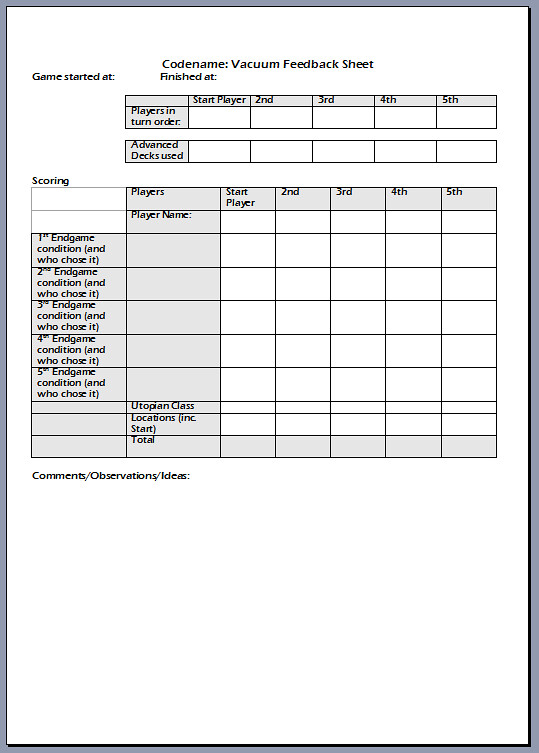
Last week though, I sent out a couple of playtest copies to some previous gaming buddies who used to be my core Reiver Games playtesters. In the package with their copy of the game were a handful of feedback sheets, so they could record the bits of the game I am most interested in.


So what am I looking for? I'm trying to find the particular biases and unbalanced areas that the game is bound to be full of. The game has 15 decks of cards, 8 possible starting territories and five (or fifteen!) endgame scoring conditions. I've played it nearly forty times and that is nowhere near enough times to sort out all the balance issues between that number of variables, especially as I bring out a new version every month or so and so I effectively have to start again from scratch at that point.


Now that there are multiple copies of the game in circulation, I can get more feedback about each version and hopefully start doing something useful with it. Data analysis! Science!


The areas I'm most interested in to begin with are:


  • Is there a first player bias
  • Is there a last player bias
  • Strong vs. weak endgame scoring conditions
  • Strong vs. weak starting territories
  • Strong vs. weak decks

Hopefully, getting my playtesters to fill in one of these will help me find those problems, so I can fix them:


The feedback sheet

Click the image to see a full size one


P.S. Award yourself 10 points if you recognised the Firefly quote in the title!

Monday, February 25

Why Critical Feedback Is Crucial

As I mentioned a couple of weeks ago, I've finally got round to asking for some structured feedback from the mates who I've been testing Codename: Vacuum on.


I really don't want to be that guy who keeps nagging his mates to play his game that they'd rather pluck their own eyes out with skewers than play. I don't want them playing it to avoid hurting my feelings; I want them playing it if they want to play it.


Playtesting is different to gaming. You play a game that's often crap or broken, each time you play it the rules or components are different, sometimes you have to abandon a game halfway through because it doesn't work and then after all that you're expected to give feedback and constructive criticism. Not all gamers enjoy playtesting - and with good reason.


So the system I came up with to avoid being that guy, was to invite people to play Vacuum with me once. If they wanted to play, they had to email me. If they wanted to play again, they had to email me again. No nagging, no guilt, just helping out if they felt like it and enjoyed it.


Seven of my mates at work are on the Games Night email list (though not all of them come) so I invited them and left it at that. All of them took me up on the offer. Most of them have played between two and five times, a couple only once. Two of them want to play pretty much every week.


What I was most interested in was: why do the five who don't want to play every week not want to play every week? What is it about Codename: Vacuum that has left them feeling cold?


Most of them are Software Engineers like me, so they understand the value of critical feedback. I asked them for answers to a simple questionnaire, and for them to be critical in particular - no sugar-coating!


By far the biggest criticism that came back from everyone was that the learning curve was steep and the wealth of available strategies overwhelming. At the moment the game has five 'standard' decks which you play with every time and ten 'advanced' decks of which you play five per game. Each deck has an end-game scoring condition which represents a valid (though not yet balanced!) strategy. In any one game there are ten available, each time you play half of those change (and in fact for my playtesters, they pretty much all change every time they play as the game evolves).


People are finding it hard to take in the options and judge which ones are strongest for the given combination of available decks. It's bewildering. I understand all the scoring conditions, but then I wrote all the cards and think about them incessantly. My chief playtester Dave has got it (he recently royally owned me in a game!) but he's played it more than ten times. No one else has really.


I guess I had seen this in action most times I've tried the game out, but I'd chalked it up to learning games and beginners confusion without really paying any particular attention to it. Getting these written answers to the questionnaires has really brought it into focus and flagged it up. If you are too overwhelmed the first time you play a game, then there's not much likelihood of you playing it a second time and any hope of a hit game and good sales have gone straight out of the window.


But the concrete feedback has given me something to latch onto, and last week I had an idea in the shower. I going to try only five scoring conditions, one per standard deck. They'll be the same every game, and because there's only five of them, they can be simpler and easier to grok. The advanced decks will still exist, but they'll be there to help you in one or more of the standard scoring conditions.


Thinking about it, this simplification might help with a few other things:


  • forcing players to diversify their decks since the standard scoring conditions are all quite different from each other
  • it should make it easier to balance the game as I only need to consider those five scoring conditions
  • it should also make the multi-player game a bit quicker, since you would play to fewer conditions

Time to try it out and see if it behaves like I expect. I've a playtest session on Monday lunchtime with a couple of mates from work.


Another advantage of coming up with it at this point is that I hope to get copies to my friends in York and Bedford in the next week or so. I can give them both versions (before and after this simplification) and get them to compare and contrast.

Monday, January 21

Codename Vacuum: Belatedly Getting Feedback

I had the idea for Codename: Vacuum about fifteen months ago now. It got its first proper play at Games Night during February last year then nothing really until July when I played it with my friend Paul whose Games Night I attended twice a week for most of our five year sojourn in York. Since October last year it's been played at least once a week as I try to iron out the kinks and fix the balance issues.


The first play was, to my mind, disastrous: the game lasted many hours and the play was dragged out by numerous discussions about things that could be changed about it, most of which would have completely changed it, certainly radically altering it from the game I first had (and still have) in mind. The second went much better with my friend Paul who had been one of my key playtesters during my Reiver Games days.


Since then, I've tried to focus on playing the game a lot with friends at work and at Games Night (there is a large overlap between those groups of people). The focus has been on teaching people the game and me personally working out which decks/cards are weak. Every month or so I've printed out a new version of the game incorporating potential fixes to the problems I've found.


Wary of the wealth of wildly restructuring ideas I had at the first public test, I've not been asking my playtesters for much in the way of feedback - I've just been using them as opponents to enable me to test the game and spot potential problems/weaknesses.


Obviously, this is a pants way to proceed, but it got me over the hump of not playing the game and has allowed me to make three or four complete revisions of the game, each of which I think is slightly better than the last. But playtesting is not just for playing the game - it's also for gathering feedback and I've been doing very little of that.


My current playtest crew for Vacuum is a core of four people who seem genuinely keen to play it. Dave has played it getting on for ten times I think, and gives me a good run for my money, winning as many (if not slightly more!) games than I do. The other three have probably played two or three times each, and I don't think any of them have beaten me yet (though I might be remember that wrong!). I'm now asking these core guys for really critical feedback after games in the hope I can use this information to hone the game still further and address the weaknesses of the game as a whole.


Possibly more interesting and useful would be feedback from the five or six people who've played it once or twice and don't seem particularly keen to play it again. What is it about the game that they don't like or do they have any ideas what it is about the game that doesn't excite them? I need to gather that feedback too, but I need to do it without seeming to be pulling them up for their lack of interest. How to do that, I'm not sure yet.


The other thing about my process that's changing is that I'm going from making a new version every month or so to just tweaking a card or a deck and re-print those out for testing. Printing and cutting out a whole new copy is about an hour and a half's work, but I can do a single deck pretty quickly (especially since I changed the form factor of the artwork - why oh why didn't I do that earlier?). It feels like the game is coming on nicely and I'm still having plenty of new card ideas - at this rate it's going to have an expansion's worth before I'm ready to publish/hawk it!


Setting my goals for the year a few weeks ago has really focussed my mind on moving things forward - I'm driven now to get a couple of copies out to my previous gaming groups in York and Bedford (both populated by Reiver Games playtesters!) by the end of February, but before I do that I want to improve the game still further.


I also need to create a rulebook that's complete enough to learn the game from, but time is tight, especially as I have to do a Self-Assessment Tax Return for the last year of Reiver Games before the end of this month :(