Showing posts with label Prototyping. Show all posts

Monday, August 24

Visitors

My parents are here this week.

It's lovely to see them.

We Facetime almost every week.

But I only get to see them in the flesh three times a year.

Needless to say progress will be slower this week.

Last week my father-in-law and his partner were here.

Also nice to see them.

Also slower progress.

I've got a few projects on the go though.

And they are ticking along.

Slow progress is better than no progress.

It all adds up.

New prototype incoming...

Monday, December 15

Excited

I've had a new idea.

Inspired by For All Mankind.

I've been watching it in my spare time.

I.e. while washing up.

It's very much my jam.

Sci-fi.

Politicking.

Some alt-history.

Someone on Bluesky said in their mind it's in the same universe as The Expanse.

Which is a personal favourite.

NASA / Neil Armstrong (Public Domain)

So now I'm working on a moonbase game.

My second.

The first one didn't go anywhere.

Hopefully this one will.

I've a neat mechanism idea.

I'll see if I can knock up half a prototype to take away over Christmas.

And develop.

I'm excited to have a new project underway!

Monday, December 25

Christmas

I’m taking a break now for Christmas.

Heading to Bristol to see family and in-laws.

Will probably take some prototypes along with some games though.

I’ve levelled up Coalescence a bit.

Hope you all have a great Christmas/Happy Holidays/winter break/summer break as appropriate!

See you in 2024!

Monday, January 2

Notes

After playing with Evernote and Notion I’ve gone back to the iPhone Notes app. 

The free one from Apple. 

In the last month I’ve taken notes on 7(!) different games. 

This is prolific for me!

Only two of those have been prototyped though.

It’s time to move from notes to games. 

Broken games. Dodgy games. Boring games. 

But no matter how much you think about it, it’s not until you make a prototype that you start finding the kinks and working them out. 

I’ve ordered 500 blank cards to save me some time.

New job starts tomorrow, so I’ll be tight for time again.

Monday, December 19

Four

I'm actively working on four games.

Rocky 'Roid is with playtesters awaiting feedback.

Siren Song I've tried a couple of times solo. I'm making notes and I'm almost ready to update the prototype.

Border Reivers has a page of notes.

And I'm doing the Scenario Booklet for FlickFleet.

I'm loving this burst of creativity.

Really enjoying the designing and prototyping of games.

Paul gave me a 10x10 game tracker he'd made me for Christmas.

I'm using it to track prototype plays.

Plenty of space at the bottom!

Too much of my time over the last few years has been swallowed by running the business.

And trying to stay sane during COVID.


Monday, February 14

One Hour

I have a full-time job.

And a young family.

Time is tight.

Since Christmas we've settled into a rhythm where I have an hour a day to work on Eurydice Games.

After work we eat.

Then I do my chores.

Then it's bedtime for the kids and I usually do Daughter the Second's.

Then I have an hour to myself while The Wife does Daughter the First's.

One hour a day. Every day.

Though I often do more after the kids are asleep.

It's amazing what you can achieve if you apply yourself consistently.

I've mostly been focussed on Xeno Wars for the last month.

Playtesting. Graphic design. Preparing for prototypes.

I've now got a lot of what I need.

As long as you're using the time wisely, a little everyday soon compounds.

Monday, May 4

Ding! Ding! New Round

This week I've finally finished off the new deck of goal cards for my Coalescence prototype. It's taken me weeks and weeks due to a lack of free time during lockdown, but I've finally got it done.

All the previous versions of this game (or at least the ones with goal cards) featured goal cards hastily scribbled on scraps of paper torn from an A4 sheet. And only about 8 of those. This version has 25 cards (the number I traditionally fit on a sheet of A3 card) printed on thick card. I've got a wider range of goals and also several with two different flavours of the same goal, which might work, or might not.

I've also taken this opportunity to practise my graphic design skills:


Prettier than hand-scribbled text only!

The next step is to try them out and see if the new ideas work or not...

Monday, March 23

Holding Pattern

A lot can change in a week. At the end of the day that my last post went live I found out that due to The Toddler’s (almost certainly not COVID but better safe than sorry) cough we were all housebound for two weeks and as someone with Multiple Sclerosis I count as a ‘vulnerable person’ who will probably be told to stay self-isolating for twelve weeks from this weekend. So possibly 13 weeks of largely staying indoors.

To combat this I’ve taken up early morning runs (allowed under the rules) instead of walking to work and started figuring out an online version of my weekly Games Night (three of us did a test on Friday of Google Hangouts for video chat and the Carcassonne iPad app, which worked pretty well once we’d got over the teething troubles).

But I can’t get to the Post Office at the moment and so I’ve taken down the Facebook ads we were running to drive FlickFleet sales, and Paul is still waiting for a new garage door, so Kickstarter rewards cutting is stalled too.

We’re the lucky ones though. Our day jobs are pretty secure and because we run Eurydice Games as a side hustle we have essentially zero overheads. Spare a thought (and a few pounds/dollars if you can afford it) for those Indy publishers that are relying on that for their income, their food and their rent/mortgage in these troubled times.

On the plus side, I've managed to fix my prototyping printer (it needed a new printhead) so I can start printing prototypes again and Daughter the First and I got a few games of Coalescence in on Saturday morning.


The new planets look amazing!

I've also got the first (of hopefully two) #CraftWednesday designs up on Redbubble.

You can get it on t-shirts, hoodies, phone cases, notebooks and mugs!

Stay safe everyone and we wish you well.

Monday, February 5

FlickFleet: A Meeting of Minds

This week just gone has been all about FlickFleet. At the beginning of the week I was trying to get everything in place for a Cardboard Edison Award submission. I needed a short intro (easy!), a rulebook (needed a lot of work!) and a less than 5 minute video overview. I revised the rulebook, adding a few more diagrams and three scenarios (only one of which I'd tested!) and then ran out of time. I think it's just about good enough to learn the game from, but it desperately needs another revision with more diagrams and some examples. The final piece of the puzzle was a video which my mate Wilka helped me with. As always when you see your hear yourself in recorded form it was excruciating. I've a face for radio and a voice for silent films. It's hard to imagine that someone could make a game as fun as FlickFleet sound more boring. Next time, I need to bring some energy, enthusiasm and personality.

But, I submitted it anyway. I'm really hoping to get some decent feedback from the process. I'm one of 192 entrants, of which about ten will be chosen as finalists based on the overview, video and rulebook. Those finalists will have to submit a prototype at the end of the month.

With the Award submission out of the way, the next focus is making some prototypes. I spent three of my lunch breaks last week on that: taking the second set of perspex (delivered to me and not random stranger in London) to give to my mate Dan for laser cutting; collecting a bag of pieces from Dan and then collecting the ship dashboards from the printers (my printer is still broken).

I wanted to get at least one finished, before my mate Paul (the co-designer) arrived for the weekend with his family on Friday evening. I had to strip the plastic coatings off the ships, bag the ships and wooden bits, cut out the dashboards, make a box and finally fold and staple the rulebooks. I finished five minutes after they arrived!


Paul's prototype in the flesh

Paul had the original idea for FlickFleet back in the Summer of 2016 and has had several critical ideas during the development. Until now though the only copy in existence has been mine and I've been doing the lion's share of the playtesting and development.

Now Paul finally has his own copy for testing with his friends, and it meant that we had a updated version to try out together over the weekend. We ended up playing all the scenarios (the two I hadn't tried yet twice each, and the other one once) and managed to work out a couple of kinks. The new jigsawed bombers worked much better and the scenarios were surprisingly together and fun considering I'd just thought them up one morning on the way to work and then typed them up. We also spent the day on Sunday with Paul coming up with scenario after scenario. I'm hoping to have four or five in the rulebook and then a bunch more on the website - for a long time this looked like it would be a bit of a stretch, now, not so much!

Scenario testing

This week I'm travelling for work again, but I'm also hoping to get some more prototypes done for sending out to some blind playtesters.

Monday, February 8

First Dance of New Look Dragon

This week I made it along to Newcastle Playtest for the second month on the trot (pretty good effort - since my new job started there's been a lot more travel and hence fewer nights out). Of course, it wasn't straightforward, as I was in Manchester for work that day, so rather than heading over from work at 6:30, I turned up at 7:45 from the station. Several of our regulars were even more inconvenienced by travel, so it was going to be a fairly quiet night until a couple of new people (Hello Michelle! Hello Bart!) turned up - in the end there were five of us with Paul and Alex. Alex had brought his two player game: Swag, Blag and Goons, Paul had brought his two player game: Kick, Punch, Stomp! and I'd brought two two-player games: a new version of Dragon Dance and Border Reivers Second Edition. We ended up splitting up and playing a couple of side-by-side two player games, but not before playing three games of the copy of Zombology I'd delivered to Paul at the start of the night. Both the new people seemed to like it, which was encouraging.

I'd spent a couple of hours on the train that afternoon designing and constructing a new version of Dragon Dance, using the idea I'd had a few weeks ago. For once I'd followed my own advice and not over done the prototype, as this was effectively a new game, so likely to be hideously broken:

New Dragon Dance

We played a couple of games that night, one with Paul and one with Bart and they flushed out some problems, and also some weaknesses, Bart had not played the previously version, and it had been a couple of years since Paul had last played so neither of them could compare it to the previous version (which I'd foolishly left in my desk and then failed to collect in time for the session due to delayed trains).

Initial feedback was that it was interesting and worth pursuing if clearly in early development.

On Friday lunchtime I also got to try it out with Gav, immediately after a game of the previous version so he had a useful comparison. Gav preferred it to the previous version, which means I'm probably heading in the right direction (at least for Gav!).

The new version is still a Good Little Game, i.e 18 cards and things you can expect to find around the house, but each card now does one to six things depending on the tokens available to you. The bluffing still works (Gav caught me a few times on the hop) and he really liked that each card is now named with a tell that you're reading and trying to interpret.

I need to make another version now (this one has some inevitable flaws) and then start gathering more data. I want it to be slightly easier for the dragon, but at the moment it's very easy for the dragon - I'll need to tweak things to try to balance that out too.

Monday, May 4

Feeling Like A Publisher Again

In 2004 I was a hobby games designer. In 2006 I became a hobby board game publisher. In 2008 I became a (bad!) professional board game publisher. In 2011 I was a failed entrepreneur and really didn't feel like designing games any more.

When I had the idea of Codename: Vacuum at the end of 2012 I started my second incarnation as  a hobby games designer. And that's where I stayed for nearly three years.

My Reiver Games failure hung over me, so I've been in no rush to get back into publishing. I know just how much hard work goes into hobby publishing (hand-made Border Reivers-stylee) and how many copies you've got to make and sell to be successful in the professional arena. Also, my confidence took a bad knock: games I thought would sell really well didn't sell and the game I had designed personally was the weakest of the games I published as Reiver Games.

So for the last two and a half years I've been a hobby games designer and nothing more. That's been fun, and I've now got a great support network in the form of Newcastle Playtest. All this time my games have been slowly developing. I've been keen not to rush into publishing again with a sub-par game.

This year's goal of hobby publishing a game is finally starting to take shape and once again I'm starting to feel like a publisher (albeit a hobby self-publisher). Rather than designing the games or doing the basic graphic design required for a prototype, I'm starting to think in terms of production.

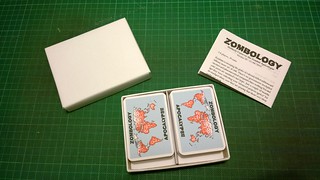
This weekend I've made a new prototype of Zombology, trialing a net for a wrap around box label (currently just a white sheet - no art at all).

New Prototype

I'm also working out how best to arrange things on sheets of paper to minimise printing costs. I've got a quality bar that I want to stick to (as good as Border Reivers), and depending on cost I'm going to have to choose a print-run size based on where the economies of scale make it affordable.

All this has happened before, and all this will happen again!

Monday, December 8

Busy, Busy

With NaGa DeMon done you'd expect things to be calming down, but not so much - this week has been one of lots of little things that needed attending to.

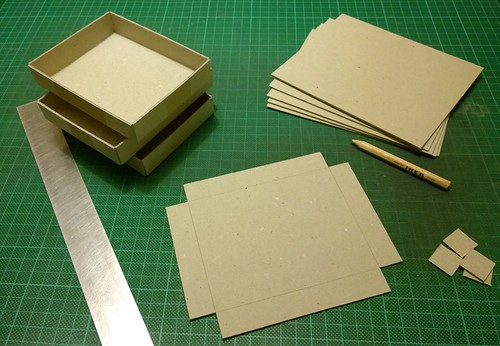
I've promised copies of Dragon Dance to the three most helpful TGWAG competitors, so I've started making those copies. I'd bought or scavenged the wooden pieces and dice before the start of November, but there's plenty still to do: boxes, cards and rules. On Saturday I started getting the boxes made and will finish them off tonight. The cards and rules require getting the printer down from the box room, which is a bit of a faff, so I'm put that off until all my printing is ready. So I've also done the graphic design for another version of Zombology - that's ready for printing.

I've also been working on my Martian Dice Windows Phone app which is nearing completion. I made a candidate for the final build at the beginning of the week and that's now being tested by a bunch of friends. I'm hoping that this will be my most popular app so far (I've got 50 downloads so far across all three apps put together!), so I've been putting some work into a web page for it and getting some mild publicity ready.

Once Martian Dice is out there my next focus will probably be Christmas, but then after that I've another idea for an app to work on next year (in addition to Vacuum, Zombology, Dragon Dance, Border Reivers second edition and maintaining all my existing apps!).

First up though, Dragon Dance NaGa DeMon winners' copies...

Dragon Dance Boxes

Monday, November 3

NaGa DeMon 2: Codename: Dragon - Components

I've said before that you shouldn't invest too heavily in the components of your early prototypes since the game is likely to change beyond recognition and those components that you splashed out on or invested hundreds of hours of artwork in are liable to be replaced by something else in very short order.

NaGa DeMon is a slight exception to that rule for me, since at the end of the month, I've committed to sending prototypes to the three most helpful competitors in TGWAG. So I need to make my copy plus three more. Since those three competitors will (hopefully!) invested their valuable time and effort in helping me, the least I can do to show my appreciation is to give them a signed, limited edition prototype that doesn't totally suck. So I want to splash out a little and make the prize a neat little package. So I need some components. Times four.

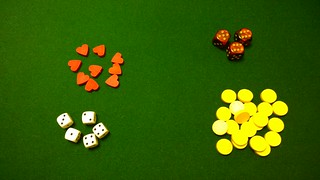
As I mentioned on Friday, I'm expecting the game to feature cards (which I'm a dab hand at, if I do say so myself), dice and counters. Some dice for St. George and some for the dragon, plus some counters for St. George and some for the dragon.

When I think dragons I think big scaly red beasts guarding a vast hoard of gold (thanks J.R.R. Tolkien!) and when I think St. George I think white and red - the colours of the flag of St. George, the national flag of England which is incorporated into the Union Jack of Great Britain.

So, to separate the dice between players, I've gone for white dice for St. George and red ones for the dragon (the dragon is a bit wordy, he needs a name. Bonus PIPs for the best suggested name in the comments). I went to Travelling Man after work on Friday to get the dice and they had some nice Chessex ones in two different sizes. Since I need more white than red (I think!), I've gone for smaller white ones (bonus: St. George is smaller than the dragon) and nice marbled red and gold ones for the dragon.

For life counters, I recently bought some red wooden hearts from BoardGameExtras.co.uk for pimping my copy of Love Letter. Thinking ahead I bought a load more for Codename: Dragon purposes. That's St. George sorted, and it fits well since lots of computer games use hearts as the iconography for lives. Which just leaves the dragon. Dragon = hoard of gold. As it happens I've a load of yellow wooden disks left over from the limited edition of It's Alive I published back in 2008. I've hung onto them knowing they'd come in handy sooner or later. Their time has come!

Which give me this:

Codename: Dragon Components

Monday, March 4

Honestly I'm Not Normally A Deviant, But ...

I'll get to the subject of that provocative title in a minute! Aside: this is my 666th blog post. Make of that what you will.


Just a brief update on progress this week, and a review of my card purchases.


At the beginning of the year I set myself some goals. Seeing as one of them was a deadline for last Thursday, I figured it'd be a good time to take stock of how I'm progressing against those goals. The deadline was to get initial playtest copies out to some close friends who were key Reiver Games playtesters by the end of February. I missed it, but only by a couple of days (I got them ready over the weekend, so they are ready for posting today). It was close, so I'm going to count that as a goal met! The only other goals relevant at this point are the blog ones. So far I'm on track for those too, I've blogged every Monday this year, the page views are above the target of 20,000 views this year and I've two new followers since the start of the year too. All good :-)


Setting the goals has really focussed me, I've worked quite hard the last few weeks to the get playtest copies ready, spending my evenings after The Daughter goes to sleep printing, cutting and collating to get the copies assembled. The biggest stumbling block was the rulebook, which I had to write from scratch in Adobe InDesign since the previous one was written in Microsoft Word, had no examples and was hideously out of date. The last minute change to simplify things that I thought of last week didn't help as that made changes necessary close to the wire.


Still, I consider myself on track so far this year :-)


As another aside, I recently read an article on BGG by Lewis Pulsipher, designer of Britannia among others, stating that to be taken seriously as a designer you need to be working on multiple games at once. One game makes you look like a dilettante apparently. I consider myself focussed, rather than a dilettante, but maybe others feel differently. Anyway, I've a family now and they come first, with limited time available the only way I can make any progress is to focus on a single game.


In other news, in making these prototypes I mentioned above, I've finally got around to using some of that card I bought a couple of weeks ago. I bought it from PaperCutz a supplier I'd not used before, so I thought I'd review the purchase briefly. I've used the card extensively in the prototypes: the box insert, deck dividers, cards and player mats are all printed on and made from the new card.


The prototypes in all their glory

PaperCutz were pretty easy to deal with, I ordered over the internet, the card arrived in a couple of days. The card was fairly well wrapped and then boxed, but regardless both the 300gsm and the 240gsm were slightly dinged on one corner, probably as a result of exuberance on the part of the courier. It's not a problem, since I cut at least 10mm from each edge as part of the construction and I can feed the dinged corner into the printer last so it doesn't throw the printer out of whack, but still slightly disappointing.


I bought 25 sheets of the 300gsm for making box inserts and 250 sheets of the 240gsm for the cards, dividers and player mats. That's enough to make 15 games :-). Or at least it was until I fell in love with the 300gsm stuff. Honestly I'm not normally a deviant, but the silky smooth, unblemished exterior coupled with a firm core that kinks pleasingly when you caress its surface with a craft knife totally got me. I've used it for the box inserts as intended, but also for the dividers and player mats, so now I've enough card to make 3 more games. I need more. I'm going to get another 100 sheets of the A3 300gsm, which I'll use for the dividers and player mats and I'll also get 25 sheets of a more voluptuous SRA3 (a slightly bigger size) for the box inserts. It turns out that I can't do maths to save my life, and the calculation I'd done in my head which lead to the decision that A3 would be big enough for the box inserts was way out. SRA3 isn't big enough! But it's close enough and will do. After those purchases I'll have enough to make another 15 copies - so I should be sorted for the next wave of prototypes in the summer too :-).

Monday, February 11

Stationery Woes

For the last few months I've been making a new prototype of Codename: Vacuum roughly once a month. I'd play the last version a few times, come up with some new ideas to try out and then make those changes on the computer. Then it was time to realise it in physical form. I bought a Canon Pixma iX6550 last year and I've been very pleased with it. When printing cards for games I lay the cards out in a 5x5 grid on a sheet of A3 card. So, clearly, I need some A3 card. Codename: Vacuum is a deck-building game with 350 cards. So I need a lot of card.


For the last few months I've been nipping to Ryman Stationery or Hobbycraft to get more card. They both sell A3 white card in packs of 25, so with the 17 sheets of card per copy of the game, I'm getting through quite a lot of packs! Hobbycraft has been my preferred stockist, their packs are £5 and are 210gsm card - which feels a reasonable thickness and weight for prototype game cards. Ryman's conversely are £6 and only 160gsm which feels cheap and flimsy by comparison.


So why do I ever go to Ryman? Because Hobbycraft are often out of stock - Ryman has been my fallback position if I need card at short notice and Hobbycraft have failed me yet again.


Since I need almost a full pack per game and I'm making roughly a game a monthly, trips to Hobbycraft for the inevitable disappointment of no stock followed by a trip into town to get the flimsy Ryman offering are regularly required.


As I mentioned at the beginning of the year I'm hoping to get playtesting copies to friends this month and more out in the summer - I'm going to be making a lot of copies. It doesn't make sense to continue to buy lots of these little packs when I need sheets a hundred or more at a time.


Time to man up:


The card I ordered online

3 inch thick pile of card! Manly.


I placed an order online with PaperCutz for 250 sheets! I've also gone with a heavier weight than even Hobbycraft sell: 240gsm. Having such a large stock will mean I don't need to keep making these disappointing trips and mean that when I'm ready to make a new copy I've got enough card to print it straight away. I also ordered 25 sheets of really heavy 300gsm card making for box inserts. If you're going to do a job - might as well do it properly :).

Monday, December 3

Design Lag

As I mentioned last week, I'm converting the art from A3 pages to card size ones. As part of that, I have to admit to myself that I'm actually creating a new version at the same time. It started out as some layout/design improvements, then a couple of card tweaks crept in, based on playing the new version several times during lunch break at work and at Games Night. As I get more plays of the newest version under my belt, I'm thinking of other things I could be adding, which cards/decks are weak and could do with improvements, which cards could be changed to better fit their theming, etc. I've now got to the point where almost every card will change in some way, again.


In the dim, distant past, before I became a father, I would knock up a new prototype whenever I had a new idea, so the cycle would be pretty much: play the game once, have an idea, make a new prototype, play it once, have an idea, make a new prototype, etc.


Now I want to spend my free time with my family, especially my daughter who I only get to see in the evenings and on weekends. But I also want to make progress on Codename: Vacuum. It takes time to do the card changes required when I have a new idea, and more time to print them out and cut them out. Probably about four or five hours in total and this time it's taking even longer due to the time required to change the document page size and re-layout all the cards.


I fit in making new versions when I've a bit of time when The Wife and The Daughter are asleep, usually early in the morning while I have my breakfast, but as you can imagine it takes several weeks for this time to add up to the several hours I need for a new version of the game. So new versions of the game are several weeks apart.


Of course, I'm still having ideas at the same rate - a few every time I play the game and I'm playing the game two or three times a week. So the ideas are stacking up. I'm going to call that 'design lag'.


As with anything, this has its pros and cons. To my mind the benefits are:


  • I spend less time making prototypes that are only played once
  • I get a good feel for the strengths and weaknesses of a version from 5-10 plays of it
  • I don't rush to snap decisions based on a single bad experience
  • New versions feel quite different, often like a big step forward

However, I think these are the downsides:


  • I get to play a version that's got a particular problem several times, aware that I have a potential solution in my head/in my notes
  • It's frustrating to have to wait a few weeks to find out if a potential fix works, or not
  • I don't get to test changes in isolation which makes it difficult to find root causes to problems

On balance, I think the design lag I'm currently experiencing is a good thing. I'm focused on testing things not making new things all the time, and each version is more thoroughly tested as a result. Plus, it frees up time for important things like spending time with my family and trivial things like blogging.


One final thing. Codename: Vacuum is just that, a nickname to describe the game while I think of a real name for it. It's a game that conceptually charts 200 years of history, starting in a steampunk alternative universe circa 1900 to approximately 2100. How does: "Full Steam to the Stars" sound? Thoughts? Surely someone has got a better idea?

Monday, November 26

Changing Form Factor

In the early stages of making cards for a game I do the art on A3 sheets of paper, with the cards in a 5 x 5 grid. I've got a blank document ready in Adobe InDesign which already has all the document guides to line things up to and the cutting guides ready prepared on a separate layer.


Having the document with A3 print size is convenient for printing, and works fine at the beginning when the card count and mix is changing regularly, but once things start to settle down it is good to move to a new format.


For Carpe Astra and Sumeria I got the printing done by LudoFact one of Germany's big games printers. They want to receive the cards as a print quality PDF or PostScript file, with one card per page, each page the size of the cards themselves. So I had to make a document where the page size was 56mm x 87mm (a standard card size, apparently). This is actually pretty convenient for doing the rulebook too, as it's easy to place a page of another InDesign document as a graphic in a document, so I could place page 40 of the cards document to get a particular card for illustrating an example.


A single card as a document page

Switching to the smaller form factor too early makes thing awkward as you now have two documents to update before printing: Make the changes to the single cards document and then go to the A3 print document, update the links and delete pages and re-add them to make the changes to the card counts. But once the card balance is steady it's not bad at all. All you need to do is open the A3 print document, update the links to the modified single card-per-page document and then click print. In fact, in some ways it makes things slightly easier, as while working in the A3 print document I keep the cutting guides layer hidden so that I don't accidentally drag some of the cutting guides around with the card art. On at least two occasions I've forgotten to show the cutting guides again before printing, which means I need to either mark the guides on with pencil (a real arse when there's 36 of them per page and 14 pages) or print it again and waste loads of card. Having them separate means that I'll no longer be doing anything in the A3 document, so I can leave them permanently enabled.


Of course, seeing as I'm moving things around, I'm taking this chance to tweak a few of the cards again and do a little bit more layout/pictography improvement too. Barely a week goes by without me making some small changes to the game. Fortunately, I'm not thinking of backing out the bigger changes between my current version and the previous one - just improving the balance of some of the weaker sets of cards.


The next step after changing the size of the document and getting the print document to link to the new one is to do a proper rulebook. Initially the rulebook was just a set of notes for me. The current rulebook is a complete description of the (previous version of the) game (but without examples or any illustrations/clarification). I need to update the rulebook to the new rules and get it into a finished enough state that people can learn the game blind from it. Then I hope to send it to a couple of my previous gaming groups (which obviously requires making a couple of extra copies) and possibly to some of my far-flung Reiver Games playtesters (or I might wait for that until I've incorporated feedback from my ex-gaming chums).


The other advantage of the single-card per page version is that it allows me to set up an A4 print document that's easy to keep in sync as things change so that I can provide print-and-play copies to selected others (seeing as most people don't have an A3 printer).

Monday, November 19

(Lack of) Art in Prototypes

A couple of weeks ago, I posted some pictures of a few cards from the last three versions of Codename: Vacuum. The pictures showed small incremental changes to the cards over time with functionality disappearing to later reappear, or subtly changing over time.


But what was probably most noticable about all three versions was the lack of artwork. The cards were 90% white. Why the lack of art?


Art-free prototype cards
The name's Bland, James Bland

It's a combination of reasons, but the most relevant is that I don't have the skills, and nor do any of my gaming buddies in Newcastle. I enjoy doing the layout and pictography, but I just can't draw to any reasonably level. I could download some vaguely relevant clip art from the internet, but I'm not a fan of copyright infringement and for a lot of the cards I have a pretty good idea in my head what they should look like, and finding those images through a Google search would take days - time I don't have to spare.


For some designers, doing the art is as much a part of the game design as coming up with the rules and components, but not for me. Nor do I have anyone who can do the art for me as a favour or for fun.


As a workaround I could rustle up some home-drawn crappy art, but I figure that would look worse than none at all - at least a compelling name and a blank page will conjure up a picture in the players' mind's eyes, whereas a badly drawn and coloured picture that would cause my dad to disown me (he's an artist and retired art teacher, though sadly not in a relevant style) would just turn the players' stomachs.


I could get someone with the chops to do the art for me, but there's a lot required, and I don't have the funds to pay someone for that work (my money's going on nappies at the moment). I can't expect an artist to work for free, or for the promise of future funds if I publish the game because that's not fair to them - especially as the game may never get published and they may never get paid or get to see their art get published. I don't mind working for free for something I'm passionate about (as evidenced by five years of running Reiver Games), but I can't expect the same from others.


So Codename: Vacuum languishes in its stark, white beauty. I've had a chat on Twitter with an old friend from my childhood who I've got in contact with again recently, he's a professional animator (and hence artist) and has offered to lend a hand in his limited free time, but again, I don't want to abuse his generosity - he has a family to support too.


It's important to get art in there before phase 3: i.e. testing and blind testing in front of real gamers.


Something else to think about is:


  • if the game ever reaches a 'finished' state
  • and, if it meets the required levels of awesomeness
  • and, if I decide to self-publish it
  • and, if I decide to use KickStarter or IndieGoGo to raise the funds for that

I'll need at least some teaser art before I start the campaign to raise the funds, I'm sure seeing awesome art on the KickStarter page helps people to decide to part with their hard-earned dough.

Tuesday, October 9

Getting Codename: Vacuum to the Table

First of all, a quick 'Hi!' to those of you who found this blog through Boardgame News or Reddit and decided to stick around to see what happens next. Welcome! And I hope I prove worthy of your attention :).


Those of you who aren't new however will be aware that despite talking about it a lot, and re-designing bits of it a lot, I haven't actually been playing Codename: Vacuum much at all.


Part of that is because I'm tweaking it at such a prodigious rate that I rarely have a prototype ready to go with all the latest changes I'm considering, and part of it is lack of time, and part of it is lack of opportunity and part of it is probably a lack of commitment on my part.


Since moving back to Newcastle last August I've only made it to the local games club (Newcastle Gamers) twice, and I've not been to been a convention since I used to run Reiver Games a couple of years ago. I nearly made it to Beer and Pretzels last year, but it ended up coinciding with a work trip to Vancouver, and TCAD coincided with the birth of my daughter, so that was out too.


I also used to have a regular playtesting session while I ran Reiver Games, where all the attendees knew that they'd spend their time trying games that might be badly broken. Whereas attendees to my regular Games Night are coming to play real games, so I feel awkward foisting half-finished games on them that might be joyless experiences.


Enough with the lame excuses! Time to pull my finger out. At last week's Games Night a couple of attendees offered to help me playtest Vacuum, so we sat down to a game of it. Again, it took longer than I was hoping, but that included a couple of breaks and me explaining how to set up the game to them while holding a baby! I guess it was around an hour and a half all told. I'd still like it to be comfortably under an hour, but maybe with experienced players that's still a possibility. I've also arranged some plays during lunchtime at work with a couple of friends this week, and one of the guys who played it at last week's Games Night wants to play it again next time, so there's every chance it'll get played four times(!) in a couple of weeks. That's more like it!


Vacuum in play

Photo via Wilka


Of course, I've already got a bunch of ideas ready from last week's playtest that I'm in the process of incorporating into yet another version. Some things that I put in, and took out are probably going back in (removed to simplify it, back in for thematic purposes and to boost several of the cards) and I'm making a few tweaks to try to encourage more player interaction (by which I mean fighting!). It won't be ready for this week's games though, so I've a chance to try the old version out a few more times and try to confirm my suspicions that these changes are necessary.

Tuesday, October 2

Prototype Decay

It's alright, I'm not talking about prototypes made from raw meat, disappearing ink or short-lived radioisotopes*, but the life-span of components as the prototypes of a game march on.


I recently read a New Scientist story about how truth decays over time (reg. required).


Before Copernicus, everyone knew that the Earth was the centre of the universe. It was a fact. Then, the sun was the centre of the universe. Now we know that we live on an uncharted backwater at the unfashionable end of the Western Spiral Arm of the Milky Way, one of billions of galaxies in the observable universe.


Similarly, there used to be four elements: earth, air, fire and water. Everything was made of those in different quantities. Then there were modern elements, made of indivisible atoms. Then it turned out that you could divide atoms: into protons, neutrons and electrons. But they were indivisible. Now it turns out that protons and neutrons can be divided into quarks. But they are indivisible, honest.


This got me thinking about how the components of a game have a half-life during the prototyping process.


During the prototyping phase components come and go. You try something, sometimes it works, sometimes it doesn't, even the things that work will likely evolve over time. The half-life of a prototype component is related to how many versions of the game you expect it to remain unchanged through. Obviously, this can relate to physical components, rules, designs, keywords, in-game text, even rules.


Through the development of Codename: Vacuum, there have already been lots of changes and it's probably only on it's third or fourth version (I really should keep better track of these things!). Some cards have had superficial changes (the name has changed, for example), others have been completely re-designed. Sometimes I add a keyword to a whole class of cards, that in no way changes what they do, but makes the explanation easier in the rules. But it affects each of those cards, requiring reprinting and cutting out.


The half-life of a component can vary from under one (not likely to survive to the next version), through one (50% chance of making it to the next version) up to a very large number (will remain unchanged through many versions).


Recognising that components have a half-life, and trying to make an educated guess as to what it might be enables you to invest a reasonable amount of time in a component. It doesn't make sense to pay an artist hundreds of pounds to create some art for a card entitled 'Boffin' if the next version of the game has replaced that card with a card entitled 'Calculation Engine' that does exactly the same thing.


As time goes on, the average half-life of your components should increase as the game begins to settle down and the changes between versions become less sweeping. That's why my early prototypes are scribbled on paper, but later ones can include art and hand-made FIMO pieces:


Border Reivers final prototype

At some point in a game's life cycle you've got to get it in front of other gamers, probably by sending it out to volunteers. I've already got people volunteering to try out Codename: Vacuum for me. Using the estimated half-life of prototype components could help you make the decision of when to start that process: if you're going to have to send them new components after every play - it's probably not ready for remote playtesting yet!


* actually, that's given me an idea for a game!