Monday, March 25

Streamlining

Not a huge amount to report this week, I've had my parents up for the week plus I was away for a couple of days on a work trip. As a result I've not made much progress on Codename: Vacuum.


It's not stood still though. I had a playtest game at lunch time one day last week and I've got the first session report from my playtesters in Bedford. As I mentioned last week, they had some issues with the first draft rulebook, but they managed to overcome my inept rulebook writing and played it last week. They've found a bunch more small errors in the cards and rulebook which I'll correct this week. Their game was a long one. There were four players, all new to the game and they were learning it from the (crap) rulebook and it ended up lasting over two and a half hours. It's always the case that a learning game with rules explanation and rule looking up will take longer, but that's still significantly north of what I was hoping for. Having a more structured rulebook that more clearly explains things will help, but the game will need simplifying too. I was hoping for more of a Race for the Galaxy play time than Twilight Imperium. Since Codename: Vacuum doesn't have simultaneous play it'll never be quite as fast as Race, but it can play fairly quickly, and with my experienced players at work we can usually get a game done in under 20 minutes per player. We even got a five player game with one new player done in 1 hour 40 minutes a couple of weeks ago.


Still, the feedback is reminding me that my design ethos definitely is make a complicated game and then simplify it, rather than starting with a simple game and expanding it. Vacuum isn't intended to be a streamlined euro like Sumeria, but there's definitely a lot of scope to simplify things. I'm trying to focus now on re-writing the rules to clarify things, and at the same time, work on those rules that are complicated to write or explain or ones that people often get wrong to try and streamline the game. The simpler it is, the easier it'll be to teach or pick up for the first time. Of course, while doing this, I've got to be careful not to rip out the heart of the game!


In other news, I was contacted a few weeks ago by a previous Reiver Games customer who was interested in playtesting Codename: Vacuum at a convention in Australia. I've been working to get a print-and-play copy ready for him, but in the light of the feedback about the rules quality, I've had to turn him down. I feel bad about letting him down, but I'd rather give him a hand-made copy later (even with the shipping cost to Australia) than provide a poor quality version now.

Monday, March 18

Epic Fail

The week before last I sent two copies of Codename: Vacuum to my friends Paul in York and Terry in Bedford. In both cases the games arrived in time for their Thursday Games Night, and that Thursday Vacuum got played at my Games Night - I was excited that it could be getting simultaneously by three groups at the same time!


Paul, who had played it once before about nine months ago, emailed me to let me know he'd received it and it all seemed fairly self explanatory, he just had one query - the rules contradicted themselves - which bit was right? It was an artefact of me creating a new 'simpler' version of the rules at the last minute, I let him know which bit was right and fixed the other bit straight away so the next printing wouldn't have the problem.


A week passed, still no word from Terry. Then last Friday I got an email from Andrew (who plays games with Terry, was also one of my key Reiver Games playtesters in my Bedford days and who accompanied me to my second Essen show in Germany). It turns out that my attempt at writing the rules had been an epic fail. Terry, Andrew and Stewart (all three very experienced gamers who regularly learn new games from their rulebooks) had set up Codename: Vacuum to play the previous week, read through the rules and then put it away! After reading through the rules, three very experienced gamers were so confused that they just packed up and played something else instead. That is a legendary rulebook failure. In the end, Andrew took the prototype home and has tried to work through it solo to get his head around it enough to explain it to the others.


Clearly, the rulebook needs a lot of work. The fact that Paul had played the game once before gave him enough of a frame of reference for the rulebook to work for him, but for both playtesting and game sales, the rulebook needs to be clear enough that you can learn the game from the rulebook. This was the first attempt at a proper rulebook for Codename: Vacuum, and the first attempt at a blind playtesting, where you learn the game from the rulebook. The rulebook as it stands fails to pass muster. I need to restructure it to give a better sense of how the game is played, what you are trying to achieve and how to achieve it. The rulebook was a fairly last minute thing done when trying to get the prototypes out the door. It needs more effort than that!

Monday, March 11

Just Collating Data As They Say

After each game of Codename: Vacuum I record a bunch of information, about who played, how long it took, who scored what in which category, etc. I've not made much use of the information yet - the game changes too frequently, so I don't have enough information about any one version to draw any useful conclusions.


Last week though, I sent out a couple of playtest copies to some previous gaming buddies who used to be my core Reiver Games playtesters. In the package with their copy of the game were a handful of feedback sheets, so they could record the bits of the game I am most interested in.


So what am I looking for? I'm trying to find the particular biases and unbalanced areas that the game is bound to be full of. The game has 15 decks of cards, 8 possible starting territories and five (or fifteen!) endgame scoring conditions. I've played it nearly forty times and that is nowhere near enough times to sort out all the balance issues between that number of variables, especially as I bring out a new version every month or so and so I effectively have to start again from scratch at that point.


Now that there are multiple copies of the game in circulation, I can get more feedback about each version and hopefully start doing something useful with it. Data analysis! Science!


The areas I'm most interested in to begin with are:


  • Is there a first player bias
  • Is there a last player bias
  • Strong vs. weak endgame scoring conditions
  • Strong vs. weak starting territories
  • Strong vs. weak decks

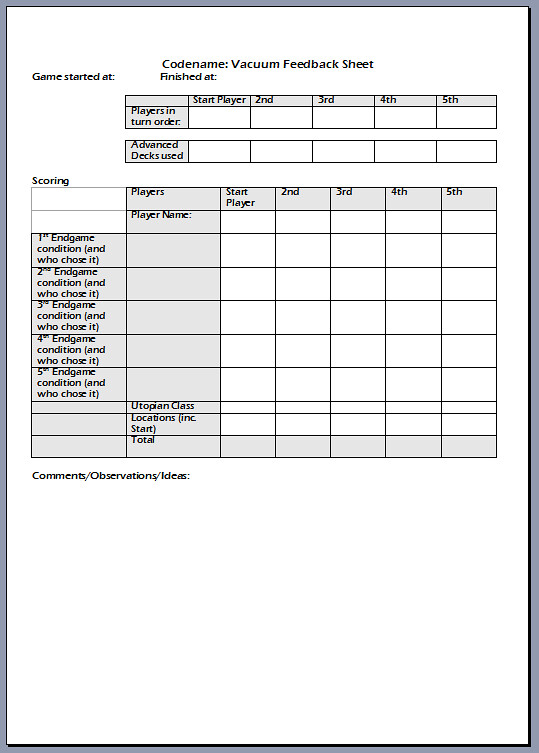
Hopefully, getting my playtesters to fill in one of these will help me find those problems, so I can fix them:


The feedback sheet

Click the image to see a full size one


P.S. Award yourself 10 points if you recognised the Firefly quote in the title!

Monday, March 4

Honestly I'm Not Normally A Deviant, But ...

I'll get to the subject of that provocative title in a minute! Aside: this is my 666th blog post. Make of that what you will.


Just a brief update on progress this week, and a review of my card purchases.


At the beginning of the year I set myself some goals. Seeing as one of them was a deadline for last Thursday, I figured it'd be a good time to take stock of how I'm progressing against those goals. The deadline was to get initial playtest copies out to some close friends who were key Reiver Games playtesters by the end of February. I missed it, but only by a couple of days (I got them ready over the weekend, so they are ready for posting today). It was close, so I'm going to count that as a goal met! The only other goals relevant at this point are the blog ones. So far I'm on track for those too, I've blogged every Monday this year, the page views are above the target of 20,000 views this year and I've two new followers since the start of the year too. All good :-)


Setting the goals has really focussed me, I've worked quite hard the last few weeks to the get playtest copies ready, spending my evenings after The Daughter goes to sleep printing, cutting and collating to get the copies assembled. The biggest stumbling block was the rulebook, which I had to write from scratch in Adobe InDesign since the previous one was written in Microsoft Word, had no examples and was hideously out of date. The last minute change to simplify things that I thought of last week didn't help as that made changes necessary close to the wire.


Still, I consider myself on track so far this year :-)


As another aside, I recently read an article on BGG by Lewis Pulsipher, designer of Britannia among others, stating that to be taken seriously as a designer you need to be working on multiple games at once. One game makes you look like a dilettante apparently. I consider myself focussed, rather than a dilettante, but maybe others feel differently. Anyway, I've a family now and they come first, with limited time available the only way I can make any progress is to focus on a single game.


In other news, in making these prototypes I mentioned above, I've finally got around to using some of that card I bought a couple of weeks ago. I bought it from PaperCutz a supplier I'd not used before, so I thought I'd review the purchase briefly. I've used the card extensively in the prototypes: the box insert, deck dividers, cards and player mats are all printed on and made from the new card.


The prototypes in all their glory

PaperCutz were pretty easy to deal with, I ordered over the internet, the card arrived in a couple of days. The card was fairly well wrapped and then boxed, but regardless both the 300gsm and the 240gsm were slightly dinged on one corner, probably as a result of exuberance on the part of the courier. It's not a problem, since I cut at least 10mm from each edge as part of the construction and I can feed the dinged corner into the printer last so it doesn't throw the printer out of whack, but still slightly disappointing.


I bought 25 sheets of the 300gsm for making box inserts and 250 sheets of the 240gsm for the cards, dividers and player mats. That's enough to make 15 games :-). Or at least it was until I fell in love with the 300gsm stuff. Honestly I'm not normally a deviant, but the silky smooth, unblemished exterior coupled with a firm core that kinks pleasingly when you caress its surface with a craft knife totally got me. I've used it for the box inserts as intended, but also for the dividers and player mats, so now I've enough card to make 3 more games. I need more. I'm going to get another 100 sheets of the A3 300gsm, which I'll use for the dividers and player mats and I'll also get 25 sheets of a more voluptuous SRA3 (a slightly bigger size) for the box inserts. It turns out that I can't do maths to save my life, and the calculation I'd done in my head which lead to the decision that A3 would be big enough for the box inserts was way out. SRA3 isn't big enough! But it's close enough and will do. After those purchases I'll have enough to make another 15 copies - so I should be sorted for the next wave of prototypes in the summer too :-).

Monday, February 25

Why Critical Feedback Is Crucial

As I mentioned a couple of weeks ago, I've finally got round to asking for some structured feedback from the mates who I've been testing Codename: Vacuum on.


I really don't want to be that guy who keeps nagging his mates to play his game that they'd rather pluck their own eyes out with skewers than play. I don't want them playing it to avoid hurting my feelings; I want them playing it if they want to play it.


Playtesting is different to gaming. You play a game that's often crap or broken, each time you play it the rules or components are different, sometimes you have to abandon a game halfway through because it doesn't work and then after all that you're expected to give feedback and constructive criticism. Not all gamers enjoy playtesting - and with good reason.


So the system I came up with to avoid being that guy, was to invite people to play Vacuum with me once. If they wanted to play, they had to email me. If they wanted to play again, they had to email me again. No nagging, no guilt, just helping out if they felt like it and enjoyed it.


Seven of my mates at work are on the Games Night email list (though not all of them come) so I invited them and left it at that. All of them took me up on the offer. Most of them have played between two and five times, a couple only once. Two of them want to play pretty much every week.


What I was most interested in was: why do the five who don't want to play every week not want to play every week? What is it about Codename: Vacuum that has left them feeling cold?


Most of them are Software Engineers like me, so they understand the value of critical feedback. I asked them for answers to a simple questionnaire, and for them to be critical in particular - no sugar-coating!


By far the biggest criticism that came back from everyone was that the learning curve was steep and the wealth of available strategies overwhelming. At the moment the game has five 'standard' decks which you play with every time and ten 'advanced' decks of which you play five per game. Each deck has an end-game scoring condition which represents a valid (though not yet balanced!) strategy. In any one game there are ten available, each time you play half of those change (and in fact for my playtesters, they pretty much all change every time they play as the game evolves).


People are finding it hard to take in the options and judge which ones are strongest for the given combination of available decks. It's bewildering. I understand all the scoring conditions, but then I wrote all the cards and think about them incessantly. My chief playtester Dave has got it (he recently royally owned me in a game!) but he's played it more than ten times. No one else has really.


I guess I had seen this in action most times I've tried the game out, but I'd chalked it up to learning games and beginners confusion without really paying any particular attention to it. Getting these written answers to the questionnaires has really brought it into focus and flagged it up. If you are too overwhelmed the first time you play a game, then there's not much likelihood of you playing it a second time and any hope of a hit game and good sales have gone straight out of the window.


But the concrete feedback has given me something to latch onto, and last week I had an idea in the shower. I going to try only five scoring conditions, one per standard deck. They'll be the same every game, and because there's only five of them, they can be simpler and easier to grok. The advanced decks will still exist, but they'll be there to help you in one or more of the standard scoring conditions.


Thinking about it, this simplification might help with a few other things:


  • forcing players to diversify their decks since the standard scoring conditions are all quite different from each other
  • it should make it easier to balance the game as I only need to consider those five scoring conditions
  • it should also make the multi-player game a bit quicker, since you would play to fewer conditions

Time to try it out and see if it behaves like I expect. I've a playtest session on Monday lunchtime with a couple of mates from work.


Another advantage of coming up with it at this point is that I hope to get copies to my friends in York and Bedford in the next week or so. I can give them both versions (before and after this simplification) and get them to compare and contrast.

Monday, February 18

Rule book

Sooner or later, our children must fly the nest and strike out on their own. My daughter is only six months old so, thankfully, that day is a long way off for her, but for Codename: Vacuum it's much closer. Until now, every single game of it has been played with my copy, with me playing and explaining the rules. As a result, the rulebook has been fairly simplistic, and for the last three months or so, quite out of date.


After 15 months of internal development, it's time for Codename: Vacuum to see the light of day. The first stage of this is to run it by a few of my key playtesters from my Reiver Games days: my friends Paul in York and Terry, Andrew and Graham in Bedford. Knocking up a couple of prototypes isn't too onerous: just a couple of hours per copy. The big difference however is the rulebook. If I'm sending them a copy and they have to play it from the rulebook, then the rulebook has to be:


  • complete
  • up to date
  • well-written
  • comprehensive
  • illustrated
  • with examples

Sadly, until a week or so ago, none of these were true of the Codename: Vacuum rulebook :(. My focus now is on getting it ready, so I can send games complete with rulebooks.


First problem is that writing rules is hard. You need to be both complete, clear and unambiguous and also concise. You need to provide examples of anything that could be unclear, you need to expect that people reading it will get the wrong end of the stick. You need to have good grammar and the whole thing mustn't look like a dictionary.


Sumeria rulebook

Making this visibly aged me


It's really hard. When I ran Reiver Games I had my friend Mal proof-read the rulebooks for me, and I got people to play the games from the rulebook and then tell me what they thought was unclear so I could improve that section. I got more feedback from people who translated the rules into other languages, and still at the end of all that there are plenty of people playing the games wrong or asking for clarification on BGG. And these were simpler games than Codename: Vacuum.


This first draft of the rulebook won't be playtested before the guys down south get their hands on it (they are inadvertently doing the playtesting for me :) ) and it won't be proof-read, which just makes me more paranoid about getting it right. It'll be light on examples and illustrations too, but it's a step in the right direction.


As a general rule I try to structure a rulebook like so:


  • Front cover
  • Inside cover: contents list
  • Exposition: A brief description of the setting and a very high-level overview of the game
  • Aim of the Game: What the players are trying to do to win
  • Setup: How to get ready for a game
  • Play: Rules of the game
  • End of the Game: when it occurs and under what circumstances
  • Scoring: How the winner is determined
  • Acknowledgements: Thanks to playtesters, proof-readers, etc.
  • Credits: Artists, translators, etc.
  • Back cover: Quick rules overview

For Codename: Vacuum I'm thinking of adding a description of all of the decks and cards between the scoring and acknowledgements covering exactly what you can and can't do with them and answering some FAQs.


My aim is to get the playtest copies ready by the end of the month. This week is my quarterly hospital trip which involves four hours on trains, so I should be able to make some progress and maybe even build up a backlog of blog posts. But even with the train trips I've got my work cut out!

Monday, February 11

Stationery Woes

For the last few months I've been making a new prototype of Codename: Vacuum roughly once a month. I'd play the last version a few times, come up with some new ideas to try out and then make those changes on the computer. Then it was time to realise it in physical form. I bought a Canon Pixma iX6550 last year and I've been very pleased with it. When printing cards for games I lay the cards out in a 5x5 grid on a sheet of A3 card. So, clearly, I need some A3 card. Codename: Vacuum is a deck-building game with 350 cards. So I need a lot of card.


For the last few months I've been nipping to Ryman Stationery or Hobbycraft to get more card. They both sell A3 white card in packs of 25, so with the 17 sheets of card per copy of the game, I'm getting through quite a lot of packs! Hobbycraft has been my preferred stockist, their packs are £5 and are 210gsm card - which feels a reasonable thickness and weight for prototype game cards. Ryman's conversely are £6 and only 160gsm which feels cheap and flimsy by comparison.


So why do I ever go to Ryman? Because Hobbycraft are often out of stock - Ryman has been my fallback position if I need card at short notice and Hobbycraft have failed me yet again.


Since I need almost a full pack per game and I'm making roughly a game a monthly, trips to Hobbycraft for the inevitable disappointment of no stock followed by a trip into town to get the flimsy Ryman offering are regularly required.


As I mentioned at the beginning of the year I'm hoping to get playtesting copies to friends this month and more out in the summer - I'm going to be making a lot of copies. It doesn't make sense to continue to buy lots of these little packs when I need sheets a hundred or more at a time.


Time to man up:


The card I ordered online

3 inch thick pile of card! Manly.


I placed an order online with PaperCutz for 250 sheets! I've also gone with a heavier weight than even Hobbycraft sell: 240gsm. Having such a large stock will mean I don't need to keep making these disappointing trips and mean that when I'm ready to make a new copy I've got enough card to print it straight away. I also ordered 25 sheets of really heavy 300gsm card making for box inserts. If you're going to do a job - might as well do it properly :).

Monday, February 4

More Visual Changes

After my very unpopular question for artists a few weeks ago (which nevertheless is now one of my ten most popular posts of all time!) I've been making a few changes to the layout off my own back.


The last version (which was wheeled out for the first time at the beginning of the year) had a few changes to the cards, a few changes to the rules and quite a lot of changes to the design. I'm now working on another version which I hope to get to the table this week (assuming I can find some card on which to print - I went to Hobbycraft to get some more on Saturday and for the second time it was out of stock :( ). This latest version further adds to the graphic design as well as trying out some very new card ideas and trying to streamline the rules a bit.


The first thing I've done on the design front is to try to differentiate between the three levels of strategy card. These levels theoretically correspond to 1900s, 2000s and 2100s technology, so I wanted the cards to have a flavour of that. Previously with the slight exception of a number representing the level in the top-right corner, the cards all looked the same.


Since the game starts in an alternative steampunk universe, I wanted the first set of cards to look steampunky. I'm no artist, so I've kept it simple, just a brass effect in the background of the card:


A boffin card

The Boffin steampunky 1900s card


It would be nice if this was a bit more steampunky, with cogs and leather and copper tubes, but I have to admit my limitations and keep it simple.


Next up are the modern day cards, around 2000s technology. Again, I've tried to keep this simple, I've a clean, modern webpage design in my head as the guideline:


A Consumerism card

The webpage-themed Consumerism card


The latest version, yet to make it into physical form also includes some border art for the futuristic 2100s cards. This is the weakest of the three to my mind, but hopefully feels vaguely futuristic!


An Armada card

A futuristic Armada card


So, you can see why I wanted an artist a few weeks ago - this is not my strong suit! But hopefully, this basic graphic design/border art gives a flavour of the three ages of cards.


I'm also trying to streamline the game a bit with this new version. One of the things that has been in the game for at least six months is that you have to pay upkeep on population above and beyond the basic population that a location comes with when you acquire it. At the end of every turn, you had to pay some coins if you'd settled extra population on any of your location cards. Despite this having been in the rules for ages, and having personally designed the game this was something I kept forgetting to do, let alone my poor playtesters, who also have to cope with a new set of rules and cards every time they play. I've taken it out in this version, in favour of limiting the number of cards you can settle on a location - I figure it's easier to remember a restriction on things you can do at the point you do them, then remember a little thing at the end of every turn for the rest of the game!


In other news, Mal suggested in the comments of the artists post that I approach the design school at the local uni to see if they'd be interested in offering the graphics design of Codename: Vacuum as a degree project. I think it's an excellent idea, now I just need to pull my finger out and get in contact!

Monday, January 28

Tax Return :(

In the UK, when starting your own small company you have a choice between forming a Limited Company (known as Company Name Ltd.) which is a separate legal entity (I assume very similar to the LLC in the US) or you can set up as a self-employed person (either as a sole trader or in a partnership) where the company is actually just yourself earning some money under a trading name.


When I set up Reiver Games back in July 2006, after getting some advice from Business Link, a now defunct government scheme to give free advice to new businesses, I chose the sole trader route - technically, Reiver Games was: Jackson Pope trading as Reiver Games.


Since at the time I was only setting up the business to try and sell 100 copies of Border Reivers that I was going to lovingly craft by hand, I wanted to keep things as cheap as possible. Setting up a limited company required paying someone to incorporate it, and then paying every year for employees liability insurance and to get an accountant to audit your books. All costs I could do without.


Setting up as a sole trader was much easier: open some bank accounts, create a website and tell HMRC (our equivalent of the IRS) that I was now self-employed as well as an employee and job done. As a self-employed person I would also have to start filling in a tax return every year. In the UK if you are just an ordinary wage-slave, paying taxes straight out of your pay cheque every month (PAYE) you don't need to file a tax return, but self-employed people do.


We have to file our tax returns by the end of January the year after the tax year we're filing for. So at the end of this month I have to file a tax return for the tax year from 6th April 2011 to the 5th April 2012. Reiver Games ceased trading in July 2011 and I finally closed all the bank accounts in November 2011, so this is the last time I'll have to file a tax return I hope.


While I was running Reiver Games (especially during the period when I was doing it full-time) I tried to keep on top of doing my books as I went along, then filing a tax return wasn't too onerous: read some numbers of the annual totals and that was pretty much it. Once I went back to work and Reiver Games was clearly going down the pan it was a bit harder to summon the enthusiasm for staying on top of my books, so filing a tax return turned into frantically catching up on the books, then filing a tax return at the last possible minute. It was like that last January and again this year. I've been doing it during the evenings over the last week or two after The Baby had gone to bed and finally finished and submitted it last night. Theoretically, HMRC will notice I've ceased being self-employed and remove the need to fill in a tax return, though they might need some prodding...


Needless to say, on top of the books, I've got pretty much nothing done on Codename: Vacuum the last couple of weeks, but I've still been having lots of ideas to try out. Now these damn books and tax return are out of the way I'll have to give them a whirl.

Monday, January 21

Codename Vacuum: Belatedly Getting Feedback

I had the idea for Codename: Vacuum about fifteen months ago now. It got its first proper play at Games Night during February last year then nothing really until July when I played it with my friend Paul whose Games Night I attended twice a week for most of our five year sojourn in York. Since October last year it's been played at least once a week as I try to iron out the kinks and fix the balance issues.


The first play was, to my mind, disastrous: the game lasted many hours and the play was dragged out by numerous discussions about things that could be changed about it, most of which would have completely changed it, certainly radically altering it from the game I first had (and still have) in mind. The second went much better with my friend Paul who had been one of my key playtesters during my Reiver Games days.


Since then, I've tried to focus on playing the game a lot with friends at work and at Games Night (there is a large overlap between those groups of people). The focus has been on teaching people the game and me personally working out which decks/cards are weak. Every month or so I've printed out a new version of the game incorporating potential fixes to the problems I've found.


Wary of the wealth of wildly restructuring ideas I had at the first public test, I've not been asking my playtesters for much in the way of feedback - I've just been using them as opponents to enable me to test the game and spot potential problems/weaknesses.


Obviously, this is a pants way to proceed, but it got me over the hump of not playing the game and has allowed me to make three or four complete revisions of the game, each of which I think is slightly better than the last. But playtesting is not just for playing the game - it's also for gathering feedback and I've been doing very little of that.


My current playtest crew for Vacuum is a core of four people who seem genuinely keen to play it. Dave has played it getting on for ten times I think, and gives me a good run for my money, winning as many (if not slightly more!) games than I do. The other three have probably played two or three times each, and I don't think any of them have beaten me yet (though I might be remember that wrong!). I'm now asking these core guys for really critical feedback after games in the hope I can use this information to hone the game still further and address the weaknesses of the game as a whole.


Possibly more interesting and useful would be feedback from the five or six people who've played it once or twice and don't seem particularly keen to play it again. What is it about the game that they don't like or do they have any ideas what it is about the game that doesn't excite them? I need to gather that feedback too, but I need to do it without seeming to be pulling them up for their lack of interest. How to do that, I'm not sure yet.


The other thing about my process that's changing is that I'm going from making a new version every month or so to just tweaking a card or a deck and re-print those out for testing. Printing and cutting out a whole new copy is about an hour and a half's work, but I can do a single deck pretty quickly (especially since I changed the form factor of the artwork - why oh why didn't I do that earlier?). It feels like the game is coming on nicely and I'm still having plenty of new card ideas - at this rate it's going to have an expansion's worth before I'm ready to publish/hawk it!


Setting my goals for the year a few weeks ago has really focussed my mind on moving things forward - I'm driven now to get a couple of copies out to my previous gaming groups in York and Bedford (both populated by Reiver Games playtesters!) by the end of February, but before I do that I want to improve the game still further.


I also need to create a rulebook that's complete enough to learn the game from, but time is tight, especially as I have to do a Self-Assessment Tax Return for the last year of Reiver Games before the end of this month :(

Monday, January 14

What's in a Name?

For many years I've been referring to new games by a codename that stands as a working title while the game is in development. It's Alive! was Codename: Monster, Carpe Astra was Codename: Network and Sumeria was Codename: Ancient before their official names were chosen or announced. And now I'm working on Codename: Vacuum.


If I decide to hawk it to publishers, job done, I can send it with the codename, since the publisher will almost certainly want to chose the name (and the artist and tweak the rules) themselves. However, if I decide I self publish again I'll need a real name for it at some point.


I've been toying with a couple of ideas (one of which I posited here to a conspicuous silence!), and it got me thinking about what makes a good game name.


Lots of euro games go for the place name option, e.g.: Goa, Macao, Cuba, Santiago, Puerto Rico; while more themed games chose something a bit more involved: e.g.: Twilight Imperium 3rd Edition, Race for the Galaxy, Space Hulk.


I would want something that gives you a flavour of the game, but it also needs to meet certain criteria:


  • There can't be an existing game with the same or a similar name
  • It's got to Google well
  • Ideally there's not a book/film/computer game with the same name
  • It's got to sound enticing
  • It ought to evoke the gameplay or setting

So Race for the Galaxy is out (taken) and Race for the Solar System is out (too similar). Sol is out (taken by a 2011 game, a forthcoming film plus brings back hundreds of BGG hits). Empire of the Sun is a film and book, Solar Empire is a 2012 game. So you can see there's a lot of competition!


Making up a word works in a lot of ways (it should be unique in the BGG database and should Google well), but it be awkward for searchers to guess the 'correct' spelling, plus it's difficult to evoke the theme, concept or mechanics of a game with a word that by definition doesn't mean anything.


I've been thinking about 'Full Steam to the Stars' or 'Steam to the Stars' for Codename: Vacuum. They both have a few things going for them:


  • No competition: a BGG search of 'steam stars' brings back no hits and Google doesn't find anything with that phrase in the first page
  • They both evoke the Steampunk initial setting of the game and the sci-fi finish with a sense of the transition in between
  • Full Steam gives a hint of the race to ensure that your target victory conditions are ones that get scored

Of course, the downside is that I'm too close to them so I've no idea whether they sound rubbish or not. The name has to be interesting enough that if you saw it on a shelf you'd pick up the box or if you saw it in the BGG Hotness you'd click the link. I'm not sure either of those have that kind of appeal.


For Carpe Astra I ran a BGG competition to choose a name (the winner got a mention in the rules and, I think, a free copy of the game). I could do the same thing here, but it's a bit of a wasted effort if I hawk it to publishers and they call it something else.


What do you all think of (Full) Steam to the Stars? Got any better ideas?

Monday, January 7

Setting Some Goals

It's a time of year traditionally dedicated to proudly proclaiming a set of Resolutions about how you will improve yourself that inevitably fall by the wayside by the end of January as things settle back to normal after your Christmas blowout.


Rather than set myself some New Year's Resolutions in that vein, I've decided instead to set myself some Games Design Goals instead. I'm not promising anything, I'm not changing the way I live my life (no matter how short-lived!), I'm just going to state for the record what I hope to achieve with Codename: Vacuum this year. I might achieve them, I might not, but I'll certainly try and it'll be interesting at the end of the year to look back and see how successful I've been in meeting them.


Creation and Play Goals


My goals are pretty simple for Creation and Play, now I'm back, I'd like to establish myself as a regular blogger again. The aim is to blog once a week on a Monday morning. I expect to miss a few due to holidays and illness/laziness, but I'd like to blog at least 45 times this year. I've hit 60,000 page views for the blog now over its 3 year history of stats. I'd like to get above 80,000 by the end of this year with a few extra followers to boot.


Codename: Vacuum Goals


I'm really pleased with the progress I'm making on Codename: Vacuum, the next stage is to get it out in the world. I'd like to get copies to my previous gaming buddies in York and Bedford by the end of February and then several copies to blind playtesters by the end of May. I hope that I'll be able to incorporate their feedback and have a print-ready game (sans artwork) by the end of November, when I need to decide whether the game is good enough to publish and if it is, what route to take to market.


There's a fair amount or graft needed to reach those goals, but if you don't set yourself something challenging you'll just fanny on interminably. Wish me luck!

Monday, December 31

The Year in Review

2012 has been a momentous year for me in a number of ways. I became a father back in August and that's been very hard work, but also very exciting and great fun already with the promise of lots more fun to come. I moved back to Newcastle at the end of last year so it's been my first full calendar year in Newcastle since 2004 and my first full calendar year in full-time employment with same employer since 2007. We bought a house in March and a car in December. And I visited Canada for the first time. But probably the most relevant thing in this forum is that it was the year I re-kindled my love of Game Design.


Games Design


I had the idea for Codename: Vacuum during a discussion with The Wife during a long car journey at the end of November last year. In just over a year it has gone from concept to a fairly solid prototype (with another almost ready to print), and interestingly it hasn't changed a huge amount. The concept is still the same (though the setting has changed very slightly) and the main mechanics and actions are still as originally envisaged. I'm pleased with how Codename: Vacuum is progressing and hope to get it to a print-ready stage by the end of next year when I'll have to make a decision about whether it's good enough to
proceed with and, if it is, whether to try KickStarter or hawk it to established publishers. Exciting times once again.


Back at the beginning of the year had an idea for a little card game (Codename: Proteome) to make as a conference giveaway from my current employer. After an initial burst of interest in the office this one completely fizzled out. It's a shame but, especially now that I have a daughter to look after, I'm very pushed for time so focussing on a single game is a way to ensure that something gets done rather than negligable progress on half a dozen things.


Finally, in November I had an idea for another game (Codename: Vengeance) which co-incided with NaGaDeMon. It was to be a worker placement/area control game conceptually based on the old Populous computer games. The announcement that Peter Molyneux was going to KickStarter to fund a re-imagining of Populous put paid to that idea too, but silver lining: I've only really got time for one game anyway, so Vacuum benefits from that idea falling by the wayside too.


General Gaming


From a general gaming point of view it's been a surprisingly good year. I've not got to any conventions or trade shows, but I've managed a fairly regular games night that suffered only minimal disruption around the house move and the birth of our daughter. I've played 328 games, a large number of which were on the iPad while travelling for work (I've decided rather arbitrarily that games on an iPad against human opposition count towards BGG play stats). My five and dimes were:


  • 25: No Thanks! - One of our favourite fillers at Games Night
  • 24: Race for the Galaxy - A perennial favourite at Games Night and with The Wife
  • 23: Ingenious - All played on the iPad with Mal on our trip to Denmark
  • 22: Codename: Vacuum - Getting somewhere with this
  • 22: 7 Wonders - Still loving this, simple and quick, but still interesting
  • 15: Carcassonne - One of my favourite games for nearly 10 years
  • 15: The Resistance - Battlestar Galactica, but playable in an hour - awesome!
  • 13: 11 nimmt! - Popular at Games Night
  • 13: Hey, That's My Fish! - Mostly on the iPad on planes to and from Vancouver
  • 11: Hol's der Geier - I'm loving this very simple, yet devious, filler
  • 10: Stone Age - Popular at Games Night and with The Wife
  • 9: 6 Nimmt! - Another Games Night filler
  • 7: Ave Caesar - Vicious and quick race game
  • 7: For Sale - Another Games Night filler
  • 7: Guess Who? - With my niece over Christmas
  • 6: Army of Frogs - All on the iPad
  • 6: Coloretto - Bought in Vancouver at Starlit Citadel
  • 5: Guillotine - Bought in Vancouver at Starlit Citadel
  • 5: Lords of Waterdeep - Very popular worker placement lite game with a D&D theme
  • 5: Lost Cities - Huh? I don't remember playing that 5 times!
  • 5: Thunderstone - much prefer this to Dominion, themed up to the nines (and I've a boatload of expansions)

With the bigger house and my own Games Night for the first time, I've bought quite a lot of games this year: Coloretto and Guillotine in Canada, Cleopatra and the Society of Architects, Clans, Tigris and Euphrates and El Grande cheap from a friend plus: The Resistance, K2, Hansa Teutonica, Village and Divinare. I've also bought Army of Frogs, Ingenious and Through the Desert on the iPad. A disappointing number of the real games have yet to hit the table.


Blogging


After the fallout of Reiver Games, my blog had slowly withered and died over the last couple of years. I started it back up last November after having the idea that became Codename: Vacuum. I posted a few times through January and February, and then it went quiet again during and after our house move. I started it up again in August (the week before my daughter was born) and have been posting pretty much weekly ever since. I've managed 27 posts this year, including one that was picked up by BoardGameGeek News and then Reddit and went on to become my second most read post ever. That month (October) went on to become my month with the most page views ever, eclipsing the early days of my blog. Of course, after the Reddit storm died down page views are back to normal, but still ticking over nicely. My most popular posts this year have been:


Here's hoping that next year will be as good! Until then, Happy New Year!

Monday, December 24

Merry Christmas

Just a short one today to wish you all Merry Christmas and a Happy New Year. Thanks for taking the time to read my blog and get involved in the discussion, there'll be one final post before the end of the year and then normal service will hopefully resume in the New Year.

Monday, December 17

Artists! How does this sound?

If you've been reading my blog over the last few months you'll be keenly aware that the one thing Codename: Vacuum is missing is art. The cards have some rudimentary graphic design done, but no illustrations whatsoever.


Card lacking artwork
Needs some artistic love, methinks.

The main reason behind this is that while I have limited graphic design skills, I have no art skills and at the moment my money is going on tiny clothes and nappies rather than hiring artists. Having said that, it would be great to have some art on the game before I send it out for playtesting. How do I reconcile these two positions?


I've been considering that question for a while now. I mentioned it to my Dad when he was up a few weeks ago (he's a retired art teacher and artist, though in a completely different style) and he started sketching out a few things. In addition, an old friend from junior school offered to help, but he's a professional animator and has a young family and needs to focus on earning a living not helping out a mate he's not seen in 25 years for free. So what to do?


I've had a slightly bizarre idea over the last couple of days, and I've no idea how it sounds so I'm going to run it past you guys to get some feedback before I actually try to implement it. So what's the idea I hear you ask?


I get aspiring board game artists to do it for me for free!


And there's my problem. How much of an exploitative arse do I sound about now? I'm thinking an unacceptable amount. But maybe not. I'll flesh out my idea, and then you can let me know in the comments whether I sound like an arse or not.


The problem of no art is compounded by the fact that I need a lot of it. I need:


  • A card back design
  • 50 location designs
  • 7 location back designs
  • 65 card front designs

That's an enormous job for one person, especially when I can't afford to pay them, so finding people to share out the work between would be a more realistic way to go. But I don't know many arty types, and certainly not enough to get that amount of art done for free out of personal goodwill.


Clearly, I would need to offer these generous hypothetical artists something in return for their hard work, even if it can't be real folding money. Otherwise I'd appear like an arse and I'd end up with an unenviable reputation and still no art.


So the idea I've been tossing around in my head is this:


I post on BGG a list of all the art I'm looking for and ask for aspiring board game artists to knock something up for some of those briefs for free. In return, they would get: an artist credit on the card(s) they've illustrated and a link to their portfolio in the rulebook. I'd also do artist profiles here on Creation and Play of the artists whose submitted work I most admire.


I'm hoping at some point to get Codename: Vacuum into print. If that never happens (a reasonable risk), then that would be the end of it. But if I decided to hawk it to other publishers then the artist's work and their portfolio link would go to those publishers in the setting of a real game. Alternatively, I might decide to try to KickStart it myself, in which case the artists whose work I like the best would stand a reasonable chance of getting their art into the finished game, and more importantly, I'd be paying them for it at that point (the KickStarter budget would include paying for art). If I end up publishing the game myself, I would only use art submitted for the prototype with the artist's permission if we could agree a price that I would pay them for it.


What do you think? Does that sound like a promising idea? An exploitative idea? An idea which is extremely unlikely to work?

Monday, December 10

Codename Vacuum Reaches Second Country!

Until recently, all the games of Codename: Vacuum that have ever been played were either at my house or at work. The game has never been played without me, and never outside Newcastle.


At some point, if I'm serious about getting it to market, it will have to spread its wings and fly the nest - it'll need to be played by other people, in other countries, by playtesters who have never met me and won't be biased by friendship with me when they come to give feedback.


It's been a quiet week or so, I went to Denmark with work last week (and missed Games Night) and we had our office Christmas party this week (on Games Night) so I've not played games much at home. In addition, we've a visit from my parents and I've had a couple of hospital trips this week and my main Vacuum playtester has gone to Australia for three weeks and so there hasn't been much time or opportunity for games at work either.


But despite all this, Vacuum reached an interesting milestone of sorts last week. It was played in a different country! The Denmark trip was with Mal, a friend of old who was my main Border Reivers playtester, so I took Vacuum (along with several smaller games and a few on my iPad) to while away the time we were spending travelling. Vacuum takes up a fair amount of space, so we couldn't play it on a plane, a train or in an airport waiting lounge, but we did find ourselves last Friday in a bar in Schiphol airport in Amsterdam with five hours to kill. So out came Vacuum (which Mal had only played once several months ago) and I proceeded to teach it to him again. We ended up playing a couple of games, while drinking very pleasant Belgian beers. The first game took a good hour and a half if not slightly more, the second was definitely less than half an hour!


Photographic evidence

Obviously, this isn't getting the game playtested in other countries by people unknown to me, but it felt like a milestone none the less. I've got a list of a few playtesters set up for when Vacuum is a bit more stable - but I don't want to send it out while it's still changing rapidly, because that shows that the game isn't yet good enough in my mind, so there's not much point in investing a lot of time and energy in sending out copies to other people who are also unlikely to think it's good enough.


Things are getting back on track now though, Games Night should be back on for the next couple of weeks in the run up to Christmas, and I've a three-player game of Vacuum lined up one lunchtime next week. I also need to find some time at home to concentrate on getting the layout done for the new version of Vacuum so that I've got something to test in the New Year.


I'd really like to get Vacuum stable enough by the end of March to send out playtest copies - so I've got my work cut out!

Monday, December 3

Design Lag

As I mentioned last week, I'm converting the art from A3 pages to card size ones. As part of that, I have to admit to myself that I'm actually creating a new version at the same time. It started out as some layout/design improvements, then a couple of card tweaks crept in, based on playing the new version several times during lunch break at work and at Games Night. As I get more plays of the newest version under my belt, I'm thinking of other things I could be adding, which cards/decks are weak and could do with improvements, which cards could be changed to better fit their theming, etc. I've now got to the point where almost every card will change in some way, again.


In the dim, distant past, before I became a father, I would knock up a new prototype whenever I had a new idea, so the cycle would be pretty much: play the game once, have an idea, make a new prototype, play it once, have an idea, make a new prototype, etc.


Now I want to spend my free time with my family, especially my daughter who I only get to see in the evenings and on weekends. But I also want to make progress on Codename: Vacuum. It takes time to do the card changes required when I have a new idea, and more time to print them out and cut them out. Probably about four or five hours in total and this time it's taking even longer due to the time required to change the document page size and re-layout all the cards.


I fit in making new versions when I've a bit of time when The Wife and The Daughter are asleep, usually early in the morning while I have my breakfast, but as you can imagine it takes several weeks for this time to add up to the several hours I need for a new version of the game. So new versions of the game are several weeks apart.


Of course, I'm still having ideas at the same rate - a few every time I play the game and I'm playing the game two or three times a week. So the ideas are stacking up. I'm going to call that 'design lag'.


As with anything, this has its pros and cons. To my mind the benefits are:


  • I spend less time making prototypes that are only played once
  • I get a good feel for the strengths and weaknesses of a version from 5-10 plays of it
  • I don't rush to snap decisions based on a single bad experience
  • New versions feel quite different, often like a big step forward

However, I think these are the downsides:


  • I get to play a version that's got a particular problem several times, aware that I have a potential solution in my head/in my notes
  • It's frustrating to have to wait a few weeks to find out if a potential fix works, or not
  • I don't get to test changes in isolation which makes it difficult to find root causes to problems

On balance, I think the design lag I'm currently experiencing is a good thing. I'm focused on testing things not making new things all the time, and each version is more thoroughly tested as a result. Plus, it frees up time for important things like spending time with my family and trivial things like blogging.


One final thing. Codename: Vacuum is just that, a nickname to describe the game while I think of a real name for it. It's a game that conceptually charts 200 years of history, starting in a steampunk alternative universe circa 1900 to approximately 2100. How does: "Full Steam to the Stars" sound? Thoughts? Surely someone has got a better idea?

Monday, November 26

Changing Form Factor

In the early stages of making cards for a game I do the art on A3 sheets of paper, with the cards in a 5 x 5 grid. I've got a blank document ready in Adobe InDesign which already has all the document guides to line things up to and the cutting guides ready prepared on a separate layer.


Having the document with A3 print size is convenient for printing, and works fine at the beginning when the card count and mix is changing regularly, but once things start to settle down it is good to move to a new format.


For Carpe Astra and Sumeria I got the printing done by LudoFact one of Germany's big games printers. They want to receive the cards as a print quality PDF or PostScript file, with one card per page, each page the size of the cards themselves. So I had to make a document where the page size was 56mm x 87mm (a standard card size, apparently). This is actually pretty convenient for doing the rulebook too, as it's easy to place a page of another InDesign document as a graphic in a document, so I could place page 40 of the cards document to get a particular card for illustrating an example.


A single card as a document page

Switching to the smaller form factor too early makes thing awkward as you now have two documents to update before printing: Make the changes to the single cards document and then go to the A3 print document, update the links and delete pages and re-add them to make the changes to the card counts. But once the card balance is steady it's not bad at all. All you need to do is open the A3 print document, update the links to the modified single card-per-page document and then click print. In fact, in some ways it makes things slightly easier, as while working in the A3 print document I keep the cutting guides layer hidden so that I don't accidentally drag some of the cutting guides around with the card art. On at least two occasions I've forgotten to show the cutting guides again before printing, which means I need to either mark the guides on with pencil (a real arse when there's 36 of them per page and 14 pages) or print it again and waste loads of card. Having them separate means that I'll no longer be doing anything in the A3 document, so I can leave them permanently enabled.


Of course, seeing as I'm moving things around, I'm taking this chance to tweak a few of the cards again and do a little bit more layout/pictography improvement too. Barely a week goes by without me making some small changes to the game. Fortunately, I'm not thinking of backing out the bigger changes between my current version and the previous one - just improving the balance of some of the weaker sets of cards.


The next step after changing the size of the document and getting the print document to link to the new one is to do a proper rulebook. Initially the rulebook was just a set of notes for me. The current rulebook is a complete description of the (previous version of the) game (but without examples or any illustrations/clarification). I need to update the rulebook to the new rules and get it into a finished enough state that people can learn the game blind from it. Then I hope to send it to a couple of my previous gaming groups (which obviously requires making a couple of extra copies) and possibly to some of my far-flung Reiver Games playtesters (or I might wait for that until I've incorporated feedback from my ex-gaming chums).


The other advantage of the single-card per page version is that it allows me to set up an A4 print document that's easy to keep in sync as things change so that I can provide print-and-play copies to selected others (seeing as most people don't have an A3 printer).

Monday, November 19

(Lack of) Art in Prototypes

A couple of weeks ago, I posted some pictures of a few cards from the last three versions of Codename: Vacuum. The pictures showed small incremental changes to the cards over time with functionality disappearing to later reappear, or subtly changing over time.


But what was probably most noticable about all three versions was the lack of artwork. The cards were 90% white. Why the lack of art?


Art-free prototype cards
The name's Bland, James Bland

It's a combination of reasons, but the most relevant is that I don't have the skills, and nor do any of my gaming buddies in Newcastle. I enjoy doing the layout and pictography, but I just can't draw to any reasonably level. I could download some vaguely relevant clip art from the internet, but I'm not a fan of copyright infringement and for a lot of the cards I have a pretty good idea in my head what they should look like, and finding those images through a Google search would take days - time I don't have to spare.


For some designers, doing the art is as much a part of the game design as coming up with the rules and components, but not for me. Nor do I have anyone who can do the art for me as a favour or for fun.


As a workaround I could rustle up some home-drawn crappy art, but I figure that would look worse than none at all - at least a compelling name and a blank page will conjure up a picture in the players' mind's eyes, whereas a badly drawn and coloured picture that would cause my dad to disown me (he's an artist and retired art teacher, though sadly not in a relevant style) would just turn the players' stomachs.


I could get someone with the chops to do the art for me, but there's a lot required, and I don't have the funds to pay someone for that work (my money's going on nappies at the moment). I can't expect an artist to work for free, or for the promise of future funds if I publish the game because that's not fair to them - especially as the game may never get published and they may never get paid or get to see their art get published. I don't mind working for free for something I'm passionate about (as evidenced by five years of running Reiver Games), but I can't expect the same from others.


So Codename: Vacuum languishes in its stark, white beauty. I've had a chat on Twitter with an old friend from my childhood who I've got in contact with again recently, he's a professional animator (and hence artist) and has offered to lend a hand in his limited free time, but again, I don't want to abuse his generosity - he has a family to support too.


It's important to get art in there before phase 3: i.e. testing and blind testing in front of real gamers.


Something else to think about is:


  • if the game ever reaches a 'finished' state
  • and, if it meets the required levels of awesomeness
  • and, if I decide to self-publish it
  • and, if I decide to use KickStarter or IndieGoGo to raise the funds for that

I'll need at least some teaser art before I start the campaign to raise the funds, I'm sure seeing awesome art on the KickStarter page helps people to decide to part with their hard-earned dough.

Monday, November 12

The Reddit Effect

I've been running this blog since February 2006 when I started to gear up towards self-publishing my first game: Border Reivers. Since then, I (and my fellow bloggers during the community blog phase) have notched up over 650 posts.


However, I've only got blogger analytics stats going back to early 2008. During those four years, the blog has had around 2,000 page views a month on average. Recently it's been lower than that (there was a year or so during which I only posted twice, after the death of Reiver Games) and once it got as high as 3,400 hits in a month (when, bizarrely, www.microsoft.ca linked to it!). My posts have generally been fairly quiet: only three have broken 500 page views with one (linked by Microsoft!) over 3,000 views.


Since I can only assume the Microsoft thingy was a typo on their site, I never imagined I'd be getting back to those heady heights of popularity again, my goal for last month was to hit the 1,800 views that I'd had the month before and to try to post weekly. Then I wrote this post about what worked and what didn't with Reiver Games. It's fairly innocuous, I think you'll agree, but W. Eric Martin felt it was worth of a link on the Board Game News section of BoardGameGeek. Off the back of that link I had 500 (yes 500!) views of that page in a single day, shunting it immediately into my top three posts of all time. The month was looking pretty good too, with nearly a thousand views in the first few days.


But that was nothing. Someone decided they liked it enough to post it to the Reddit sub-reddit on board games the next day. That day I got over 2,000 views on that one page, almost all of them coming from Reddit. That page is now firmly ensconced in second place among my most popular posts and last month leapt to my most popular month of all time with 4,700 views.


Page views graph for October

When I started this blog it was to publicise Border Reivers, and then after the community phase I ran as a marketing tool for Reiver Games. In neither capacity was it particularly successful, but I'm still learning what it takes to attract traffic. Of course, now I'm not using it for anything really, more as a vanity project to record my new design efforts and to (hopefully) provide useful information for people who are considering or have just started setting up a publishing company. I've not got anything to sell or a company of my own to promote.


Getting links from the likes of Reddit can really transform the reach of your blog (if only for the one post that was posted to Reddit), so if I was trying to sell something, getting the attention of Reddit would be something I'd be trying hard to push.


Clearly, this is an anomaly, and my page views will be back to a pedestrian 2,000 or so a month from now on, but I hope some people who found the blog through BGN or Reddit liked it enough to carry on reading...