Monday, November 12

The Reddit Effect

I've been running this blog since February 2006 when I started to gear up towards self-publishing my first game: Border Reivers. Since then, I (and my fellow bloggers during the community blog phase) have notched up over 650 posts.


However, I've only got blogger analytics stats going back to early 2008. During those four years, the blog has had around 2,000 page views a month on average. Recently it's been lower than that (there was a year or so during which I only posted twice, after the death of Reiver Games) and once it got as high as 3,400 hits in a month (when, bizarrely, www.microsoft.ca linked to it!). My posts have generally been fairly quiet: only three have broken 500 page views with one (linked by Microsoft!) over 3,000 views.


Since I can only assume the Microsoft thingy was a typo on their site, I never imagined I'd be getting back to those heady heights of popularity again, my goal for last month was to hit the 1,800 views that I'd had the month before and to try to post weekly. Then I wrote this post about what worked and what didn't with Reiver Games. It's fairly innocuous, I think you'll agree, but W. Eric Martin felt it was worth of a link on the Board Game News section of BoardGameGeek. Off the back of that link I had 500 (yes 500!) views of that page in a single day, shunting it immediately into my top three posts of all time. The month was looking pretty good too, with nearly a thousand views in the first few days.


But that was nothing. Someone decided they liked it enough to post it to the Reddit sub-reddit on board games the next day. That day I got over 2,000 views on that one page, almost all of them coming from Reddit. That page is now firmly ensconced in second place among my most popular posts and last month leapt to my most popular month of all time with 4,700 views.


Page views graph for October

When I started this blog it was to publicise Border Reivers, and then after the community phase I ran as a marketing tool for Reiver Games. In neither capacity was it particularly successful, but I'm still learning what it takes to attract traffic. Of course, now I'm not using it for anything really, more as a vanity project to record my new design efforts and to (hopefully) provide useful information for people who are considering or have just started setting up a publishing company. I've not got anything to sell or a company of my own to promote.


Getting links from the likes of Reddit can really transform the reach of your blog (if only for the one post that was posted to Reddit), so if I was trying to sell something, getting the attention of Reddit would be something I'd be trying hard to push.


Clearly, this is an anomaly, and my page views will be back to a pedestrian 2,000 or so a month from now on, but I hope some people who found the blog through BGN or Reddit liked it enough to carry on reading...

Monday, November 5

Codename: Vacuum Shaping Up

As I mentioned last week, I've finally got into the habit of playing lots of Codename: Vacuum.


Initially when creating a new game, I playtest solo (pretending to be two or more players), until I'm fairly sure I have something that could charitably be called a game. I don't enjoy this phase: for me, gaming is a social pastime, a way of spending some time with your friends. Sitting in a room pretending to be Jack, then Jacques, then Jaime and finally Jackie, before pretending to be Jack again, all the while knowing exactly what cards everyone has and what strategies they are all pursuing is not my idea of a fun evening in. But by the same token, I don't want to trot out some total crap that I've not even tested with anyone else in case they disown me and start blanking me in the street - a prototype has to at the very least work as a concept before I try it out with other people.


So then I start playing it with friends, or a dedicated cadre of hardened playtesters. They either like me, or enjoy playtesting (or, conceivably, both) and so are willing to cut me some slack if the game is a bit weak. Which it will be. But the only way to find out what the weaknesses are is to test it, and that's what friends are for. As you play it a bit more with other people who try different strategies and have different ideas you find out the flaws and have a chance to fix them. The game goes through more iterations, some better, some worse, but hopefully on an upward trend.


Eventually you are going to want to trot it out in front of real gamers, to get an idea of whether you game is awesome. If it's not, it's back to the drawing board, there's a boat load of mediocre games out there, and KickStarter has just lowered the hurdles to publishing, so it's easier to get a game to market than ever before. You don't want to be one of the dregs, you want to be one of the cream. At this stage your game still won't be awesome yet, but it has to pique enough people's interest to warrant further investment. Gamers playtesting your game have to at least see the potential awesome, otherwise they won't bother playtesting it instead of playing this week's new release. The sooner the game is in front of real gamers the better, but, if you do it too soon, instead of the word on the street being 'I playtested that, it was neat, and it's probably even better now' it'll be 'I playtested that last year, what a dreadful, boring, totally unbalanced waste of time'. Word of mouth is great as long as it's in your favour, so you have to time the exposure right.


Codename: Vacuum is currently still firmly in Phase 2. I'm playing it regularly with friends to work out the kinks before it hits the real test in Phase 3. But there's already some information available:


Good

  • Thematically it fits together nicely, the cards make sense and I like the Steampunk to Sci-Fi transition. People get excited when they see certain cards, which is great.
  • It's a working game. You can play it with a strategy in mind from the start and there's plenty of strategies available. You have to interact with your opponents and modify your strategies to respond to them.
  • It's fairly quick, two player learning games are taking 45-70 minutes and three player games once we've all played it at least once are coming in around an hour.
  • It works across the player range. I wanted it to be 2-5 players, and having now played it with 5 players, I know it works across the whole range.

Bad

  • The game is still a bit longer than I'd like, ideally it would be playable in under an hour and around 30 minutes if you've a lot of experience.
  • There's a trade mechanism in the game, but it only really makes sense if you're trading with yourself (or at a push between yourself and the neutral player), I'd like it to be a more inter-player thing, but that will probably slow things down further.
  • It's still hideously unbalanced, and will remain so through the next several iterations I imagine as I make fairly sweeping changes between versions.
  • One of the cool things about Dominion is trying to work out which combos of cards from the set you're playing with this time will be the most powerful, having something like that feeling in Vacuum would be really cool. It doesn't have it yet.


In slightly better news, I've got a new version now, it's mainly addressing balance issues I've found so far, but it will inevitably introduce some more of its own. In addition to finding and fixing those, the other things I still need to work on are a more interactive trade mechanism and reducing the game length.


In starting to run before you can walk news, I'm now rather optimistically starting to think about how I can get the game to market (if I can get it into a great enough state). There's some small publisher interest or I could tout it to the big guys or even go it alone via KickStarter. I need to get it finished first though!

Monday, October 29

My Gaming in Newcastle

Eleven years ago this month, The Wife (then The Affianced) and I moved to Newcastle upon Tyne in the north east of England. The Affianced went off to University again and I started working with my current employer.


At the time, I wasn't in to boardgames (I know, hard to imagine, considering how obsessed I am with them now!), instead, in my spare time, I wrote bits of computer games. All that changed eventually, when I started designing my first game: Border Reivers.


There's only so much fun you can have playtesting a board game by yourself, so I enlisted friends from work to try it out so I could work out what worked and what didn't and tweak it accordingly. I chose the theme (and the name of my company) from local history and Newcastle became a favourite city of ours.


However, we move around a lot and three years almost to the day after moving to Newcastle, we found ourselves heading south to York where I joined Beyond Monopoly and made friends through gaming for the first time. York is only 100 miles south of Newcastle, and for the first year we lived in York I continued working for the same company, three days a week at home and two days a week up in Newcastle. I made some great mates at my employer and even after I got a job a bit nearer to home in York I remained in contact with them, occasionally hosting events in York or heading up to Newcastle for a weekend.


With gaming now such a large part of my life I introduced my friends in Newcastle to other games and frequently playtested games with them, and in fact when I decided to attend Essen for the first time, Mal (the world's second most capped Border Reivers player, and Reiver Games proof-reader extraordinaire) came out with me.


After four years in York it was time to move on again, this time another 150 miles further south to near Bedford, where again I made my friends through my passion for gaming. Newcastle was a four hour drive away now, but we still popped up a couple of times, and Mal made a couple of trips down.


By this point I'd been running Reiver Games as a full-time concern for two years and it was clear that it wasn't going anywhere, so I was looking for paid work again. I was looking for work as a Software Engineer as it was the only thing I knew how to do, but I was a bit rusty after three years out of the business and I was struggling to find work. I contacted the guys I had worked with in Newcastle for four years, five years previously and they agreed to take me back four days a week one summer as a contractor to get some recent experience on my CV. It was not like starting a new job at all, more like coming home! Most of the same people worked there (in fact there was only one face I didn't recognise on my first day!). After that summer, I found a job down south that didn't excite me, so The Wife and I decided it was time to stop saying 'It would be nice to live in Newcastle again' and actually do it instead, so I contacted my old employer again and they offered me employment there for the third time.


View of the Tyne at Newcastle by Wilka
Photo via Wilka again

It took The Wife a couple more months to work out her notice down south, so there was a couple of months where I was camping inside the rental place we'd let for while we found a nice house to buy. I had an empty house with no furniture and very few belongings to myself during the week, so I made sure to take up several of my favourite games and with some collapsible chairs and a folding camping table, set up my own Games Night for the first time (previously I'd always had mates with larger collections than me, and just gamed at their houses).


I invited several of my friends from work and some ex-colleagues, and Gareth who ran Newcastle Gamers. To begin with it was just Mal and I, but slowly more people became interested and it has now grown to the point that we regularly have six or seven attendees and once we had ten! (that camping table comes in handy again most weeks!). Pretty much all the attendees are either friends from work, old friends who used to work there or partners of people who still work or used to work there - my gaming life revolves around the only employer I've ever had in Newcastle.


Why is all this relevant? It's not really, but I've been working on a new game idea for a year or so and was having difficulty finding the time to get it to the table (more so, now that I have a two month old daughter). I'd been avoiding getting it to the table at Games Night for fear of spoiling people's fun with a crappy half-arsed game. Then it struck me: I'm at work all day every day as are half the attendees of Games Night. Let's put them to work! So I invited them to join me of a lunch time for a game of Codename: Vacuum. I've played it 5 times over the last few weeks and still have more games booked up in the future. I've had to limit myself to one or two games a week so that it doesn't knacker my hours too much (a game at the moment lasts around an hour either for me and a newbie or three players with at least one game behind them). This is working really well, a great chance to play regularly and build up the information I need before I can make the next version (which is nearly ready!). Long may it continue.

Monday, October 22

Essen

The end of last week saw the yearly Spiel trade show in Essen, Germany. Over 4 days 150,000 people descend on the Ruhr valley to see the latest releases from the world's game companies. Held in an enormous convention centre, the show fills 9 of the 12 halls with booths ranging from the glitzy, spacious efforts of the largest German publishers at the front down to small, unbranded stalls of guys trying to flog copies of their hand-made game at the back.


Wandering the halls you can buy (for cash only usually) the latest games, hot off the presses as well as play the games and often meet the designers, artists and gaming luminaries who wander the halls between meetings.


The show is very busy, especially on the weekend - the front halls can be literally elbow-to-elbow at times - but it's still a great way to try out a bunch of new games before all your friends get them (or they go out of print briefly!).


I have no intention of visiting the show as a punter - I don't buy enough games to make the trip to Germany worth it, especially as I can buy the games in the UK shortly afterwards at a similar price, however I did enjoy attending twice as a publisher while I ran Reiver Games.


I thought it might be interesting to share what I learnt about attending Essen as a publisher.


Both years I had the same booth in Hall 4 where the smaller publishers hang out. I had 10 square metres (5 metres wide by 2 metres deep) with 9 metres of plain white walls on three of the sides. I paid for a carpet and the hire of tables and chairs (which are all pretty expensive from the venue - I saw some guys opposite from me in the second year nip to Ikea, buy cheap tables and chairs and they even sold them on at the end of the show to another exhibitor!).


Me at Spiel 09

In 2008, I shared half my stand with Peter and Melchior of Geode Games, in the second year they had moved next door to a stand of their own. Both years I had three tables at the front of the stand with a wall of games in shipping cartons along the back - I got several games out of the shipping cartons and faced them out along the top so that people walking past could see what it was I was selling and I had games easily accessible in case of a sale. It sounds obvious, but you need somewhere to be able to play your games: get (or bring) some tables and chairs.


Both times I took three friends to help out, in 2008 Duncan, his wife Lucy and Mal joined me (and in fact Dunk drove) on the ferry from Hull to Rotterdam and in 2009 Dunk, Lucy, Andrew and I flew to Dortmund or Düsseldorf and then got the train to Essen. Seeing as they were friends attending purely out of good will, I paid for the ferry/flights and their accommodation (both times in Apparthaus Arosa self-catering apartments). Four people sounds like a lot, but if you've got three tables of gaming it means you can have one person explaining on each table and someone selling games/taking cash. Although what we mostly did was let people have some time off. I did the majority of every shift and it's really hard work - if you're getting paid overtime it's not too bad, if you're doing it as a favour for a mate it's a bit much without a break. It also meant that we could have someone leave early and go and cook us some dinner - if you've been flat out from 8:30am to 7pm talking almost non-stop and with very little for lunch, that is worth its weight in gold! I tried to give the others one morning/afternoon in three off, though they didn't always take it!


In the first year I took one pallet's worth (800 games) of It's Alive!, the only game I had at the time. A friend (Dean of Ludorum Games, now sadly also closed) drove my games to Essen in the van he was taking his games in for the bargain price of £50 in petrol money. I sold about 150-200 copies to punters and the remainder to Fred distribution in the US (though I think they sold them on to ACD or Alliance a while later). I came home with 4 copies! The second year I paid £200 to get a couple of pallets shipped there by a local distribution company (500 Sumeria, 500 It's Alive! and 200ish of Carpe Astra) and from what I remember, I sold about 150 Sumeria, 100 It's Alive! and 50ish Carpe Astra. I then had to pay DB Schenker (the distribution company who have a concession at the venue) £400-500 to ship one pallet back. Ouch!


In hindsight, I'd have been better to man-up, hire (or buy cheap) a van and drive it there. Then I'd have been able to take cheaper furniture that I could reuse the next year too, and no crippling return shipping fees.


In my second year I also invested in some plastic banner signs. Two 3 feet wide and 2 feet high with my company logo on for the end panels on the sides so that people walking down the aisle would see them, and one each for my three games (3 feet wide and 4 feet high) with pricing information on for the back wall. Three feet wide banners fit nicely in the one metre wide panels and a couple of S-shaped metal hooks from Ikea over the top of the panels and through the holes in the banners held them securely in place. The banners would have been nicely re-usable had my company not run out of steam by 2010.


So, I think in summary, attending Spiel is expensive for a small publisher, so try to amortize costs as best you can across multiple visits, rather than paying again and again for the same thing each year. I'd also recommend that if you're trying to sell to shops and distributors rather than just directly, that you try to arrange meetings with as many distributors as you can beforehand to tout your wares. Oh, and have a price in mind for shops and distributors who are buying in bulk, they come round with surprising frequency and it's nice to just be able to sort it out without having to pause the game you're playing.

Monday, October 15

A Matter of Taste

Some people like a fine red wine (we'll call them 'wrong uns'), some prefer a warm, ruby ale ('ladies and gentlemen of taste and distinction'). Like everything in life, games are a matter of taste.


Some people like wargames with a rulebook as thick as a grown man's waist, some people like miniature games where the painting is as much part of the game as the combat. Some people like 'Ameritrash' games where the fun comes from beating your opponents to pulp through the medium of your own bodyweight in dice and some people (we'll call them LaGoTaD) like euro-games, where pushing an array of coloured cubes around more efficiently than your opponents is considered a good time.


As a designer, I tend to design games that are the sorts of games I like to play: fairly short euro-games with an occasional dice-fest thrown in for good measure. I thought it might be interesting to discuss my favourite games, what about them I like and how that affects my design.


My Favourite Games


  • Carcassonne:
    Carcassonne was one of my first euro-games and is still one of my favourites. It's fairly quick (~30 mins), the card draw brings randomness so each game is slightly different and there is direct player interaction through trapping meeples and stealing cities and farms from your opponents. A good euro-game sells tens of thousands of copies. Carcassonne has sold millions. It's easy to see why. Weaknesses? Not much, though I suppose there aren't many strategies available.
  • Race for the Galaxy:
    With a cool space theme and quick play time, Race has been a staple of my gaming for years. It's fairly complex to learn (thanks to the pictography) and there's not a huge amount of interaction between players, but there are many strategies available and the simultaneous player actions mean you can play pretty quickly if you know what you're doing.
  • 7 Wonders:
    Another quick game with simultaneous player actions. There's a little trading between players, and the end of age scraps but it's mostly do you own thing again. Several strategies available, but you have to play the cards you're dealt so there's some randomness there and some interaction as you choose which cards to pass on.
  • Thunderstone:
    I was really not excited by Dominion, I found it bland and featureless, but Thunderstone really grabbed me because of the theme and the tighter theme integration. And that's despite a significantly longer play-time. Thunderstone is the only deck-building game in my top five, and doesn't have any simultaneity, which probably contributes to the longer play time. As with many deck-building games, the selection of types of cards has a big effect on the game - it can make it great or painful.
  • Puerto Rico:
    A classic euro-game. Very little downtime between turns (as everybody gets to act on everyone's turn) and an interesting role-selection mechanism. The longer play time means this doesn't get to the table as often as the others.

My Most Played Games (excluding ones I published!)


The games I've played the most is a similar list, but with a couple of notable differences:


  1. Magic: The Gathering is an incredibly addictive card game. Again it has fairly quick game play (~20 mins) and a wealth of strategies (mainly because the manufacturer bring out new cards continuously with new rules). It's got a fun theme and the game is all about direct player interaction - to win you have to crush all your opponents into a fine dust.
  2. Carcassonne
  3. Race for the Galaxy
  4. 7 Wonders
  5. Hive: A very simple (in terms of rules) but engaging 2-player strategy game that feels a little like very quick chess. Terry and I could play this in around 10 minutes, so it was a common filler while waiting for others to arrive at games night when I lived down south.

As you can see there's a few things that tie my lists together: fast play time, multiple paths to victory and some player interaction. How does the current early incarnation of Codename: Vacuum measure up?

Codename: Vacuum

Codename: Vacuum is a deck building card game (similar to Thunderstone) with a tableau element (similar to Race for the Galaxy) and a space theme (again, RftG. I'm aiming to get the play time down to around 30-45 mins for players who know the rules, which has similarities with most of the games on my lists but without simultaneous player actions that might be tricky. So far no-one but me has played it more than once, so every game is a learning game and it's hard to tell how well I'm getting on towards that target. Vacuum has 11 scoring conditions available per game, of which only 1 per player plus 1 are scored in any game. The players choose which conditions will score - so this can vary from game to game (and in fact there are fifteen in total of which only ten are available in any game). So once I've balanced the scoring conditions, multiple paths to victory should be assured. Finally, there is direct player interaction (if you so choose), you can waltz over to your opponent's territories with an armada and capture them. Player interaction often slows things down though as one player stops to think how to respond to an unexpected assault from an opponent. I need to balance my desire for player interaction with my desire for short play time. On that note, I'm trying to think of ways to make the trade actions more interactive between players, but all my ideas so far would slow things down a lot :(.


It's getting to the table a lot now, at least two or three times a week, so hopefully it'll really start to take shape over the next couple of months.

Tuesday, October 9

Getting Codename: Vacuum to the Table

First of all, a quick 'Hi!' to those of you who found this blog through Boardgame News or Reddit and decided to stick around to see what happens next. Welcome! And I hope I prove worthy of your attention :).


Those of you who aren't new however will be aware that despite talking about it a lot, and re-designing bits of it a lot, I haven't actually been playing Codename: Vacuum much at all.


Part of that is because I'm tweaking it at such a prodigious rate that I rarely have a prototype ready to go with all the latest changes I'm considering, and part of it is lack of time, and part of it is lack of opportunity and part of it is probably a lack of commitment on my part.


Since moving back to Newcastle last August I've only made it to the local games club (Newcastle Gamers) twice, and I've not been to been a convention since I used to run Reiver Games a couple of years ago. I nearly made it to Beer and Pretzels last year, but it ended up coinciding with a work trip to Vancouver, and TCAD coincided with the birth of my daughter, so that was out too.


I also used to have a regular playtesting session while I ran Reiver Games, where all the attendees knew that they'd spend their time trying games that might be badly broken. Whereas attendees to my regular Games Night are coming to play real games, so I feel awkward foisting half-finished games on them that might be joyless experiences.


Enough with the lame excuses! Time to pull my finger out. At last week's Games Night a couple of attendees offered to help me playtest Vacuum, so we sat down to a game of it. Again, it took longer than I was hoping, but that included a couple of breaks and me explaining how to set up the game to them while holding a baby! I guess it was around an hour and a half all told. I'd still like it to be comfortably under an hour, but maybe with experienced players that's still a possibility. I've also arranged some plays during lunchtime at work with a couple of friends this week, and one of the guys who played it at last week's Games Night wants to play it again next time, so there's every chance it'll get played four times(!) in a couple of weeks. That's more like it!


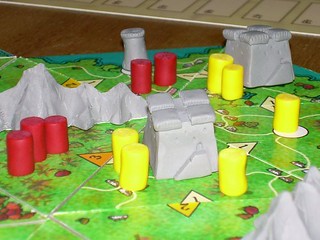
Vacuum in play

Photo via Wilka


Of course, I've already got a bunch of ideas ready from last week's playtest that I'm in the process of incorporating into yet another version. Some things that I put in, and took out are probably going back in (removed to simplify it, back in for thematic purposes and to boost several of the cards) and I'm making a few tweaks to try to encourage more player interaction (by which I mean fighting!). It won't be ready for this week's games though, so I've a chance to try the old version out a few more times and try to confirm my suspicions that these changes are necessary.

Tuesday, October 2

Prototype Decay

It's alright, I'm not talking about prototypes made from raw meat, disappearing ink or short-lived radioisotopes*, but the life-span of components as the prototypes of a game march on.


I recently read a New Scientist story about how truth decays over time (reg. required).


Before Copernicus, everyone knew that the Earth was the centre of the universe. It was a fact. Then, the sun was the centre of the universe. Now we know that we live on an uncharted backwater at the unfashionable end of the Western Spiral Arm of the Milky Way, one of billions of galaxies in the observable universe.


Similarly, there used to be four elements: earth, air, fire and water. Everything was made of those in different quantities. Then there were modern elements, made of indivisible atoms. Then it turned out that you could divide atoms: into protons, neutrons and electrons. But they were indivisible. Now it turns out that protons and neutrons can be divided into quarks. But they are indivisible, honest.


This got me thinking about how the components of a game have a half-life during the prototyping process.


During the prototyping phase components come and go. You try something, sometimes it works, sometimes it doesn't, even the things that work will likely evolve over time. The half-life of a prototype component is related to how many versions of the game you expect it to remain unchanged through. Obviously, this can relate to physical components, rules, designs, keywords, in-game text, even rules.


Through the development of Codename: Vacuum, there have already been lots of changes and it's probably only on it's third or fourth version (I really should keep better track of these things!). Some cards have had superficial changes (the name has changed, for example), others have been completely re-designed. Sometimes I add a keyword to a whole class of cards, that in no way changes what they do, but makes the explanation easier in the rules. But it affects each of those cards, requiring reprinting and cutting out.


The half-life of a component can vary from under one (not likely to survive to the next version), through one (50% chance of making it to the next version) up to a very large number (will remain unchanged through many versions).


Recognising that components have a half-life, and trying to make an educated guess as to what it might be enables you to invest a reasonable amount of time in a component. It doesn't make sense to pay an artist hundreds of pounds to create some art for a card entitled 'Boffin' if the next version of the game has replaced that card with a card entitled 'Calculation Engine' that does exactly the same thing.


As time goes on, the average half-life of your components should increase as the game begins to settle down and the changes between versions become less sweeping. That's why my early prototypes are scribbled on paper, but later ones can include art and hand-made FIMO pieces:


Border Reivers final prototype

At some point in a game's life cycle you've got to get it in front of other gamers, probably by sending it out to volunteers. I've already got people volunteering to try out Codename: Vacuum for me. Using the estimated half-life of prototype components could help you make the decision of when to start that process: if you're going to have to send them new components after every play - it's probably not ready for remote playtesting yet!


* actually, that's given me an idea for a game!

Thursday, September 27

The Changing Face of Codename: Vacuum

As I've mentioned before, when designing a game, you start out with a vision of what you want your game to look and feel like when you play it. You make a prototype (which turns out to be rubbish!) and then start making incremental changes trying to improve the game while keeping in mind your original goals.


My original idea for Codename: Vacuum was a deck-building card game set in space. Over time the theme has been tweaked slightly to being set in a steampunk-esque version of our solar system between the years 1900 and 2100. That's not a big change though, It's Alive! went from collecting different coloured candles to light a Menorah to being about collecting different body parts to build Frankenstein's Monster!


But the game components have changed during that time too. The initial plan was to have a pure card game (like Dominion), but as the game idea was fleshed out in my head I thought it would be good to add some wooden tokens. I added some coins to allow a more interesting trade mechanic, and some 'Explore tokens' to introduce another scoring mechanism/path to victory.


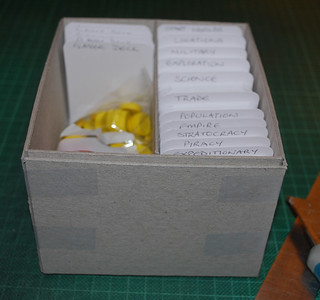
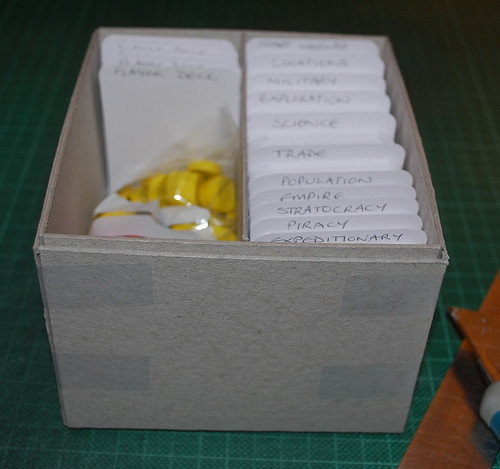
This box for an early version just about fits the cards and wooden bits, but is obviously not designed for getting pride of place on a shop shelf!


Box for my first prototype

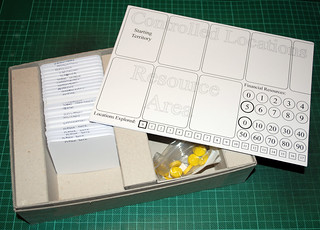
In the latest version that I've just finished assembling over the weekend I've got rid of most of those tokens, and replaced them with with player mats and coin/explore tracks instead. The player mat allows me to reduce the numbers of wooden tokens by quite a lot (reducing cost), but also to justify a large box size (which makes sense for the game as it brings the box size in line with Race for the Galaxy, a game with a similar number of components.


Standard box sizes help for a number of reasons:


  • Cheaper manufacturing - the manufacturers already have all the tools for that size
  • Easier shelving - for gamers and shops alike
  • Expected MSRP - much as I don't like it, people expect a certain price based on the size of the box, not the number of contents, so small boxes rammed with stuff look expensive because they are in a small box compared to a gamer with the same components in a larger box

Also, making a proper size box with a normal looking box insert makes the game feel that much more real :)


New box for my new prototype

My initial plan was to have a turn overview, coin and explore token tracks and spaces for all your cards on the player mat. There's not really enough room for those things without the turn overview though, so that's had to go. Maybe I'll add some turn overview cards instead.


First stab at a player mat - very full!

Friday, September 14

Vacuum: The Inconstant Phase

Codename: Vacuum is the game that is infecting my brain at the moment. It's always at the back of my conscience, thinking of ideas for tweaks, improvements and major changes.


The game is in the early stages where I'm thinking much more about it than I'm playing it so it's not unusual for me to make three or four sets of changes between plays - in some cases they are all changes on the computer before I print it out for testing, in others, no sooner have I printed a copy than I've had another idea and started making another slightly different prototype on the computer before I've even had a chance to play the copy I've just printed and cut out!


What am I hoping to achieve with all these changes?


  • Fun! The game should be a fun experience to play. There should be interesting decisions at every turn, the chance to surprise or stiff you opponents and a enough randomness and luck that it doesn't feel dry and samey.
  • Fast! I want to game to have a similar play time to Race for the Galaxy, i.e. experienced players can play it in around half an hour.
  • Consistent: I want the game to be easy to learn and easy to play because things make sense, the various bits of the game are consistent with each other - the rules aren't a mess of special cases and exceptions.
  • Well themed: The theme is consistent with itself and the game works with respect to its theme.
  • Streamlined: The game is as simple as it can be while maintaining an interesting challenge and great experience.

Obviously, you don't start with something that perfectly meets those criteria, you starts with something that captures an idea in your head, and then through multiple tests, feedback and iterative changes you move that initial version towards a final game that meets those criteria.


When making changes you need to hold that initial idea of how you want the game to work in your head and then tweak the current version incorporating the playtest experiences and feedback using those criteria as yardsticks: if I make this change will it make it faster? Or slower? Does it improve the consistency? Would this change make it more fun? Sometimes you'll have an idea that improves it against one of the criteria but makes it worse against another. Is it acceptable to streamline the game if it reduces consistency slightly? It depends, but you've got to make that call on all the ideas you have.


So what is the overall idea that is driving Codename: Vacuum development? I wanted to make a game that plays in around 30 mins with experienced players. I wanted a deck-building game with a tableau element (like Race for the Galaxy) but with direct interaction between players. I wanted a steampunk game that evolves through the passage of time into a proper sci-fi game. I wanted multiple paths to victory.


Sounds like a tall order? I've set the game in a fairly standard steampunk setting (imagine the works of Jules Verne, H.G. Wells, Arthur Conan Doyle and Edgar Rice Burroughs) but unlike the majority of steampunk games there's a passage of time from around 1900 through an alternative modern day to a hundred years in our future). It's set in our solar system, but a solar system with men in the moon, Martians, Jovians and lots of other extra-terrestrials. The game is a deck-building game, but you can play a few cards to your tableau where you can make use of them every turn, driving the shape of your strategy. You can explore the solar system, trade with other players and neutral locations, use your military to attack and claim the neutral locations or those claimed by an opponent and you can research technologies to improve your strengths in various areas. Come the finale, you get to pick from ten scoring cards to determine on which criteria all the players will be scored. As with most deck-building games, there are several sets of cards and you play with a subset of them, so each game will be slightly different depending upon the randomly selected subset chosen for this game.


Hopefully that description piques the interest of a few people and everyone's not sick to the back teeth with deck-building games. In the meantime, I need to keep testing it out and making the tweaks until it's in a position where I can send copies to blind playtesters for the all-important feedback about whether it's worth pursuing.


I also need a name...

Monday, September 3

Reiver Games - An Analysis

As many of you know, I ran a board games publishing company for five years: Reiver Games, from July 2006 to July 2011. I ended up selling off 3,000 games to a liquidator for 12p each, and lost about £8,750 (thankfully of insurance money and not my life savings!). Clearly something when very wrong.


And yet, I managed to sell 5,500 games and the company started off very successfully. So where did it all go so hideously wrong? What would I do differently if I was starting now with the knowledge I've gained the hard way?


After years trying to write tiny bits of computer games and a bad experience with Mighty Empires, I started designing Border Reivers at the end of 2002. I spent a couple of years playtesting it with a close group of not-really-gamer friends then I shelved it, and didn't come back to it until 2006 when I had the idea of forming Reiver Games and seeing if I had what it takes (and Border Reivers had what it takes) to sell a game.


I tried the game with real gamers in York and got pretty good feedback, so I convinced The Wife (using only fast talking and The Dummies Guide To Hypnotism) to let me invest £1,250 of our paltry savings in setting up a company to sell my game. I did all my sums and reckoned I could at a stretch sell 100 copies, and figured that £30 was a reasonable price for a home-made, limited edition game. One year after forming the company I has sold all my stock of Border Reivers, and my bank balance read £2,500 - a 100% ROI! So far, so awesome. During that year, I'd been extensively pimping my game on BGG and had been approached by another designer (actually several other designers, but only one that made the cut) and had decided that I should do a similar home-made, limited edition of his game: It's Alive! With the benefit of hindsight and a lot more gaming experience under my belt at the various cons and games clubs I'd attended, it was clear that Border Reivers wasn't actually a very good game. It's Alive! was a tighter game with much broader appeal (who doesn't love body parts?), so I took another punt and decided to hand-craft 300 copies of It's Alive!


By July 2008 I had sold all of those, and my bank balance read £4,500, nearly another 100% ROI. This was awesome! If I'd stopped there Reiver Games would have been fantastically successful - beyond my wildest dreams.


Then everything changed. During 2007 I'd been diagnosed with Multiple Sclerosis, and despite the treatment I was receiving I felt that my condition was worsening fairly quickly. I had a good job, but wasn't overly enamoured of it, and both The Wife and I were getting fed up with the amount of my 'free' time and holiday allowance I was spending on the company, cutting out and assembling games, checking and responding to emails, doing PR and blog posts and endless trips to Post Offices the UK over. This was not sustainable. Something had to give.


Conveniently, about this time, we checked my life insurance policy, and it turns out the critical illness cover I had taken out covered MS. A few phone calls and forms later, and I was in the frankly bizarre situation of being able to spend my own life insurance payout (without the fear of fraud charges that usually accompanies it!). We paid off the vast majority of our mortgage and (with more fast talking and liberal resorting to The Expert's Guide to Hypnotism) The Wife agreed to invest a chunk of the insurance money in Reiver Games (with another chunk put aside to live off while I had no salary income).


This was a turning point in lots of ways. It's when I started selling to shops, online stores and distributors, when I started getting the games made professionally, when I started attending Spiel in Essen and when the company started to fail.


I was keen that the company take off to the point where it could provide a salary for me and be a genuine job, not an excuse for bumming around. To do that I figured I would have to make and sell a lot of games. While the hand-made games had been a huge success for me, making them was a real chore. I wrecked our coffee table, was frequently cutting my hands and they often ached. Each copy of Border Reivers took 3 hours to assemble, It's Alive! one and a half - and that wasn't counting things and putting them in a box, it was cutting the box and tiles out of 2mm greyboard, folding, gluing, labelling, cutting the cards out and counting and sorting. I didn't fancy doing this day in, day out (plus I'd have ended up with RSI in no time!).


My first mistake was to price It's Alive! Second Edition at the same price as the hand-made edition, rather than the price dictated by the manufacturing cost. The second: getting a loan to publish Carpe Astra that I would spend the next two years paying £330 a month to service. This was compounded by manufacturing too many copies of those games. I made 3,000 It's Alive!, 2,000 Carpe Astra and 3,000 Sumeria. I should have done 2,000, 1,000 and 1,500 respectively - that's what I sold in a sensible time.


I tried to move from being a small hobby publisher with a dedicated, but small, army of fans to being a full-size pro publisher with professionally manufacturer games and sales and distribution channels. And I tried to do it too quickly. If I was a marketing genius, it's conceivable that it could be done, but it was a long shot and I didn't have it in me.


Of course, things have changed since then. KickStarter is a game-changer in the games publishing market, not only has it helped smaller companies like Tasty Minstrel flourish, but even big players like Eggertspiele and Steve Jackson Games have used it recently. It's a great combination of funds raising, market research, pre-order management and just listing a game there gets you loads of advertising to help you attract customers.


Although my first couple of years as a pro publisher were technically profitable, I was making very little money and it was clear that I had way too much inventory left. The loan payments were eroding the money I was getting back from sales and I didn't have enough cash to publish a new game - so, as with most businesses, it was cash-flow that killed me.


In hindsight, what I should have done was a halfway-house. Getting the games made professionally, but in small runs that I could sell directly to gamers and at cons. Going through shops and distributors, while it got me lots more sales, meant I had to make a lot of copies to get the costs low enough to sell to distributors and I had to squeeze my margins to unworkable levels. Maybe a thousand at a time would have been a sweet spot, but without shops and distributors on board even that may have been too many. And, had I waited a couple of years, I should have used KickStarter!

Thursday, August 30

Distractions!

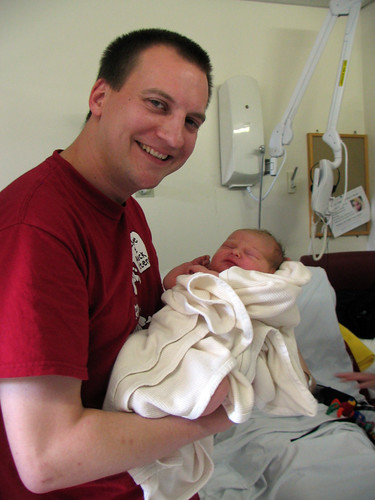
Last week The Wife gave birth to our first child: a beautiful, healthy girl called Anya Janette Pope. As you can imagine I'm going to be a little distracted over the next 20-odd years, but I still hope to make some progress on my games design (especially Codename: Vacuum at the moment). I'm on Paternity Leave from work for the next couple of weeks and I've already bought everything I need to print and cut out the next set of cards, so hopefully I'll be able to find a couple of hours when I can accomplish that (around staring in wonderment at the baby The Wife and I - mostly The Wife! -have made).


I'll also try to keep posting here as I make any progress, but as you can imagine it will probably be a bit less frequent!


Micro-Popelet

Look what I made!

Tuesday, August 21

Making Progress

Since I wrote that last post a few weeks ago, I've been thinking about Codename: Vacuum quite a lot and trying to work out the kinks in this early incarnation of the game. In essence the game works, but it's probably slightly over-complicated, and there are definitely a lot of balance issues to work out.


The first step is to play the game over and over and over again, making copious notes about what works, what doesn't, who scored what, which cards were played, which victory conditions were used and any ideas I've had.


Normally, the first tens of games would be played by myself, trying various strategies, getting the game basically working and trying to iron out the worst of the balance issues to ensure that when I start playing it with other people, it's a working game that won't be an entirely joyless experience for my playtesters.


It's a nice idea in principle, but I struggle to find the time for playtesting, and I really hate playing a game against myself: for me, a lot of the enjoyment of game is pitting your mind against friends in a structured competition. Playing against myself, where I know what cards my opponents have, what strategies they're following and what they are going to do next sucks all the fun out of it.


So I played a very brief test drive against myself early on before making a first prototype, and then I tested it with my games night several months ago. Since then, after a long hiatus I played it with my mate Paul, one of my key Reiver Games playtesters, and I've played it against myself again recently trying to judge whether the ideas I had during and after the game with Paul worked.


While living in York, and running Reiver Games, I had a weekly playtest session with some friends from the local games group (including Paul) where we'd try out several of the over a hundred prototypes I had received. After moving down South to near Bedford I set up a similar arrangement with my games group down there, which slowly migrated from being a playtesting session, to a playtesting session with a few real games, to a games session with a little playtesting and finally to a games session as Reiver Games ran out of steam.


Although I have a regular games night up here on a Thursday, I'm missing the chance to get some proper playtesting in - it doesn't seem fair to subject my games night chums to a half-arsed game that might not work at all, so a semi-regular playtesting session would be great.


I've spent the last week or so doing new versions of the cards using Adobe InDesign on the computer (that's the software I bought to do the real layout for Reiver Games - the final art that I sent to the printers in Germany). Just as I was finishing that I finally snapped the power lead to my laptop so I had to quickly save everything off to an external drive and uninstall InDesign before the battery ran out so I could set it all up again on this machine (The Wife's old one).


On my way home from work last night I got the card I need, so the next stage is printing and then cutting out all two hundred-odd cards. Then we're off to the races again...


The main focus at the moment however has to be preparing for the birth of our daughter, and then after that, raising her! Everything else will have to take a back seat for a while (or until she's off to university!).

Wednesday, August 15

Back Again

Another long hiatus! I actually wrote this blog post a couple of weeks ago, before I lost my home internet connection, now that's back up here it is!


It's been several months since I last posted here. In the meantime, We've bought a new house and moved into it and moved ever closer towards the due date of The Mini Pope.


With all the distractions I've done nothing on any games designs since the end of February - five months ago! Recently, now that most of the baby preparations are pretty much done and we're just waiting around for the big occasion my mind has started to wander back towards Codename: Vacuum, my steampunk/sci-fi deck building and tableau game.


I'd only played Vacuum once, with my regular games group back in February. The game didn't go well, not just because the game was a disaster (though as you might expect for a first play it was pretty bad!), but also because of the test. There was lots of discussion about things that could be changed and other ideas on every move, which dragged the game out over two and a half or three hours. I was hoping for a game that could play in 30 minutes with players who know it well, so two and a half hours felt disastrous, and the wealth of other ideas and suggestions (most of which would have changed the style of game dramatically) sapped me of my enthusiasm.


In the early stages of a game's design, you've an idea in your head of an awesome game, and scribbled on paper in pencil you have your first stab at that awesome game. Sadly, it's not awesome. It doesn't work like it did in your head. It's slow. Very unbalanced. Bits of it are clearly broken.


What you want to do, is play the game, find out which bits are broken, which are unbalanced and what is too complicated or too simplistic, and fix them. Then play it again. And again. And again. Each time making a few small changes. Some of your ideas will improve things, others will make things worse. It's an iterative process, culling the bits that don't work and thinking of some new ones that might. But, by the same token, you want to make incremental changes, not sweeping ones. Change something. Is it better? Worse? Change it again, or change something else. Slowly, over time it will get better. Then, strip it down to minimise the unnecessary clutter in the rules.


Now that things have settled down with the new house and we're nearly ready for the baby, my mind has wandered back to games design, and Codename: Vacuum in particular. After the first playtest I made some notes about things to improve, and printed a new set of cards that I thought addressed some of the problems that first game had. Last weekend, my friend Paul came up for the weekend and we played games late into the night on Saturday. Paul had been one of my key playtesters for Reiver Games, so I offered him a chance to play Vacuum.


The game went much better. We played the game in less than an hour and it went much smoother than the previous test. Most things worked. Several of the cards were unbalanced, but you only find that out by playing with them, so that's not a problem.


Paul enjoyed the game, and so did I, so now I'm enthused again :). I've spent the week since Paul's visit writing the rules up properly for Vacuum, so I don't forget things when my brain becomes addled due to new baby-related sleep deprivation. Next step is to print some more cards to fix the worst of the balance issues, then it's ready to go again.

Thursday, March 1

Proteome: A Designer for Hire?

As I've mentioned recently, I've started designing a second game: Proteome: The Drug Discovery Card Game. I've mentioned before that I got the idea after a joke from the marketing department at work. We were discussing my games designing past and Beth mentioned that I should make a game for our company to giveaway at scientific conferences that we attend. We all had a laugh about it, but it sparked an idea in my head.


To make a game professionally, you need to make 500 copies at a bare minimum - 1,000 is a more realistic number. Making a board game, with several components, a board, cards wooden pieces, etc. is not cheap. A small run - 1,000 copies or so could be very expensive - £15 or more a copy, which would mean a £15,000 outlay. Clearly a lot to be spending on conference giveaways. The next morning, in the shower I had an idea for a card game that fit the bill. A card game is that much cheaper to manufacture - plus easier to pocket as you wander the convention trade show.


If the game is to be given away at conferences the audience is not going to be hardcore gamers, there might be a few gamers in attendance, but it'll be almost entirely people who've played nothing but Monopoly and Cluedo. The audience will be smart, but not into complicated games. Of course, being me I don't want to produce something rubbish that I'd be ashamed of if a hardcore gamer saw it - I'm looking for a fairly simple filler that is engaging and appropriately themed. Appropriately themed in this case means collecting and publishing data on proteins that could be a target for a new drug, while robustly refuting the discoveries of your competition.


The more I thought about it, the more I thought it would be a good idea - both the game concept and the giveaway idea. So over the last couple of weeks I knocked up a prototype for my game idea, and took it to work (where I dropped it on the desk of Paddy, a vocal encourager, and said 'Done!'). We played it this week and it's not there yet, but the basic idea works. It's too complicated (a perennial problem with early prototypes of mine!) and could do with simplification, but there's something there. It gathered quite a lot of interest while we were playing it during lunch in the office :).


Marketing seem to be taking the idea of a game as a giveaway quite seriously. Who'd have thought that I'd stop working in games, go back to work and then still get to do games design as part of my day job? Of course, even if I can get the game finished there's no guarantee that management will go for the idea, so it may all come to naught. But it's fun while the idea is still a possibility.

Monday, February 27

My Juices Are Flowing...

Creative juices that is, before you get any ideas.


Reiver Games, my previous games publishing effort was formed after I got into games design. After years writing tiny bits of computer games I was in the mood for doing something that I could start, work through and finish. I'd played Mighty Empires with some friends for a weekend (and I mean a weekend - we played for 36 hours over three days!). I thought I could create something similar that was a bit less random (I'd been wiped out in a dragon attack after 24 hours of play!) and that played a bit quicker. Border Reivers was the game I created in that vein. On the back of Border Reivers and the perceived success of it (I sold out of the 100 hand-made copies within a year) I was in the designing mood, I started probably five or ten new games ideas, all sorts: an abstract game, an empire game, a beach-combing game and card game about the development of York.


After a year or so, I had another game out, designed by another designer and it was selling much better than Border Reivers had. With a little distance I'd realised that Border Reivers wasn't as good as I'd originally thought. In fact, I was beginning to think it was pretty weak. I'd played it with a lot of people by that point, and some loved it, some liked it and some were distinctly unimpressed. I could see there were flaws in the design, but as both the designer and the publisher I had no distance. I'd not played many games by the time I'd finished Border Reivers: Carcassonne, The Settlers of Catan and Citadels, maybe a couple of others. As I played a wider range of games I got a better grip on what a good game was. At this point I was trying to position Reiver Games as an independent publisher, and I was receiving more and more submissions to publish. The quality of those submissions varied enormously and it was clear that some designers really struggled to understand just how unfinished their designs were. As an independent adjudicator, I could clearly see these games were weak, but as the designer they were too close, too invested in their designs to see the flaws.


Seeing this from the other side made me re-think my own designing. I was that designer too, too invested in my own games to see their weaknesses and flaws. I start to be much harsher on my games, equivocating, second-guessing myself and struggling to make any decisions. Aware of the flaws of Border Reivers and the problems a lack of impartially brought I stopped designing my own games, afraid I'd publish games of my own design, after blinding myself to their flaws. After It's Alive! I published Carpe Astra (with some design input from myself) and Sumeria, neither of which sold very well. As Reiver Games slowly crawled towards the grave I lost confidence in myself, even to choose other designers' games.


Needless to say, designing was far from my mind for all this time. Now, a year and a bit after I went back to work I'm in the mood again. I've got two different prototypes ready to go: Codename Vacuum a Steampunk/Sci-Fi deck-building and tableau driven game, and Proteome: The Drug Discovery Card Game, an idea that sprang into my head after a joke from one of the marketing team at work. What's next? I've a tile-laying game knocking around in my head too, themed around Lewis & Clark's exploration of the American west.


What I really need to do now is get playing them, so I can start the improvement/design/development process. I've a weekly games night that I don't really want to become all about the playtesting (as the games will be broken a lot of the time and not much fun to play), and there's a bi-weekly games club in Newcastle which I don't make it to very often. I'll be going to Beers and Pretzels in May, but before then I could do with a few playtesting nights to get the games into some sort of shape before showing them to the discerning public. I need to find some time in my busy schedule.

Sunday, February 12

Codename Vacuum Gets an Overhaul

As I've mentioned in my last few posts, I've started designing games again. It's been a long time (for most of the time I ran Reiver Games I wasn't designing myself, just developing other people's submissions), but I've really caught the bug again.


I'm investing pretty much all of my games design free-time in Codename: Vacuum a tableau-driven, deck-building steampunk space opera (trying saying that ten time quickly!). The first playable prototype was finished a couple of weeks ago and saw action at one of my weekly games nights. It kind of worked how I'd intended but was too complicated and way too long (around two hours!). I'm aiming for the under-an-hour sweet spot that lots of games I really like (and a few I don't) hit. I'm thinking: Race for the Galaxy, 7 Wonders, Eminent Domain, Dominion.


It turns out that my design principles are to start off with something way too complicated and then simplify over time - which reminds me of something Grant Rodiek designer of Farmageddon tweeted last week:


If my rules don't get shorter after I incorporate my changes from a playtest, I immediately assume I took the wrong path.

It starts off well in my head: Steampunk!, Space Opera, with spaceships, and combat and trading ..., and then gets a little bloaty: ... and locations, and science, and tech trees and pirates and the passage of time ... and then gets ridiculous: ... and you can choose what weapons your ships have, and what clothes your admiral is wearing and and whether you are going to trade bauxite or Martian elephant leather.


Velour?

In the carefully controlled environment inside my head the game works like a charm - fast paced, fun with just the right amount of player interaction and decision making.


Then you play it with real people and you realise that the world in your head has no connection to reality at all. The game is slow, there's too many options, too many rules, whole chunks are non-intuitive, overly clunky or just pointless.


So you try to take what you've learnt and start again. You simplify things, take bits out, reduce the options, streamline this and cleanse that. Make a new prototype and try again.


That's where I am now with Codename: Vacuum. I've spent a good chunk of this week redoing all the cards on the computer, ready to be printed out again. Pretty much every card has changed, whether removing options, stripping out unnecessary complexity, trying to get things to make sense or have a purpose or just trying to improve the balance between all the various options. I hope to have the second prototype ready for testing towards the end of the week, either at my games night on Thursday, or at Beyond Monopoly! a games club in York that I used to attend when I lived there and will be visiting again for a first time in several years on Saturday.


Fingers crossed I'll find time in this hectic week to get it finished, printed and cut out. Then get it to the table (I've already had a few people requesting a chance to playtest it for me :-) ). At which point I'll find out that this new, streamlined, balanced version incorporating everything I learnt from playing the last hideously-broken version is way too complicated, too slow and hideously broken. At which point I'll have to start all over again!


Playtesting and developing a game is a long hard slog, at the beginning it's a case of four steps forward and three steps back. But, hopefully, over time you make progress and get to the point where it still mostly fits that vision you had all those months or years ago, but is slick, interesting, fun to play and you have people clamouring to play it when they see you. Will Codename: Vacuum make the grade eventually? I hope so, but only time will tell.

Tuesday, January 31

A First Look at Codename: Vacuum

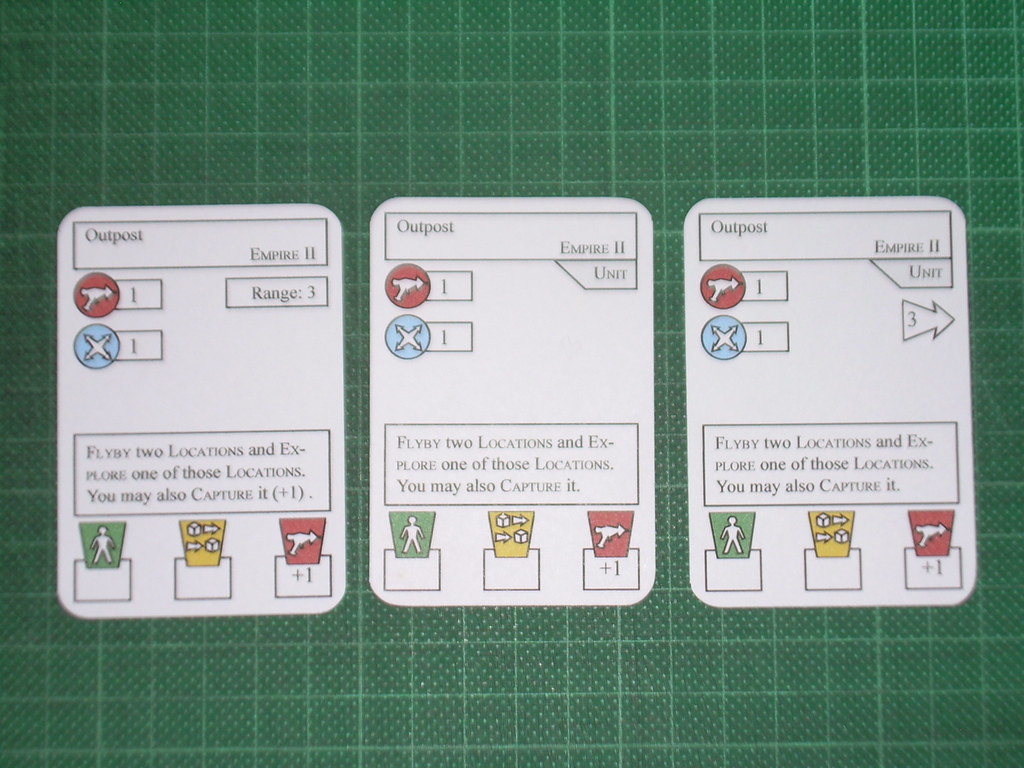
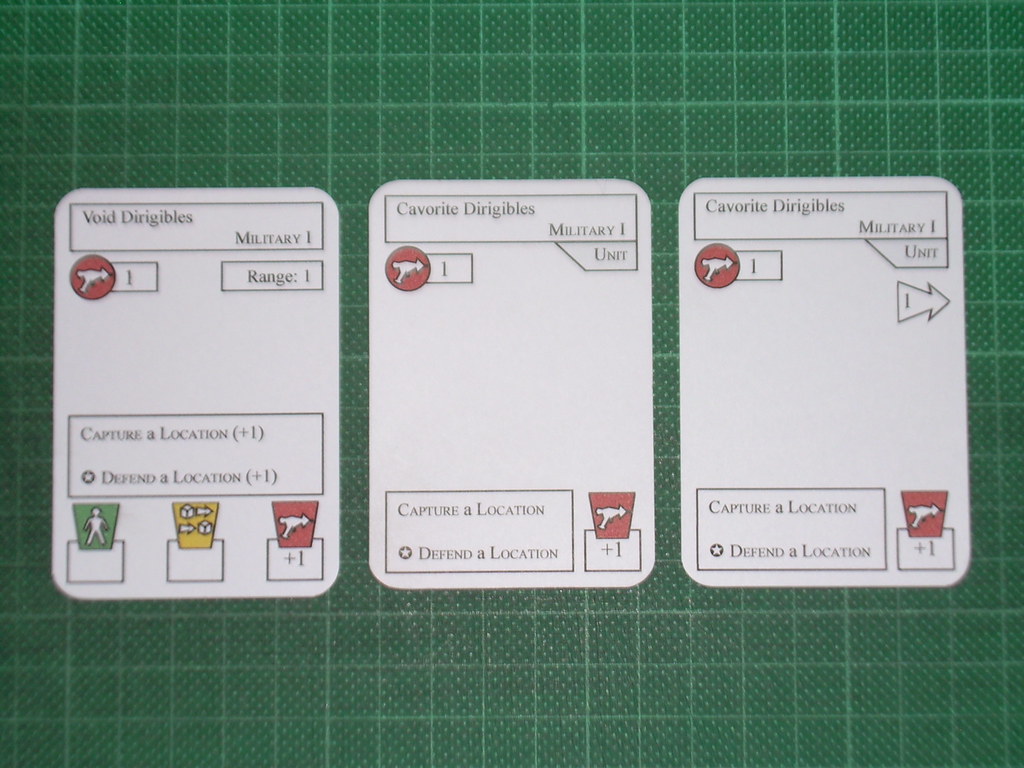
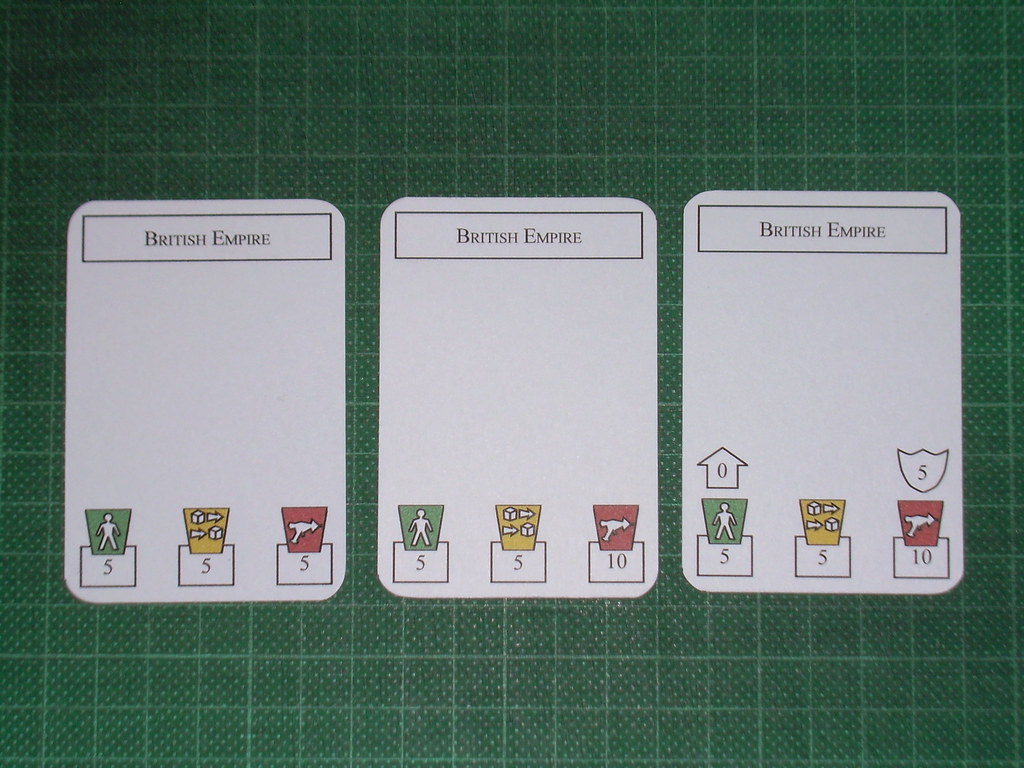
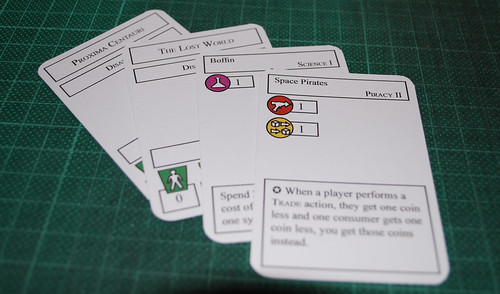
As I've mentioned over the last few blog posts, I'm working on a new board game design, under the moniker: Codename - Vacuum. It's been a slow process, I first had the idea back in December, but finally, the game has seen the light of day as a finished first prototype:

This is a very early prototype, the first one to be played properly (though I did start a game of an earlier version made out of torn paper!). This one will hopefully get a run out at Games Night on Thursday and this weekend when I'm down south seeing several of my gaming buddies and previous playtesters.

The first idea I had about the game was a deck-building game with a Race for the Galaxy-esque player tableau set in a classical space setting. About a week later, once I'd had a chance to think things over, I realised there were too many of those floating around at the moment (I'm thinking Core Worlds and Eminent Domain which I got for Christmas "for research" ;-) ) and other big name sci-fi games (Eclipse I'm looking at you [... on my shelf ;-)]). So it was time for a slight theme-tweak. Instead of sci-fi, I was thinking Steampunk Space Opera. Sounds great doesn't it? I have my mate Ben to thank for that one. He asked me what it was about. My answer?

[long pause] Um. I don't really have an elevator pitch for it. It's steampunk. In space. Forming an empire in our solar system.

Ben's "Steampunk Space Opera" is a lot punchier!

The original idea was typical space opera, locations spanning multiple star systems, large scale battles. This one is a little different - the locations are real/fictional places within (and just outside!) our solar system, and with all the funkiness that steampunk brings: brass! gears! monocles! cavorite! The idea is that you take one of the great powers of the world in an alternative 1900 (set in a world where all those cool things in fiction are real: Martians! Men in the Moon! Cavorite! Dinosaurs! - I've been raiding Conan Doyle, Burroughs, Wells and Verne for ideas :-) ). Unlike most steampunk games I'm aware of, there will be a progression: early techs are pure steampunk then things will evolve during the game to modern and then futuristic technologies.

Again, in addition to the theme changes there have been changes to the mechanics as well. These changes have happened more recently. Like this week, while printing the prototype! Initially I was thinking a pretty standard deck building game, but with a tableau in front of you where you kept the locations you had captured.

I'm now thinking a combination of hand-management of your tableau and deck building. I'm thinking four types of cards: locations, units, population and technologies. Cards can be played into your tableau or into your deck. Cards in your tableau can be used every round, those in your deck will be available some rounds and not in others. The tableau is of a limited size so you need to choose which cards to keep there. There are some restrictions of course: locations can only go in your tableau, population in your deck or attached to a location, only one of each type of technology can be used in each turn.

This is of course a very early prototype. It will be unbalanced and probably broken. The cards might not make sense, definitely have typos and the rules are way too complex and will need simplifying. The reason I've not invested much effort in the card art yet is that I expect these cards to be changed frequently. New titles, new rules, new mechanics, the version I have in a few months is likely to be completely different from this one, so I don't want to invest too much effort in it. After a few plays it may turn out the whole game is a write-off. Only time will tell...

Here's a little teaser for you until I've played it a few times and got something to report:

Monday, January 23

Gaming Buddies

I've not made a huge amount of progress on Codename: Vacuum the last few weeks - it has been fairly hectic for a number of reasons. In the meantime, a trip to York made me think of something.

In the last seven years I've lived in five houses in three towns over 250 miles apart. During that time I've made a bunch of really good friends - the sort of guys you stay in touch with despite living hundreds of miles apart and try (not as much as I'd like!) to make the effort to visit them despite the distance. And I've made all these friends through gaming.

This weekend we had to pop to York (90 miles away from our new home in Newcastle upon Tyne). While there we popped in to see my friend Paul. Paul responded to a request for Border Reivers playtesters back in 2006, and I then joined his twice weekly games night and he became one of my best mates and Reiver Games playtesters. While in York I also met Dave through the local games group Beyond Monopoly!. Dave and I shared an interest in gaming (I think it was Space Hulk that first drew us together, but we liked very similar games, and liked the same things - except the Star Wars prequels!). Sadly, after a couple of years Dave moved to Plymouth (350 miles from York) and I haven't seen much of him since (though it's definitely my turn to visit (now 410 miles away!).

Then we moved again, 160 miles further south to near Bedford, and I joined a new game group. Terry, Graham and Andrew were available during the day on occasion, so we formed a playtesting group. As Reiver Games slowly withered and died our group changed from a playtesting group to a regular gaming night.

In a couple of weeks we're going down south to spend a weekend playing games with Terry, Graham and Andrew. We saw Paul and his family yesterday, and have agreed to see them on the way down south for another catch up and some gaming. I'm hoping to arrange an epic trip down to Plymouth to see Dave in the next few months (which will probably involve, you've guessed it, some gaming).

We moved back to Newcastle at the end of last year, where we still have some really good friends (several of whom come to my games night), but through the local games club (which I've hardly made it to yet) and a games night at the local games shop: Travelling Man I'm hoping I'll make some more excellent friends.

I'm really glad I have gaming as a way to meet new people, and that the people I meet share my interests and often turn into some of my best mates. Who have you met through gaming?

Saturday, December 3

The Beginning: First Steps in Crafting a New Game

My games design process starts with a spark of an idea, either theme, mechanics or a combination of the two. This usual sets my head to buzzing with a whole raft of ideas, from mechanics, artwork, market segments, and the inevitable riches that will follow from the million copies sales it is bound to achieve. At this stage I have to ride the wave of unrealistic optimism and get as many of the ideas down as possible before I forget them all. In the past this means getting to a notebook as fast as possible and just dumping all my thoughts onto paper. These thoughts will mostly be theme and mechanics ideas, with maybe a mission statement for the game describing which sector of the market I'm aiming for, target play time, etc.

Recently I've started using a draft email to myself as a virtual notebook that I can access from anywhere I've got internet access, without having to remember to cart the notebook around with me. I've found this really useful, but it has it's strengths and weaknesses like anything else. It's quick to use, and very portable, and also allows editing as your ideas change over time. The downside is that sketching images of design ideas, card layouts, tile distributions, etc. is much slower than scribbling something quickly with a pencil.

The ideas keep coming and the game will evolve pretty quickly at that stage with everything potentially open to change. Over a few days I get enough down (and have enough ideas) to begin the prototyping journey. I've a lot more ideas down on paper than prototypes - lots of these ideas fail at the first hurdle as I come to the conclusion that they won't work, won't be fun or just lose interest in them. After the first year or so of running Reiver Games I went off games design, aiming instead to position the company as an independent publisher of games by other designers. For some reason, I'm back in the designing mood.

If the game keeps my interest enough to make it off the paper of my notebook, the next stage is to make a paper prototype. The early prototypes are just something that you can play (probably by yourself) to work out the worst of the kinks. There will be loads of them and at this early stage everything is still changing constantly, so you want to make something that's playable but doesn't require too much effort to construct. Normally I do this all with pencil and paper. I take sheets of A4 paper (similar in size to US letter I think) and literally tear them down to size. Cards are a sheet folded into 16ths or 32nds, player boards might be a sheet folded in half (i.e. A5), a game board might be two sheets taped together (or a sheet of A3). There's no artwork, just enough text/iconography drawn on with a pencil to be playable. I use pencil rather than pen as I fully expect to be rubbing things out and then re-drawing/writing them after every test game. Using paper for cards is definitely sub-optimal from a play point of view (they are very hard to shuffle!) but this version isn't really intended to be played by anyone other than me, and rather than spending tens of hours cutting out and making pretty card ones, it's more important at this stage to make sure this early game idea actually works enough to play with other people (which is when the real playtesting begins).

The game I'm working on at the moment (Codename: Vacuum) is a card game in the Dominion vein, i.e. it has hundreds of cards. I started making a starter set of cards a few weeks ago and got to just about enough to start testing it to see if the basic premise works before I came down with a filthy cold and then we had Christmas. I'm back home again and I'm already thinking of changing up my process for this game.

Folding and tearing all the cards, then drawing on them the basic layout is a lot of work when you do it hundreds of times. To add the fact that this version is almost unplayable in terms of shuffling is making me think of cutting to the chase and making the Phase II prototype straight away. Or at least Phase 1.5. This would be made out of craft card (about 220 gsm) and be partially printed with a basic card layout to reduce some of the drawing drudgery. I'd still leave the game without any artwork and write the game text in pencil to make it easy to change as I work out the strengths and weaknesses of the various cards.

I still have the Adobe InDesign software I bought for Reiver Games, so I can use that to quickly knock up the card outlines and cutting guides, print those out and then fill in the text with pencil afterwards. I also got an A3 inkjet printer that was capable of printing on card - specifically for printing prototypes - so I'll be able to print them at home too. I've got three days before I have to go back to work - time to get cracking!

What is your process? What steps do your designs go through? What tools do you recommend?

Wednesday, November 30

Which Came First? The Mechanics or the Theme?

With my earlier games: Border Reivers and Carpe Astra the mechanics definitely came first, and the same is true of It's Alive! one of the games I published on behalf of someone else. With Border Reivers I started trying to make a game like Mighty Empires that played faster and less randomly; I really liked the networking mechanic in the submission by Ted Cheatham that became Carpe Astra, though the theme changed quite dramatically. It's Alive! had been through several themes before I changed it to building Frankenstein's monster. So in my experience, mechanics first seems to work ok.

To further reinforce this, most of the many games I've started designing but failed to finish/lost interest in/couldn't get working started out with a theme first, which I tried to find mechanics that fit after the initial idea.

The theme acts as a hook for the game to interest people, hopefully enough that they want to play or buy the game. It's often possible to re-theme a game by picking something that roughly fits the mechanics and then tweaking the mechanics, action names or card wording to get the game to make sense with the new theme. In my experience it's often possible with very few changes to the game.

As I mentioned earlier this week after a conversation with The Wife a new game idea sprang into my mind almost fully formed. Theme and mechanics combined. Since then I've tweaked the theme slightly to distance it from a couple of similar new games (which I've added to my Christmas list so I can play them and ensure my game develops differently) and the mechanics have begun the long road of changes that will hopefully lead to a great game.

For me personally, I think the mechanics-first approach is the way to go. What are your experiences? Are you a theme-first or mechanics-first designer? How will my new game idea develop: theme and mechanics in lock-step, or will the theme change as time goes on? Stay tuned to find out!

Monday, November 28

Hello? Hello? Anyone here?

Well, it's been nearly six months since Reiver Games officially shut down. The email addresses and website will be disappearing this week probably, the bank accounts are shut and the only time my games are mentioned on BGG is people trying to offload their copies in trades or auctions.

It's Alive! is now available on the iPad (a version which the designer arranged, I gave him the rights to the game and let them use the artwork for free, but otherwise had nothing to do with it).

I've moved back to Newcastle upon Tyne, where I lived when I first designed Border Reivers (hence the northeast theme), and I'm back working for the company I worked for at that time again too. I'm still into games, hosting a regular weekly gaming night at our house and trying to get along to Newcastle Gamers when my busy schedule allows.

Games design-wise I've done almost nothing for a while now, I've had a couple of ideas over the last few months, but it's been hard to drum up any enthusiasm for anything with the spectre of Reiver Games hanging over me, reminding me how bad I was at it. In the meantime, I've been moping around the house clearly bored: "In need of a hobby".

Until yesterday. Yesterday was a day of driving, at the end of a weekend of driving. The Wife and I were coming back from Bristol where we'd been visiting family and we had a five and a half hour drive on which to amuse ourselves (I was supposed to be driving, but driving-schmiving). We got to talking about Reiver Games and The Wife asked how sad I was about it. I admitted that I was disappointed that I couldn't make it work, and that every now and again I thought about how I could have done it differently: smaller print runs, not make the leap from hobby self-publisher to selling to distributors and trying to make a living from it in one go, etc. And then something weird happened.

You could do it again, you know. As a hobby. I'd help.

Wow. In the (para-phrased) words of Wash from Firefly: "Good wife". I'd tried. I'd failed. Miserably. To the tune of several thousand pounds of (almost) our money. And The Wife was willing to let me try again!

We got talking about the sorts of games I'd make if I had a chance to do it again differently. We talked about the sorts of games I think sell really well and the sorts of games she likes. And then I had an idea. It sprung from something she said and suddenly my mind was whirring with game ideas, I had a fairly well-formed concept in my head and I was fleshing out mechanics and card examples in my head instead of the things I should have been doing (like sticking to my lane and avoiding HGVs). It's Codename: Vacuum by the way, more to come on that front hopefully (especially if anyone is listening!).

So where now? I'm designing again, and I've got a load of enthusiasm back. I'm making notes and hoping to do some prototyping in the next couple of days. Will I have another go at a publishing company? Probably not. But the possibility is there and you never know. I'd certainly do things differently this time round and I know so much more than I did when I started Reiver Games, so it would definitely be less of an uphill struggle.

Reboots seem popular these days (Star Trek, X-Men: First Class, the new Spiderman), maybe I should hop on the bandwagon...

Tuesday, June 7

The End

It's been almost exactly a year since my last post here, but I'm back for a one-time only update on the state of Reiver Games, me and a brief retrospective on the five years of Reiver Games.

A Year! What's Happened?

Since I last posted here I've been trying (successfully :) ) to get back into paid employment. After a brief spell of work experience working for a previous employer in Newcastle, I found a full-time role in software development (my official trade) near home and I've been doing that for the last seven and a half months. I'm nearly back to full steam, relearning those skills I'd learnt in the eight years before I quit coding to try Reiver Games as a full-time concern. The job is going well, they seem to like me and the work I'm doing, and I've got to say I'm loving getting a pay-check every month. It's awesome :)

Bored Now. What About Reiver Games?

Reiver Games has been very slowly ticking along in the intervening twelve months. I cut the prices of the games I had on consignment at distributors in the UK and the US in an attempt to get rid of them so all my stock was in one place. It worked, I sold the last games on consignment at the beginning of this year.

a

That left me with just over three thousand games left in my warehouse (and my office): predominantly Sumeria, but with a decent chunk of It's Alive! and Carpe Astra too. Plus about 600 copies of the 2-player expansion of Sumeria. I've been trying to sell these to liquidators over the last few months and getting little traction.

About a month ago all that changed, Tanga.com got back to me (I'd assumed at that point that I'd heard the last from them) and agreed to take 300 of each game (and 300 expansions) to sell in the US (so if you're in the US they should be arriving in about two weeks...) and with that sale I could afford to sell the rest to a UK liquidator for a laughable amount. Between the two they should just about pay off my bank loan, so I can close the company down and pay off my creditors without having to dip into our personal funds.

I've got about a dozen games left at home (the loose ones I couldn't sell to a liquidator) that I'm selling on my website at pretty much cost plus shipping. Once those are gone it's just the final 300 copies of the Sumeria expansion, and then I'm done. I'm thinking of sending the remaining expansions to BoardGameGeek, so that at least they should find loving homes :)

You Rich Enough To Retire?

Sadly no. I don't have the exact figures, but I reckon I lost about £13,000 ($19,000) on Reiver Games. Dear God, that sounds awful. The one slight redeeming feature is that the vast majority of that was some money we came into unexpectedly (which was the only reason I could afford to invest in the company and not earn anything for two years). I say again: Earning a wage again is awesome.

What Went Wrong?

Clearly I screwed things up. How? Can I at least provide some pointers to the intrepid among you to help you avoid my mistakes?

Firstly, I made the jump from hobby publisher to professional publisher too soon and too quickly. The games I made by hand were very successful - I sold out of both print runs within a year and pretty much doubled the investment both times. 100% ROI is pretty good going. But that was selling a few hundred games mostly direct to gamers, not selling thousands predominantly to distributors and shops. Rather than rushing into things, I should have continued to make the games by hand and sell them to gamers at conventions, while building up my reputation and stable of games. Once I had a strong reputation and 5-10 games under my belt, I should have moved to a half-way house, where I got the games professionally manufactured in much smaller print runs (500 - 1,500) but still sold directly to gamers - that way I could afford the high costs of small print runs, since there were no middle men taking their cut. The fully professional model could come later, once I had a bunch of awesome games with a proven track record and a wider reputation. This is similar to the model Martin Wallace has taken with such success (though clearly it helps that his games are extremely popular).

My second mistake was around print run sizes and manufacturer choices. I decided to get the games manufactured in Europe for three reasons: it would be easier to liaise with the manufacturers, the environmental cost of shipping the games to me would be less than from China, and I knew that working conditions and materials would be of a known high standard. I was very happy with the second manufacturer I used: LudoFact in Germany. Their customer service was excellent. The production quality was excellent. They delivered on time and as budgeted. Sadly, getting the games manufactured in the EU cost me, as the unit cost was significantly higher, which both raised my retail price and squeezed my margins. In an attempt to overcome this problem, I increased the size of my print runs to reduce the unit costs. This left me with me with more games than I, as a new relatively unknown publisher, could sell. As a result, the capital I needed to invest in new games was instead sat in my warehouse as unsold stock, and even worse, it was costing me money to warehouse it there.

Mistake number three was related to mistake number two. In an attempt to get retail prices to an affordable level, while still selling at 40% of retail to distributors I squeezed my margins too far, to the point where I was making nowhere near enough money on each game, and yet still the games were expensive, especially in Germany (where they had to compete with local manufacturers doing vast print runs) and the US (where they had to compete with local manufacturers doing much larger print runs and getting the games made in China). With high prices people were less likely to take a punt and see if they liked it, so sales were lower than they needed to be. Making the games in the smallest box I could fit them in, while popular with collectors with huge collections and saving money on shipping, also made the games look even more expensive when compared similar sized games in the shops.

Finally, there was the bank loan. The bank were very happy to lend me £10,000 to get Carpe Astra manufactered, just after It's Alive! was released. It's Alive! was several months late, due to problems at the manufacturer, and with my pitiful margins had hardly recouped any of its investment when I wanted to release Carpe Astra. It turns out that the bank made a good decision: I'm going to re-pay the loan in full a few months early. Sadly, it was a terrible idea for me. I was paying £330 a month servicing the loan, which meant the money I was making month in, month out was quite rapidly disappearing from my account, leaving me little to invest in new games. In hindsight, I should have gone more slowly as discussed above, without having to rely on a loan. If I really wanted to jump straight in at the deep end of selling to distributors, then I needed a much larger initial investment, probably on the order of £50,000 - £100,000 - enough to fund five or ten games without relying on external finance.

It probably shouldn't be the last point, but I also needed a much better understanding of marketing and a solid marketing strategy. Considering how little I knew, it's a wonder that I managed to sell 5,500 games worldwide before the end.

Final Thoughts

I'm proud of what I achieved during the last five years with Reiver Games. From a pipe dream of making a board game in Newcastle eight or nine years ago, I sold four games (8,500 copies in total including the liquidators), to five of the world's continents. I got my products into 21 distributors in North America, the UK and throughout Europe.

I really enjoyed the graphic design and learning new skills in sales and marketing and dealing with manufacturers, distributors, shops and logistics. I loved going to trade shows and conventions and introducing gamers to my games.

I'm really glad that I decided to go for it, and that The Wife gave me her unconditional support. Had I not done it, I'd be financially better off, but I would not have learnt everything I did over the last five years, nor would I have met so many gamers who share my passion for board games.

I'd like my last words here to be a huge thank you to all my customers (thanks again for your support), all the gamers I've met (thanks for your enthusiasm), the designers (including those who sent me games I didn't publish) and my friends and family (especially The Awesome Wife) for your support, encouragement, advice and for not treating me like the lunatic I clearly am. I'll leave this blog up, hopefully the information contained herein will provide information, advice, a cautionary tale and entertainment(?) for other wannabe designers, publishers and entrepreneurs.

Wednesday, June 9

Rollcoaster Finally Falls Off Tracks

So I hinted that there might be some exciting news coming soon on my blog. Sadly this isn't it.

After I announced that I was closing the company I had several enquiries from people interested in acquiring either some or all my stock or even a share in the company. Despite being obviously very disappointed to be closing down the company after three and a half years, this interest in buying bits from me was a silver lining as it meant I might be able to pay off my debts and even possibly re-coup a small chunk of my initial investment.

Then, just over a week ago I went to a meeting with another UK publisher: Spiral Galaxy Games to discuss the possibility of a co-publishing deal for Braggart, the fun card game I've been alluding to on my blog for many, many months. It was a productive meeting, we came up with an agreement we were both happy with and it looked like Reiver Games was going to rise from the ashes and continue publishing games. I contacted the designer and the artist I had lined up, everything looked good, everything was go. We were going to try to get everything ready for Essen in the hope I could get a stand booked at the last minute (it was already past the booking deadline).

The designer had already seen the contract (though not yet signed it) and was up for it, but he wanted to finalise the game before signing the contract. The artist needed to get working immediately, and wanted me to sign a contract with her. I was a little wary about signing the artist's contract before the designer's one was signed as I didn't want to be left carrying the can if the designer dropped out.

After a chance meeting with the designer at the UK Games Expo it became clear to me that the designer wanted to finalise the game before signing the contract so that he could negotiate a new contract where I didn't have the right to change anything - he wanted complete control over the game design (which I can understand - it is after all his baby). Sadly, that meant that he was not interested in signing my standard contract (which give me the right as the publisher to make changes to the game as necessary after seeking input from him). With the designer pulling out, I'm left owing the artist a couple of hundred quid for the early artwork she's done (which was fantastic).

With no hope of publishing that game, and nowhere near enough cash in the company to publish anything else any time soon I'm back to shutting the company down. I've sold a bunch of stock to a UK distributor and now I'm trying to close a deal to get rid of the rest of the stock to a publisher in the US.

The last couple of weeks have been very intense. First very down, then very up then down again. Fortunately, on another front things are looking up as I've got a chance to work with a former employer in Newcastle on a short-term contract. It'll give me a chance to refresh my IT skills and add some recent experience and a recent reference to my CV.

Saturday, May 8

An Update

Just a quick update to let you all know where things stand with Reiver Games.

Firstly, I'd like to say a huge thank you to everyone who has got in contact to commiserate or show their support - thanks also to everyone who has ordered games from me since the announcement :)

So, where do things stand? At the moment Reiver Games is continuing as it always has, shipping direct orders and dealing with distributors as before. I've received several enquiries from people or companies interested in helping me close out. I've no firm offers yet, but one indicative offer and several expressions of interest.

As far as I can tell from the early information I've received these range from 'I would like to buy all you stock' to 'I would like to buy Reiver Games as a going concern complete with website, licences and possibly even your continued involvement'. I've also had some interest in re-printing my games in other languages.

Obviously, there's many a slip betwixt cup and lip, so none of these may materialise into a confirmed offer. But at this point I'm quietly hopeful.