Friday, November 21

NaGa DeMon 10: Hopefully, Less Rubbish

I wrote this blog post on Monday night, but I've been waiting to post it until I had a chance to test it, to avoid the problems I had with the last version. Then I got sick, missing a couple of days' work and then finally we've had some bad news and I'm off again, so no real chance to test it. Seeing as Derek and Enrique have both requested it in time for the weekend, here it is. Hopefully it's better than the last version, it is at least possible for the knight to win this one!

As I feared the last version was pretty unbalanced. Sam and I played it three times on Monday lunchtime with the dragon winning by 10 points twice and by 15 once! All in under 10 minutes :-(. I'd made the Breathe Fire work at long and short range and added another dragon attack (the Tail Lash) at long range. Despite the better defence cards for the knight he was still hopelessly out-classed. Discussing it afterwards with Sam I was quite happy with his idea that the dragon would win more games than the knight (if only slightly), but as it stood, the knight had no chance.

So, in fairly short order, here's a new version. This version has even more asymmetry added, now the knight has 9 cards and the dragon only 7. The knight's extra card is a short range defence that can be combo-ed with an attack or two, and the dragon has lost the Tail Lash and Breathe Fire is back to long range only.

New rules follow, with new print and play files at the bottom.

Dragon Dance
Fire v. Lance
2 players
10-30 mins
10+?

Contents:

9 Knight action cards
7 Dragon action cards
1 Knight player aid card
1 Dragon player aid card
9 heart tokens representing the knight's life force
20 gold coins representing the dragon's life force
3 large red dice for the dragon
5 small white dice for the knight

Dragon Dance is a game of bluff, cards and dice between a knight and a dragon in a mortal fight over the King's daughter.

Aim of the Game

The aim of the game is to reduce your opponent to zero life force through cleverly timed attacks without running out of your own life force. Each round you will simultaneously choose a die and then a card to action - either attacking, defending or manoeuvering as you dance around each other looking for an opening to exploit. The dragon is more powerful and has more life force, but it's also less agile and slower, so the knight has to strike fast before his limited life force is extinguished. The game weaves between long and short range as combatants close and retreat to catch each other on the wrong foot.

Setup

Decide between yourselves who will play the dragon and the knight. The dragon player takes the dragon player aid, action cards, three red dice and the twenty gold coins to represent its life force. The knight player takes the knight player aid, action cards, five white dice and nine heart tokens representing his life force.

Both players roll all their dice and place them in front of them and place their player aid cards with the 'Long Range' side face up nearby.

Play

The game takes place over a number of rounds during which the players act simultaneously. Throughout the game the players' life tokens, remaining dice and played cards are kept open so that both players can see them.

Each round consists of four phases:
  1. Choose a die (or none)
  2. Choose a card
  3. Action the card
  4. Discard card and die
Choose a die
In the first phase, both players simultaneously choose either one of their remaining dice, or none. High values boost attacks, low values boost defence and medium values boost both attack and defence but to a lesser degree.

During this phase, hide your remaining dice from your opponent and then choose one of them to use this turn (by, for example, placing a finger on it) or choose none (by, for example, placing a finger on the table next to your dice). Then reveal your dice along with your selection. The chosen die will be used to either boost an attack or defence card, or as a bluff to trick your opponent into playing a sub-optimal card.

Choose a card
Once both players have revealed their chosen die (or none), both players simultaneously chose a card to play this turn. The chosen cards are placed face down on the table in front of them and then when both players have chosen the cards are revealed. Chosen cards must be playable at your current range, check your player aid to see which cards you can play at your current range, or check the 'Short range' or 'Long range' icons on the cards in your hand. You begin the game at long range. The only effect of the short and long range icons is to limit the cards available to you during this phase. If one or both players play a card which changes the range, the cards chosen are still valid as long as they were valid choice at the starting range this round.

Action the card
Both cards are actioned simultaneously.

Attacks & Defence
If either player chooses an attack card, calculate the damage they deal as follows:
If they have chosen a die, use the table on the card to determine how much damage they are dealing, if no dice is chosen determine damage using the no dice column in the table.
If their opponent has not played a defence card, they lose life force equal to the damage dealt.
If their opponent has played a defence card, use the table on the defence card (along with any die chosen) to determine the defender's protection as for the attack damage. The attacker's damage minus the defender's protection is the amount of damage dealt to the defender.

Example 1:
Konrad (the knight) chooses a '5' and the Hack attack card and Derek chooses a '1' and the Flap defence card. With a 5, the Hack deals 3 damage, but the Flap and a 1 prevent 4 damage, so no damage is dealt.

If both players attack, the damages are calculated and dealt simultaneously, possibly killing each other at the same time.

Example 2:
Roberto (the knight) chooses a '6' and the Charge card and Todd chooses a '3' and the Breathe Fire card. With a 6, the Charge deals 5 damage, which is unblocked, so the dragon loses 5 life force. Breathe Fire with a 3 deals 3 damage, so the knight loses 3 life force.

Charge
The knight has the Charge card, which is a very powerful long range attack, combined with a reduce range movement. After dealing damage, if any, resolve the movement as described under 'Movement' below. For example, in Example 1 above, the combatants would now be at short range.

Dodge
The knight has a Dodge card which if played reduces damage dealt to him this round to zero regardless of what attack the dragon performs.

Example 3:
Jack (the knight) chooses a '4' and the Dodge card. Sam chooses a '5' and the Rake card. Sam's attack would have dealt 3 damage to the knight, but the Dodge reduces that to zero, so no life force is lost.

Knight's Block
The knight also has a block card which reduces damage dealt. If the dragon player has played an attack card and a die, the block will reduce the value on the die before calculating the damage dealt. This could reduce the damage dealt to zero. The amount the dragon's die roll is reduced by depends on the die the knight used in conjunction with it: with a 1,2 or a 3 the dragon's die result is reduced by two, with a 4, 5, or a 6 it is reduced by one. If used without a die it has no effect or against a defence or maneouvre card it has no effect.

Example 4:
Enrique (the knight) chooses a '4' and the Block card. Mal chooses a '5' and the Bite card. With a '4' the Block reduces the dragon's attack die by one, so Sam's '4' is changed to a '3'. Sam's attack now deals 2 damage to the knight, instead of the 4 damage it would have dealt with a '4'.

Combo
Knight has two short range attacks Hack and Slash which have the 'Combo' keyword and one short range defence 'Riposte'.
  • If a Hack or Slash is played and deals damage as described in the 'Attack and Defence' section above, the knight may perform a follow up attack using the other short range attack card.
  • If Riposte is played and it successfully reduces damage dealt, the knight may perform follow up attack(s) using one or both of the short range attack cards.
You can only use Combo if the combatants remain and short range and the knight has one or two short range attack cards in his hand along with unused dice to assign to the attack(s). These attacks are undefended and deal another (two) rounds of damage this turn.

Example 5:
Konrad (the knight) chooses a '4' and Hack, while Roberto chooses a '2' and Advance. The Hack deals 2 damage to the dragon, and seeing as it dealt damage, Konrad can use the Combo effect to immediately play the Slash card from his hand (not the discard pile) along with the remaining '1' die to deal a further 1 damage, the second attack cannot be defended against. Roberto's dragon loses a total of 3 life force.

Movement
If either player has played a movement card (Charge, Advance or Retreat) then the range is adjusted:
  • If one or both players reduce range you are now at short range
  • If the knight plays Retreat you are now at long range
  • If the dragon plays Advance and the knight plays Retreat your range remains the same
Both players must now flip their player aid cards as necessary to show the range they are now at. Both player aids must always show the same range.

Note that the knight's Advance and Retreat cards also prevent one damage if played with a die showing a 1, 2 or a 3.

Discard card and die
At the end of the round both players discard the cards they played (face up where they are visible to both players) and any die they used with it. These discarded cards and dice are unavailable to the player until they play the Recuperate card, which allows them to reclaim all discarded dice and cards, returning the cards to their hand. Once they have reclaimed the dice all their dice are re-rolled.

End of the Game

The game ends at the end of the round in which at least one player has been reduced to zero life force. If the dragon has zero life force, the knight has won regardless of whether or not he has life remaining. Otherwise the dragon wins.

Download the cards

There are two versions of the cards: either front and backs as two separate files or alternatively, all the pages as a single file interleaved for easy double-sided printing.
or

Wednesday, November 19

NaGa DeMon 9: An Intermission

Just a brief one today. I've finally been brought low by the sickness bug that's been sweeping my office and house, so there's not going to be any progress on anything for a day or two. I've got a new version that hopefully fixes the problems with the last version that I did on Monday night before I came down with it, but I'd rather not post it until I've had more of a chance to test it. Hopefully it'll be up in a few days...

Monday, November 17

NaGa DeMon 8: Redux

It's just gone half-time in November, and finally I've got a second version of Dragon Dance for your delectation. Initially I'd intended to make fairly minor changes (decrease dragon hit points and tie = knight win), but feedback from Konrad's three games and a game I played with Dave late on Thursday night inspired some more sweeping changes which kind of crept up on me while I spent 6 hours on trains on Friday.

The changes have led to the dragon becoming stronger (more damage, another attack card and breathe fire now works at both ranges) but also clumsier (0 damage for low dice on most attacks) and bolder (no retreat). Meanwhile the knight now gets some defence while advancing and retreating, and his block reduces the dragon's attack die roll potentially reducing the damage received to zero! In the last version I think the dragon was too strong, and yet these changes have probably made it stronger still, so the knight needed some bulking up too. I've no idea whether these ideas will improve things, or how broken they are, but hopefully they are at least more interesting!

New rules follow, with new print and play files at the bottom.

Dragon Dance
Fire v. Lance
2 players
10-30 mins
10+?

Contents:

8 Knight action cards
8 Dragon action cards
1 Knight player aid card
1 Dragon player aid card
9 heart tokens representing the knight's life force
20 gold coins representing the dragon's life force
3 large red dice for the dragon
5 small white dice for the knight

Dragon Dance is a game of bluff, cards and dice between a knight and a dragon in a mortal fight over the King's daughter.

Aim of the Game

The aim of the game is to reduce your opponent to zero life force through cleverly timed attacks without running out of your own life force. Each round you will simultaneously choose a die and then a card to action - either attacking, defending or manoeuvering as you dance around each other looking for an opening to exploit. The dragon is more powerful and has more life force, but it's also less agile and slower, so the knight has to strike fast before his limited life force is extinguished. The game weaves between long and short range as combatants close and retreat to catch each other on the wrong foot.

Setup

Decide between yourselves who will play the dragon and the knight. The dragon player takes the dragon player aid, action cards, three red dice and the twenty gold coins to represent its life force. The knight player takes the knight player aid, action cards, five white dice and nine heart tokens representing his life force.

Both players roll all their dice and place them in front of them and place their player aid cards with the 'Long Range' side face up nearby.

Play

The game takes place over a number of rounds during which the players act simultaneously. Throughout the game the players' life tokens, remaining dice and played cards are kept open so that both players can see them.

Each round consists of four phases:
  1. Choose a die (or none)
  2. Choose a card
  3. Action the card
  4. Discard card and die
Choose a die
In the first phase, both players simultaneously choose either one of their remaining dice, or none. High values boost attacks, low values boost defence and medium values boost both attack and defence but to a lesser degree.

During this phase, hide your remaining dice from your opponent and then choose one of them to use this turn (by, for example, placing a finger on it) or choose none (by, for example, placing a finger on the table next to your dice). Then reveal your dice along with your selection. The chosen die will be used to either boost an attack or defence card, or as a bluff to trick your opponent into playing a sub-optimal card.

Choose a card
Once both players have revealed their chosen die (or none), both players simultaneously chose a card to play this turn. The chosen cards are placed face down on the table in front of them and then when both players have chosen the cards are revealed. Chosen cards must be playable at your current range, check your player aid to see which cards you can play at your current range, or check the 'Short range' or 'Long range' icons on the cards in your hand. You begin the game at long range. The only effect of the short and long range icons is to limit the cards available to you during this phase. If one or both players play a card which changes the range, the cards chosen are still valid as long as they were valid choice at the starting range this round.

Action the card
Both cards are actioned simultaneously.

Attacks & Defence
If either player chooses an attack card, calculate the damage they deal as follows:
If they have chosen a die, use the table on the card to determine how much damage they are dealing, if no dice is chosen determine damage using the no dice column in the table.
If their opponent has not played a defence card, they lose life force equal to the damage dealt.
If their opponent has played a defence card, use the table on the defence card (along with any die chosen) to determine the defender's protection as for the attack damage. The attacker's damage minus the defender's protection is the amount of damage dealt to the defender.

Example 1:
Konrad (the knight) chooses a '5' and the Hack attack card and Derek chooses a '1' and the Flap defence card. With a 5, the Hack deals 3 damage, but the Flap and a 1 prevent 4 damage, so no damage is dealt.

If both players attack, the damages are calculated and dealt simultaneously, possibly killing each other at the same time.

Example 2:
Roberto (the knight) chooses a '6' and the Charge card and Todd chooses a '3' and the Breathe Fire card. With a 6, the Charge deals 5 damage, which is unblocked, so the dragon loses 5 life force. Breathe Fire with a 3 deals 3 damage, so the knight loses 3 life force.

Charge
The knight has the Charge card, which is a very powerful long range attack, combined with a reduce range movement. After dealing damage, if any, resolve the movement as described under 'Movement' below. For example, in Example 1 above, the combatants would now be at short range.

Dodge
The knight has a Dodge card which if played reduces damage dealt to him this round to zero regardless of what attack the dragon performs.

Example 3:
Jack (the knight) chooses a '4' and the Dodge card. Sam chooses a '5' and the Rake card. Sam's attack would have dealt 3 damage to the knight, but the Dodge reduces that to zero, so no life force is lost.

Knight's Block
The knight also has a block card which reduces damage dealt. If the dragon player has played an attack card and a die, the block will reduce the value on the die before calculating the damage dealt. This could reduce the damage dealt to zero. The amount the dragon's die roll is reduced by depends on the die the knight used in conjunction with it: with a 1,2 or a 3 the dragon's die result is reduced by two, with a 4, 5, or a 6 it is reduced by one. If used without a die it has no effect or against a defence or maneouvre card it has no effect.

Example 4:
Enrique (the knight) chooses a '4' and the Block card. Mal chooses a '5' and the Bite card. With a '4' the Block reduces the dragon's attack die by one, so Sam's '4' is changed to a '3'. Sam's attack now deals 2 damage to the knight, instead of the 4 damage it would have dealt with a '4'.

Combo
Knight has two short range attacks Hack and Slash which have the 'Combo' keyword. If a Hack or Slash is played and deals damage as described in the 'Attack and Defence' section above, the knight may perform a follow up attack. Providing the combatants remain and short range and the knight has his other short range attack card in his hand he may immediately play it (assigning a remaining die if any) as an undefended attack which deals a second round of damage this turn.

Example 5:
Konrad (the knight) chooses a '4' and Hack, while Roberto chooses a '2' and Advance. The Hack deals 2 damage to the dragon, and seeing as it dealt damage, Konrad can use the Combo effect to immediately play the Slash card from his hand (not the discard pile) along with the remaining '1' die to deal a further 1 damage, the second attack cannot be defended against. Roberto's dragon loses a total of 3 life force.

Movement
If either player has played a movement card (Charge, Advance or Retreat) then the range is adjusted:
  • If one or both players 'reduce range' you are now at short range
  • If one or both players 'increase range' you are now at long range
  • If one player 'reduces range' and the other 'increases range' your range remains the same
Both players must now flip their player aid cards as necessary to show the range they are now at. Both player aids must always show the same range.

Note that the knight's advance and retreat cards also prevent one damage if played with a die showing a 1, 2 or a 3.

Discard card and die
At the end of the round both players discard the cards they played (face up where they are visible to both players) and any die they used with it. These discarded cards and dice are unavailable to the player until they play the Recuperate card, which allows them to reclaim all discarded dice and cards, returning the cards to their hand. Once they have reclaimed the dice all their dice are re-rolled.

End of the Game

The game ends at the end of the round in which at least one player has been reduced to zero life force. If the dragon has zero life force, the knight has won regardless of whether or not he has life remaining. Otherwise the dragon wins.

Download the cards

To keep everyone happy there's now two versions of the cards: either front and backs as two separate files or alternatively, all the pages as a single file interleaved for easy double-sided printing.
or

Saturday, November 15

TGWAG League Table 3

Another great week of Dragon Dance progress. I've played it another five times and I've had a report from Konrad who has played it three times as well. Early indications are now hinting that the dragon is possibly a little overpowered in version one of the rules.

Talking about the rules, I've been very surprised at how stable this first version has been. Usually my first version of any game is dreadful, but this one not so much. So I've been struggling to think of how to improve it. Initially the only change I was thinking of making was to make a tie count as a knight win (the dragon's dead after all) and maybe reducing the dragon's hit points a bit. But Konrad's very detailed feedback gave me a couple of ideas and then I had a couple more from Dave's feedback after our end of Games Night game on Thursday. On the train on Friday I ended up making fairly large changes, so when that version becomes available it'll be interesting to see whether it's more interesting/fun and how badly I've broken the balance!

In terms of TGWAG there's been steady progress across the board, but Konrad's printing out, pimping, playing three times at the expense of his own NaGa DeMon game and then very detailed feedback with some cracking ideas has enabled him to race away at the front. Enrique (Eblasco/@7isprime) has also managed to nudge Roberto (during his trip to Saudi) into fourth place, currently out of the running for a free copy of the game.

Name PIPs PIAL Free game?
Sir Konrad/@pidaysock 23 Knight Yes
Derek Hohls/@gamesbook 11 Squire Yes
Eblasco/@7isprime 9 Footman Yes
Roberto 8 Footman No
@kimacus 3 Serf No
Mal 3 Serf No
@MTTJ_Patrick 3 Serf No
@toddderscheid 2 Serf No

Congratulations to Sir Konrad of Deutschland on his well deserved knighthood!

Friday, November 14

NaGa DeMon 7: Less Selfish

Last year, despite the point of NaGa DeMon being to share and discuss your experiences I was very much focussed on my own efforts: Zombology. I played it lots, I blogged about it lots and that was it. The Daughter was still sleeping dreadfully and to survive at work I needed very early nights, so I had little time available for my NaGa DeMon and none for anyone else's.


This year, a couple of things are different. Firstly, The daughter, bless her heart, is finally sleeping like a boss - so I can go to bed at a sensible time fairly safe in the knowledge of an uninterrupted night and a morning that won't start at some ungodly hour in the middle of the night. Which means more free time. But also, more opportunity.


Sam, a friend at work is also taking part in NaGa DeMon, designing his first game themed around electioneering. So we've been splitting lunchtime playtesting sessions between Codename: Dragon and his game. In addition, a couple of the Newcastle Playtest crew were talking about taking part this year, I missed the last session due to cleaning up after the day's double-glazing, but we've arranged an impromptu meet up next week, so hopefully I'll be able to get involved and help them out with their playtesting.


Konrad, last year's TGWAG winner (and looking increasingly like this year's too!) is also taking part, so I'd like to try out his Cyberspace game too.


With the NaGa DeMon website fairly stagnant, I've been cross posting my NaGa DeMon blogs to the Google+ group for Board Games Design, so I'm watching that space too, I've not had much to say there yet, but as more information comes up about other people's games I hope to get involved.


In other news, I'll be spending 15 hours on trains over the next three days, so I hope to do more artwork for Dragon Dance, along with a new version of the rules and some more blog posts.

Thursday, November 13

Mobile Development: Beta Testers Wanted

A brief interlude from my NaGa DeMon efforts.

I've been working on a Windows Phone version of the Martian Dice game designed by Scott Almes and published by Tasty Minstrel Games. Initially it was purely a personal project, so I could play it on the train when I go to Manchester for work (it's not available on the iPad) and as a programming exercise for myself. As it took shape I was fairly happy with it, so I approached Michael Mindes of TMG, and he very kindly said I could make it available as long as it was free of charge and I made clear it wasn't made or maintained by TMG.

It's now 'finished' and going through beta testing, and I'm looking for beta testers for it. If you would like early access (in return for some feedback!) please post a comment including your email address.

It only works on WP8 and WP8.1, and it's pass and play with no AI.

Wednesday, November 12

NaGa DeMon 6: Something To Aim For

I've now played seven games of Codename: Dragon, four against Sam, two against Mal and one against Ian. I've drawn twice, once as the dragon and once as the knight both against Sam, and won every other game. Which is good, it makes me thing there's an element of skill in the game as the most experienced player wins more games.

Recently, Mal was wondering whether the dragon had too few hit points. I replied that I didn't have enough data, and here's the proof:

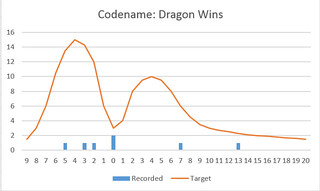
Dragon Chart

The blue bars represent the games I've played and the amount of life the winner had left at the end. The knight is on the left of zero, the dragon on the right. The orange line represents a target for the win distribution I'd like the final game to have. So very few ties, and a roughly Gaussian distribution on either side, but with the dragon as likely to win as the knight (assuming equally matched players).

It's going to be really difficult to achieve this considering the asymmetry in the game:

  • the knight has fewer hit points
  • the dragon has fewer dice, so needs to recuperate more often
  • the dragon's attacks and defence are stronger
  • the knight has the ability to attack and change range
  • the knight has the ability to prevent all damage once
  • the knight has the ability to combo attacks

But it gives me a target to aim for. Clearly what I need to begin with is a shed-load more data. That's where you come in - there's PIPs galore available for helping me to fill in those blanks!

Monday, November 10

NaGa DeMon 5: Since Records Began

A vital part of designing any game is recording ideas, what works and what doesn't and outcomes.

In recent months I've been using Evernote on my phone, iPad and Laptop to record ideas about games along with feedback and information about game outcomes. This year I've also been using it to keep track of everyone's PIP scores (it's much better at that than the way I was using Excel last year).

I generally expect a new game to go through its first few versions very quickly, since the first time you try it there's usually something dreadfully broken that you'd not even contemplated that needs immediate attention - without fixing it the game is so broken that it's not even playable.

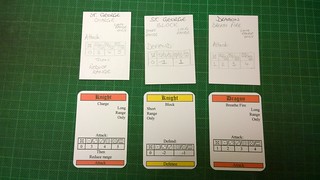
With that in mind my first prototype was a mixture of pen and pencil scribbles on plain white card, I only used pen for the things I was convinced wouldn't change (the names of the characters: St. George and Dragon), with everything else drawn lightly in pencil ready for frequent erasing and amending.

As it turns out after a week of playing I've not changed anything (except the name of one of the characters: now the more generic Knight). So it's time for a component upgrade: I've printed my own P&P files ready for testing this week:

Dragon Prototypes 1 & 2

A disadvantage of my assumption of horrible brokenness is that I've not been recording the outcomes of the games properly. When the components are changing on a daily basis, recording the results of the games in minute detail is a waste of time. You know there's something obviously broken, so knowing that the knight wins 53.3% of games with on average 3.45 life left isn't going to help. Expecting the worse I've made a mental note of who won (me!) and who they were playing (a fairly even mix of knight and dragon) but I've not been recording the final scores needed for tweaking to try to make the game as balanced as possible between the asymmetric knight and dragon. Seeing as I've now played five games and I've just made a new version with no substantive changes I can now start tracking the scores to the point where I accumulate enough data to be meaningful. I've also tried to work backwards and remember the scores from the five games I've already got under my belt.

Hopefully I'll soon have some more data from TGWAG competitors to add to that which I've collected and mis-remembered myself...

Saturday, November 8

TGWAG: League Table 2

It's been a good week, not only have I played Codename: Dragon five times already (without a loss!), but I've also managed to get a first stab at the rules and an initial print and play version up for playtesting. And all this despite having the house turned upside this week due to the double-glazing being done. The double-glazing will be finished by the middle of next week, so things should settle down a bit then I hope.

It's also been a good week for TGWAG. In addition to last week's four competitors (all of whom have gained points this week) we have four new competitors too.

Name PIPs PIAL Free game?
Konrad/@pidaysock 12 Squire Yes
Derek Hohls/@gamesbook 8 Footman Yes
Roberto 6 Footman Yes
Eblasco/@7isprime 4 Serf No
@kimacus 3 Serf No
@toddderscheid 1 Serf No
Mal 2 Serf No
@MTTJ_Patrick 2 Serf No

So we have a few people raised from serfdom, and Konrad has even been made a squire! Heady heights. The big question is: will anyone get knighted next week?

Friday, November 7

NaGa DeMon 4: Print and Play

Just under a week in and already I'm posting Print and Play files!

Codename: Dragon has really surprised me. It's the first time I've designed a game and the first prototype hasn't been so hideously broken that I've had to make sweeping changes - either during the first game or immediately afterwards. I've now played this version five times, three times as the knight and twice as the dragon. The first game resulted in a tie, but since then I've won every game I've played, which implies that it's not so totally random that there's no learning curve that rewards repeated plays.

That's the good news. The bad news is that despite it kind of working how I had hoped and not being too unbalanced or broken, there's been no love for it yet. My testers have been happy to play again and I think are largely still trying to get their heads round how the game works. But no one is clamouring for another game or offering to sell me their firstborn or a kidney for a copy of their own that they can carry with them at all times and foist upon unsuspecting spouses, relatives, friends and strangers.

So it clearly needs some work.

But I'm not sure what. That's where you come in. There's a couple of links at the bottom of this post to the front and back files, both two sheets of A4. If you fancy it please print them out and give the game a go (you'll also need the rules, 29 counters and 8 six-sided dice). There's PIPs by the bucket-load for feedback (especially critical) and ideas.

Please get stuck in!

Wednesday, November 5

NaGa DeMon 3: First Rules!

We're still right at the beginning of November, but things are off to a great start. I've managed to play Codename: Dragon a few times at work this week already and considering how fresh the idea is, the game works remarkably well. Don't get me wrong, it's a long way from finished. But even now it's playable and interesting. I was delaying putting the rules up here until I'd had a chance to play them and check them for glaring problems, but here are the first version rules for critique:

Dragon Dance
Fire v. Lance
2 players
10-30 mins
10+?

Contents:

8 The knight action cards
8 The dragon action cards
1 The knight player aid card
1 The dragon player aid card
9 heart tokens representing the knight's life force
20 gold coins representing the dragon's life force
3 large red dice for the dragon
5 small white dice for the knight

Dragon Dance is a game of bluff, cards and dice between a knight and a dragon in a mortal fight over the King's daughter.

Aim of the Game

The aim of the game is to reduce your opponent to zero life force through cleverly timed attacks without running out of your own life force. Each round you will simultaneously choose a card and a die to action - either attacking, defending or manoeuvering as you dance around each other looking for an opening to exploit. The dragon is more powerful and has more life force, but he's also less agile and slower, so the knight has to strike fast before his limited life force is extinguished.

Setup

Decide amongst yourselves who will play the dragon and the knight. The dragon player takes the dragon player aid, action cards, three red dice and the twenty gold coins to represent his life force. The knight player takes the knight player aid, action cards, five white dice and nine heart tokens representing his life force.

Both players roll all their dice and place them in front of them and place their player aids with the 'Long Range' side face up nearby.

Play

The game takes place over a number of rounds during which the players act simultaneously. Throughout the game the players' life tokens, remaining dice and played cards are kept open so that both players can see them.

Each round consists of four phases:

  1. Choose a die (or none)
  2. Choose a card
  3. Action the card
  4. Discard card and die

Choose a die
In the first phase, both players simultaneously choose either one of their remaining dice, or none. High values boost attacks, low values boost defence and medium values boost both attack and defence to a lesser degree.

During this phase, hide your remaining dice from your opponent and then choose one of them to use this turn (by, for example, placing a finger on it) or choose none (by, for example, placing a finger on the table next to your dice). Then reveal your dice along with your selection. The chosen die will be used to either boost an attack or defence card, or as a bluff to trick your opponent into playing a sub-optimal card.

Choose a card
Once both players have revealed their chosen die (or none), both players simultaneously chose a card to play this turn. The chosen card is placed face down on the table in front of them and then when both players have chosen the cards are revealed. Chosen cards must be playable at your current range, check your player aid to see which cards your can play at your current range, or check the 'Short range' or 'Long range' icons on the cards in your hand. You begin the game at long range.

Action the card
Both cards are actioned simultaneously.

Attacks & Defence
If either player chooses an attack card, calculate the damage they deal as follows:
If they have chosen a die, use the table on the card to determine how much damage they are dealing, if no dice is chosen determine damage using the no dice column in the table.
If their opponent has not played a defence card, they lose life force equal to the damage dealt.
If their opponent has played a defence card, use the table on the defence card (along with any die chosen) to determine the defender's protection as for the attack damage. The attacker's damage minus the defender's protection is the amount of damage dealt to the defender.

Example 1:
Konrad (the knight) chooses a '5' and the Hack attack card and Derek chooses a '1' and the Flap defence card. With a 5, the Hack deals 3 damage, but the Flap and a 1 prevent 4 damage, so no damage is dealt.

If both players attack, the damages are calculated and dealt simultaneously, possibly killing each other at the same time.

Example 2:
Roberto (the knight) chooses a '6' and the Charge card and Todd chooses a '3' and the Breathe Fire card. With a 6, the Charge deals 5 damage, which is unblocked, so the dragon loses 5 life force. Breathe Fire with a 3 deals 3 damage, so the knight loses 3 life force.

Charge
The knight has the Charge card, which is a very powerful long range attack, combined with a reduce range movement. After dealing damage, if any, resolve the movement as described under 'Movement' below. For example, in Example 1 above, the combatants would now be at short range.

Dodge
The knight has a Dodge card which if played reduces damage dealt to him this round to zero regardless of what attack the dragon performs.

Example 3:
Jack (the knight) chooses no die, and the Dodge card. Sam chooses a '6' and the Rake card. Sam's attack would have dealt 3 damage to the knight, but the Dodge reduces that to zero, so no life force is lost.

Combo
Knight has two short range attacks Hack and Slash which have the 'Combo' keyword. If a Hack or Slash is played and deals damage as described in the 'Attack and Defence' section above, the knight may perform a follow up attack. Providing the combatants remain and short range and the knight has his other short range attack card in his hand he may immediately play it (assigning a remaining die if any) as an undefended attack which deals a second round of damage this turn.

Example 4:
Konrad (the knight) chooses a '4' and Hack, while Roberto chooses a '2' and Advance. The Hack deals 2 damage to the dragon, and seeing as it dealt damage, Konrad can use the Combo effect to immediately play the Slash card from his hand (not the discard pile) along with the remaining '1' die to deal a further 1 damage. Roberto's dragon loses a total of 3 life force.

Movement
If either player has played a movement card (Charge, Advance or Retreat) then the range is adjusted:
  • If one or both players 'reduce range' you are now at short range
  • If one or both players 'increase range' you are now at long range
  • If one player 'reduces range' and the other 'increases range' your range remains the same
Flip your player aid cards as necessary to show the range you are now at.

Discard card and die
At the end of the round both players discard the cards they played (face up where they are visible to both players) and any die they used with it. These discarded cards and dice are unavailable to the player until they play the Recuperate card, which allows them to reclaim all discarded dice and cards, returning the cards to their hand. Once they have reclaimed the dice all their dice are re-rolled.

End of the Game

The game ends at the end of the round in which at least one player has been reduced to zero life force. If the other player has at least one life force remaining they are the winner, otherwise the game is a draw and the Princess wanders off.

Monday, November 3

NaGa DeMon 2: Codename: Dragon - Components

I've said before that you shouldn't invest too heavily in the components of your early prototypes since the game is likely to change beyond recognition and those components that you splashed out on or invested hundreds of hours of artwork in are liable to be replaced by something else in very short order.

NaGa DeMon is a slight exception to that rule for me, since at the end of the month, I've committed to sending prototypes to the three most helpful competitors in TGWAG. So I need to make my copy plus three more. Since those three competitors will (hopefully!) invested their valuable time and effort in helping me, the least I can do to show my appreciation is to give them a signed, limited edition prototype that doesn't totally suck. So I want to splash out a little and make the prize a neat little package. So I need some components. Times four.

As I mentioned on Friday, I'm expecting the game to feature cards (which I'm a dab hand at, if I do say so myself), dice and counters. Some dice for St. George and some for the dragon, plus some counters for St. George and some for the dragon.

When I think dragons I think big scaly red beasts guarding a vast hoard of gold (thanks J.R.R. Tolkien!) and when I think St. George I think white and red - the colours of the flag of St. George, the national flag of England which is incorporated into the Union Jack of Great Britain.

So, to separate the dice between players, I've gone for white dice for St. George and red ones for the dragon (the dragon is a bit wordy, he needs a name. Bonus PIPs for the best suggested name in the comments). I went to Travelling Man after work on Friday to get the dice and they had some nice Chessex ones in two different sizes. Since I need more white than red (I think!), I've gone for smaller white ones (bonus: St. George is smaller than the dragon) and nice marbled red and gold ones for the dragon.

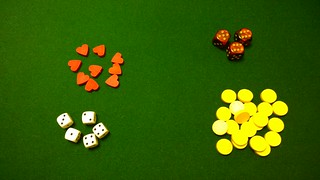
For life counters, I recently bought some red wooden hearts from BoardGameExtras.co.uk for pimping my copy of Love Letter. Thinking ahead I bought a load more for Codename: Dragon purposes. That's St. George sorted, and it fits well since lots of computer games use hearts as the iconography for lives. Which just leaves the dragon. Dragon = hoard of gold. As it happens I've a load of yellow wooden disks left over from the limited edition of It's Alive I published back in 2008. I've hung onto them knowing they'd come in handy sooner or later. Their time has come!

Which give me this:

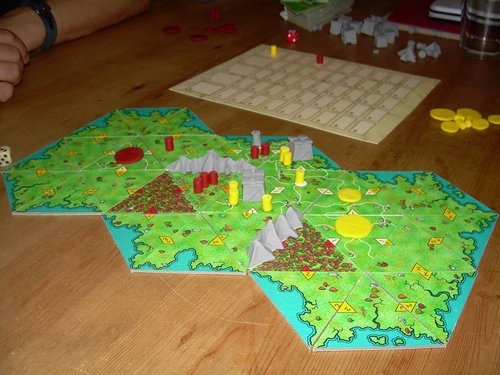
Codename: Dragon Components

Sunday, November 2

TGWAG League Table 1

We're only two days into NaGa DeMon and already The Game Within A Game is off to a good start. We've got four competitors so far competing for three signed and numbered limited edition copies of the NaGa DeMon version of Codename: Dragon.

Konrad and Derek both took part (and won a copy) last year, with Roberto and Todd new participants for 2014.

Name PIPs PIAL Free game?
Konrad/@pidaysock 4 Serf Yes
Derek Hohls 3 Serf Yes
Roberto 2 Serf Yes
@toddderscheid 1 Serf No

My father-in-law is visiting at the moment, but I've managed to bag up the components I think I need for my first copy, and last night I made some basic cards for it too. The cards are hand-scribbled with pencil to enable easy editing when the first version inevitably turns out to be horribly unplayable. I'm going to try to get some games in at lunchtime this week, since I'm pretty sure I can't make Newcastle Playtest on Tuesday after all - it'll be cleaning up after the first day of double-glazing instead.

Friday, October 31

NaGa DeMon 1: Codename: Dragon - A First Look

This time last year I had a first draft of the rules of Zombology, but due to various things I'm not quite so organised this year, but here's what's in my head at the moment. I'd appreciate any feedback on the ideas, what you think might work well or what badly and anything you think I've overlooked. This week we're having our house double-glazed, so I imagine I'll be spending most of my free time cleaning up whichever rooms have been trashed during the day. Also my father-in-law is visiting shortly. I'm hoping to make it to Newcastle Playtest on Tuesday, though I won't know until after Monday's clean up how viable that is.

Codename: Dragon: The Concept

It's a two-player card game about the showdown between St. George (patron saint of England and a bunch of other places) and the dragon. It's a Good Little Game, so 18 cards, some counters representing George's hit points and the dragon's hit points and some dice (a few for each player). One player plays St. George, he has nine cards, a few hit points and several (4? 5?) dice. The other player plays the dragon, with more hit points, but fewer dice (3? 4?).

At the beginning of the game both players roll all their dice. Then each round both players simultaneously choose a card (representing an attack, defence or movement) and optionally a die. Once chosen, both players reveal their chosen card, action them and then discard them and any die they chose.

The cards represent attacks (which do more damage for high die rolls), defence (which work better with low die rolls), movement (between long and short range) and a recoup card which lets you draw back the cards from your discard pile to your hand and re-roll all your dice.

The game has two ranges, long and short. At the beginning you are at long range. Some attack and defence card only work at long/short range and the ninth card that both players have is a double-sided cheat sheet showing which cards work at the current range. Each player has cards that let them move from short to long range and vice versa. If one player advances and the other retreats they stay at the same range, if both advance they are at short and if both retreat they are at long range. If only one player moves then the range changes as appropriate for the card played.

First player to run out of hit points is slain by their opponent.

Some details

The game is asymmetric, the dragon cards are different from George's cards and have different strengths and weaknesses. I'm thinking the dragon cards will be:
  • Cheat sheet
  • Recoup
  • Breathe fire (long range, high damage)
  • Bite (short range, medium damage)
  • Slash (short range, low damage)
  • Block (medium protection)
  • Flap (high protection)
  • Advance (move long -> short)
  • Retreat (move short -> long)
St. George's cards could be:
  • Cheat sheet
  • Recoup
  • Charge (long range, high damage + move long -> short)
  • Hack (short range, medium damage)
  • Slash (short range, low damage)
  • Combo (short range, medium damage, can be played immediately after Hack or Slash if they did damage)
  • Block (short range, low protection)
  • Dodge (all damage avoided)
  • Retreat (move short -> long)

An example card

An example of what I'm thinking to make the above a little more tangible:

Slash (St. George)
Can only be played at short range.
Damage done:
If no dice: 0
If 1/2/3 on the die: 1 damage
If 4/5/6 on the die: 2 damage

Flap (Dragon)
Can be played at long or short range.
Reduce damage by:
If no dice: 1 damage
If 1/2 on the die: 4 damage
If 3/4 on the die: 3 damage
If 5/6 on the die: 2 damage

Obviously, I'm going to have to play this a lot to adequately balance it, but what are your first impressions? Any ideas? Want to help test it when the files and rules available? There's PIPs in it!

Monday, October 27

NaGa DeMon 2014: TGWAG

Last year I took part in (inter-)National Games Design Month (or NaGa DeMon for short): during the month of November you are challenged to design a game. It's extremely unlikely that you'll be able to make a decent quality game in only a month, but like its fiction counterpart NaNo WriMo, the idea is to get a first draft completed. Last year I worked on Zombology, a drafting card game that has ended up being my main focus in the months since I 'finished' it during last November.

I was very keen initially to take part again this year and then umm-ed and ahh-ed a bit as various impediments appeared in my calendar in November, but some of them have disappeared and I've finally come down off the fence on the side of taking part. Yay!

My focus this year will be Codename: Dragon - a 2-player card game about St. George and the Dragon. It'll be a game of bluff and simultaneous action selection with dice and only 18 cards (so fitting with the Good Little Games ethos). Which makes it easy to test (I only need one playtester) and easier for others to print and play. I'll be posting the rules here along with print-and-play files as I make them and would really appreciate your help in testing and refining the game.

As with last year I'm going to run the game within the game (TGWAG) to encourage you, my internet audience to take part and help me make progress in the very short timespan available to me. During TGWAG I award Pointless Internet Points™ to people who help out and at the end of the month the three (down from five last year) people with the highest PIP totals will get a free copy of the NaGa DeMon version of Codename: Dragon, signed and numbered by my good self. Though probably not until January, if last year is anything to go by!

I'll be awarding PIPs to people who help me out by promoting the game or the TGWAG competition (e.g. retweeting my tweets, Google+ shares, etc.) or proofreading the rules that I post here, or giving me ideas or suggestions for new rules or mechanics or, most importantly of all, for printing out the print and play files and actually playtesting the game for me and providing feedback on what you liked and didn't like.

No PIP competition would be complete without Pointless Internet Achievement Levels (PIALs), so here's this years goals:

1 PIP: Serf
5 PIPs: Footman/Footwoman
10 PIPs: Squire
20 PIPs: Knight Errant
30 PIPs: Knight Sergeant
40 PIPs: Knight Commander
50 PIPs: Patron Saint

Interested? Sign up in the comments below and start your arduous journey to Patron Saint.

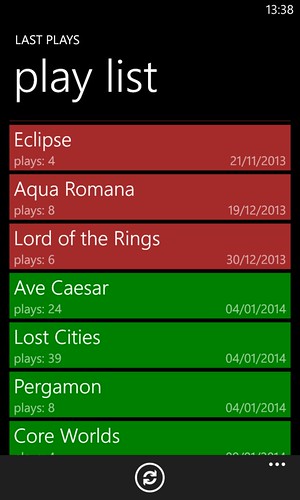
In other news, this week was mostly testing and releasing an update of my BGG Last Plays app. It now supports loading over close/restart, landscape support and sideways scrolling of the game name for games with longer names. Plus a couple of minor UI tweaks and fixing a crash found four times by various users.

In yet further news, my latest Windows Phone app (a super secret, unlicensed board game app that I've been developing as a training exercise and for my own amusement) has been approved by the physical game's publisher. So I now need to get it finished off so that I can add it to the store. It's approved for non-commercial use, so like my other apps it'll be free and ad-free.


Monday, October 20

Holding Forth

It's been a busy week with, thankfully, a boat load of gaming. During the week I got to playtest my secret game app with some friends, which gave me some great new ideas for improving the UI (plus revealed a bunch of bugs I'd not found by myself). Thursday lunchtime we played a couple of 3-player games of Zombology, and despite my fear that the new version (with the ability to hold over a card each round) was too easy we managed to lose both, so the 3-player win/loss ratio for this version stands at 1/2 which to my mind is about right! I still need to make some changes, but maybe not as sweeping ones as I first thought.

My November has also resolved itself. I had been hoping to do NaGa DeMon again, but with the major work being done on our house slipping back into November and my parents planning to visit for a week during November (both during the week of Newcastle Playtest, effectively ruling that out) it was looking like I'd really struggle to make enough progress to make it achievable. My parents have now delayed their visit to the start of December, so I think NaGa DeMon is go again :-) I've an idea for a game I'd like to try to make (Codename: Dragon that I mentioned at the end of last year), and I'll run TGWAG again.

To top the week off in style we drove down south to spend the weekend with my mate Tim and his family. Tim and I go way back, so it's always good to catch up and spend some time playing with our families, plus Tim and I get to game late into the night (or at least what I call late, so gone 10!). This weekend was no different we played lots of games during the day with Tim's son (I was whooped at a surprising number of games by a six-year old - clearly I'm not quite as bright as I like to think!), and then in the evening we played a game Tim is designing, then Thunderstone and finally Tim and I played Firefly until just gone one am. It was a great weekend and Firefly came in around 2.5 hours with the two of us, despite Tim not having played before.

Tim and I spent most of the weekend talking game publishing. Tim's game is coming on really nicely and he's considering KickStarting it. By day he writes computer games for a living so he's got a great understanding about what makes a good game and he know loads of great artists. (As an aside RH Aidley who did the art for It's Alive! and Carpe Astra for me and also Ice Flow for Ludorum Games is someone I met through Tim). Tim wanted to ask loads of questions about the process of publishing a game, so I got to hold forth, wittering on about my experiences with Reiver Games and what little I know about KickStarter. I wish Tim all the best with his game (and now have a copy for playtesting :-) ), but I'm still not sure if I'd want to go back into publishing if ever I consider one of my designs ready for the world. Still, it reminds me that I know a load of contacts and still have a bunch of knowledge about the process and finances of running a game company. I hope I can use that knowledge to help Tim out.

Monday, October 13

My Brain Is Finally In Gear

After several weeks of very little progress on my games design while I focussed on app development for my phone instead, I've finally had a good week of game design progress.

It got off to a good start on Monday night, when I printed out the latest version of Zombology, which has sat on my hard drive for several weeks if not a month waiting to see the light of day. There were a couple of problems I spotted after printing that I didn't have time to correct, but I'll fix them up before the next version.

Tuesday was the October meetup of the Newcastle branch of Playtest UK. With new Zombology in hand we started off with a couple of games of that - it's becoming a habit to start with Zombology as it's short and supports lots of players so we can play a couple of games of it before splitting into smaller groups for other games. We tried the new rules which I mentioned a couple of weeks ago, and as I feared at the time, they require more changes to be made. Opinion on the new rules was split with Dan and Paul preferring them and the others either on the fence or preferring the old rules. With twice as many decisions to make and the ability to hang onto a card you definitely felt a lot more in control, but the downside was that the Cure cards were all hogged in the second half of the game, so the initial deal was more important. Either way, the new version was way too easy for the players to win, so I'll have to address the card balance if I continue with the new rules, as well as come up with something for the Cure-hogging possibly.

Border Reivers Second Edition

After Zombology we split up and I got to play 54 Jones, Paul's game about Sci-Fi Sewer Surfing Cleaner Clones. As ever it was very entertaining, and this version was the slickest I've played so far. Then we played another Zombology (with Alex who'd missed the first two games) and then a couple of side-by-side Border Reivers, using the bits from the four players limited edition to cobble together two two-player games. Paul had played the limited edition rules last month, so this time we all played some of the ideas I've had for a new version. As is to be expected for a first play, it was pretty unbalanced, so I've got a bunch of changes to make before I play it again.

Thursday lunchtime we got a couple of games of Zombology in (three and four player, so I've now played this version with 3, 4, 5 and 6) and yet again they were player wins, further convincing me that it needs tightening up again.

Finally on Saturday I made it to Newcastle Gamers for a few games. We played Trains (new to me), Carcassonne the City (on my list of games to play this year) and Love Letter. Trains was suggested by Olly as something a little like Codename: Vaccuum that I might want to play for research purposes. As it turns out it gave me some new ideas.

On top of all of this, I've been cracking on with my board game app on my phone and I really ought to put out another update to my BGG Last Plays app to fix a crash reported in the wild and a couple of minor things suggested by friends.

Busy, busy, busy!

Monday, October 6

Zombology Upgrade

Yet another week of no real game design progress. Thankfully, all that is about to change. It's Newcastle Playtest again on Tuesday and it looks like it's going to be a busy night - three new members have signed up via Meetup.

I'm going to spend tonight finally making the new version of Zombology I talked about several weeks ago, so it'll be ready for Playtest on Tuesday. The only differences to the components are replacing the three remaining serious scientific suits with ridiculous ones and smartening up the art a bit in the places where I hadn't got round to it in the previous version. I've also got the new idea I had last week to try out too. One of the critics of the current version is Paul Scott from Newcastle Playtest. He's another person who finds it too random - a problem the new idea will hopefully address. I'm looking forward to hearing whether he, in particular, prefers the new version to the old. It's been a few weeks since I last played Zombology, it'll be good to make some more progress on it once again.

I also need to start thinking about NaGa DeMon. NaGa DeMon was a huge success for me last year. It was the birth of Zombology and the busiest month I've had on my blog by a country mile, so I'd like to repeat it this year if I can. It's going to be a bit more awkward though this year. My parents will be up for a week in November and I'll probably miss Newcastle Playtest due to their visit. We're also having some major work done on our house, so I'm going to struggle to find the time to design, iterate, playtest and blog during November. I've considered giving it a miss this year, but at the moment I'm still hoping to go for it. We'll have to see how things go...

Monday, September 29

A Breaking Change?

Not much to report on the game design front again (apologies to those of my readers who are coming here for game design!). I've not played many games this week, just Eclipse (for the second week on the trot) at Games Night. I tried to arrange another Zombology for lunchtime during the week, but yet again couldn't raise a quorum for it.

I have had an idea for Zombology though. Ok, that's a little disingenuous. Several of my playtesters have had the same idea, and after months of brushing it off as something that would over-complicate the game, I've finally decided to give it a try.

It's all been sparked by The Wife's criticism that she didn't feel like she had any control. When she said it it made me think back to a bunch of other people who had had the same criticism. So I thought about it, and 'I've had' this idea that might help. Zombology is a drafting game, like 7 Wonders, where every turn you play a card from your hand and pass the rest on to the player on your left. I like the fact that the draft gives you some knowledge about what's available in this particular game (since not all the cards are dealt in each game), and it allows you to play cards based on the knowledge of what you've passed to your neighbour. The downside is that if you're dealt a handful of great cards that can't be played yet, you have no choice but to give them to someone else.

The idea I've shamelessly stolen from my playtesters is to play a card, and keep a card, from each hand, passing all but one of the remaining cards on. Suddenly there's twice as many decisions to make in the game, which card to play and which one to keep each round. Do you keep the same one over many rounds and play it at the end, or play the kept card and chose a different one to keep next round? Do you keep an event card to prevent another player from playing it, or keep an excellent science card for the end game?

The pros of this idea are hopefully:
  • You feel a lot more in control
  • Twice as many interesting decisions
  • Opportunities to block opponents' attacks
  • No changes to the cards necessary

The cons are likely to be:
  • The cards going round are more crap as everyone is hogging the good ones
  • More decisions means longer play time
  • Might require sweeping changes to the cards

Notice something about the last item on each list? The change is an incredibly minor one, just a couple of new lines in the rule book, no card changes or new artwork required. But I fear it will drastically change the dynamic of the game, making it far easier to win and unbalancing all the strategies I've spent nearly a year balancing to a fine point. Once I've tried it a few times I should know whether I need to go back to the drawing board again, re-building the decks from the ground up to fix the balance again. Of course, it might not even help with the control aspect, so at least I don't need to make any changes to try it out.

In other news, this week's free time has mostly been spent making a board game app for my phone. I make a trip or two a month to Manchester with my boss (usually) on the train. That's six hours that's often spent playing games on my iPad. I'm making an app for my phone for a simple game that I can't get on the iPad. It's not something that I'm going to publish, seeing as I don't have the license to do it, but it'll be fun for my own enjoyment and I'm learning new stuff as I make it. It's already playable if you know the rules, but it doesn't restrict you at all, so it's very easy to make illegal moves. That's the next step - make it force you to play by the rules!

Monday, September 22

Gone Digital

Not much progress this week on Games Design, because I've been focussing my efforts in the digital realm. Last weekend we got a new PC, replacing our knackered old laptop (I think it ran on Windows 1885) with something a bit more modern. It came with Windows 8.1, which has the added bonus of being able to develop Windows Phone apps on it. I also got my phone back on Monday (with a new motherboard!), which meant I was in full digital flow again.

Early in the week I released a new version of my BGG Last Plays app which fixed a crash found by my mate Mal, tweaked a couple of things in the UI and included games in your collection you'd never played (an oversight - since I don't have any unplayed games I didn't think to check!). That also meant that expansions were included now too (though as before you can hide any games you're not interested in).

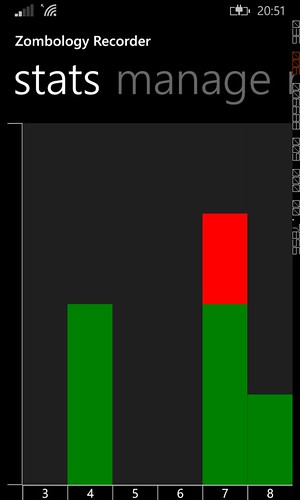
The rest of the week was focused on developing a recording app I'm making for Zombology. Now that Zombology is fairly stable what I need to do is play it a lot of times and see whether the win/loss ratio is where I want it, and check it's consistent across different numbers of players. So I've written a little app to record this information and present it graphically for quick reference. It's nearly done, just the graphing of the results to finish off.

ZombologyRecorder

After that I've a couple more app ideas that I'd like to knock up, one which is a little project that I doubt I'll be able to make available for license reasons, but it'll be a fun little project and I'll use it, the other is an idea that might actually be saleable! But that's a bigger job, and further off.

On the games front, I've not even played Zombology this week, I was unable to form a quorum (of three including myself!) for a lunchtime game during the week and at Games Night we just played Eclipse (another one ticked off my games to play this year list).

However, The Wife played Zombology last week and found it a little too random for her tastes, she said she didn't feel like she had enough control. I'm fine with some of that in a ten minute game, but thinking about it that tallies with a similar criticism from Paul Scott at Newcastle Playtest, so perhaps I need to address it after all.

Monday, September 15

Zombology: Evolution

As most of you know, Zombology started life as my attempt to do a NaGa DeMon game. In November last year I set myself the goal of designing a game in a month!

Of course, I knew it wouldn't be finished by the end of November, but I wanted to make something playable in that time. I decided on a quick card game as that would be the easiest thing to make. With only a month I wanted something that I could iterate quickly: both the rules and the components, posting new versions of the rules, playtesting the game frequently and incorporating the feedback quickly into new versions that could then be tested too.

By the end of the month I'd been through five versions of the rule book and I'd played it sixteen times. And, as a bonus, it kind of worked as a game. But that's not the end of it. In the following ten months I've played it another sixty odd times, there have been another five major updates to the rules and the components have gone from incredibly basic to slightly more polished (with basic art and everything!).

The games has morphed from an every-man-for-himself drafting game for 3-10 players to a semi-co-op drafting game for 3-8 players. It's morphed from sensible science to ridiculous science (Vegan Diet as a potential cure for Zombies!?). But at its heart it's still the same game - a quick, silly, science-themed drafting game with some take that and some collective suit building.

It's now at the point where I've got to make a decision what to do with it. I think it's a fun little game for playing at the beginning or end of a night - perfect filler material. The options I'm considering at this point are:
  • approach one of the publishers I know from my Reiver Games days
  • or, make it available print on demand through Drive Thru Cards or the Gamecrafter

There's a few publishers that I'm comfortable approaching, though I've no idea whether it's the sort of thing they are interested in. Perhaps that needs to be my first step.

On a related note, before I sent my new phone off for repair (the camera stopped working when I upgraded to Windows 8.1), I starting working on another app for my phone. This one is for personal use: it's to record games I've played of Zombology and the win-loss ratios by number of players. Now the game is settling down I need to get a better idea of how well balanced it is. I've also invested in a Windows 8 laptop to replace our archaic, glacially-slow one. This means that I can now do Windows Phone app development at home, rather than just during my lunch breaks.

Monday, September 8

Reavers! Incoming and Heading Straight for Us!

Bonus points if you get the title source. Most of this blog post isn't actually about that kind of reaver though, it's about Reivers. With an 'i'. Border Reivers to be precise. In 2002, after an incredibly long and unsatisfying game of Mighty Empires, I had an idea for a light civilisation/wargame that eventually became Border Reivers. Published in 2006, I made 100 copies by hand and sold them all over the world. It was the first game I designed and the first game I published, and while it obviously holds a special place in my heart, it was one of the weaker games I published, which partly explains why I never reprinted it. Over the years (as this post attests) I've toyed with the idea of doing a second edition, with some changes to fix the reported weaknesses, but nothing ever came of it. After the poor sales of Carpe Astra I lost confidence in my ability to design games and decided that I needed a checkpoint between designer and publication which I could provide for other designers but couldn't for my own designs, since I didn't have the required distance to objectively critique my own games. So Border Reivers II withered and died.

Until a month or so ago. As part of my goal to play all my games at least once this year, I played a game of Border Reivers against my boss at the end of one of my Games Nights. He crushed me like the proverbial grape, in part assisted by some lucky reinforcement dice rolls - which relates to one of the criticisms I had received about the game.

So that got me thinking about Border Reivers again and, now I'm not looking to self-publish and have the excellent Newcastle Playtest resource available to me, I've decided to brush BR2 off again and see if I can do anything with it. On Tuesday it was the aforementioned Newcastle Playtest so, as well as a new version of Zombology, I took Border Reivers along. There was lots of interest in playing it, but one of the changes I'm keen on is to switch it from 2-4 players to 2 player only, so Paul Scott and I had a game. We played the good old-fashioned rules, and then at the end I asked Paul for ideas on how to improve it, before a lengthy discussion about the criticisms I'd received from players/owners of the first edition.

Border Reivers is a light wargame with some civilisation aspects, set on the English-Scottish border during the late middle-ages. It was a time of continual skirmishing along with frequent livestock-rustling (or reiving as it was known). In the game, you start with a city and five armies and have to cultivate your territory, raise armies, build fortifications and settlements as well as going to war, ambushing and reiving your opponent. In the original rules there were two ways to win - either by annihilating your opponents (which only really happened in a 2-player game) or by being the first to accumulate 40 cash. Each turn you got to gamble on reinforcements, either armies or cards that gave you several interesting hidden tactics to assault your opponents. You spent an amount of cash between 0 & 9 and then rolled a D10, if your die roll was less than or equal to your spend, you got a reinforcement. Lots of people really didn't like this and, in fairness, lucky dice rolls early on could really swing the game. One of the ideas I've had is to keep this mechanism, but take away the chance of a free reinforcement and reduce the variability - i.e. roll a die with fewer sides. I'm also considering replacing the cash victory condition with a victory points one, where you get victory points for a variety of things throughout the game. I'll need to try some of these ideas out over the next few months and see which of them stick. Mal, I'm assuming you're up for a game?

Border Reivers prototype from back in the day

Back to the title, after the crazy success of my BoardGameGeek collection Windows Phone app (now up to 9 downloads, that's got to be almost everyone who owns one, right?) I've now published my Firefly: The Game app too. This one is designed to streamline the Full Burn movement action in the Firefly board game by reducing the number of 'move a piece, draw a card' cycles you have to go through. It's called Keep Flyin' and is available in the Windows Phone Store now.

Keep Flyin' my Firefly: The Game Windows Phone app

Finally, we played a couple of seven-player games of Zombology at Newcastle Playtest on Tuesday. The new version has another card type removed, more of the new style art and a few informational changes requested by testers. It went pretty well and on the train on Wednesday down to Sheffield for my quarterly MS check up I made some more cosmetic changes to the cards. This is feeling pretty finished now, so I ought to step up my efforts to contact some publishers.

Monday, September 1

I'm Published!

But not in the way the you might think. On Friday I submitted my first app to the Windows Phone Store. It was accepted within the hour and was available to download two or three hours after that. A twitter, BoardGameGeek and Google+ announcement later and it's got 5 downloads! 5! As far as I can tell that means that about 80% of the worldwide Windows Phone ownership have installed my app. How's about that for market penetration?

The app, BGG Last Plays, is available for WP8 and 8.1 from the store as we speak. It's a Windows Phone port of the excellent http://lastplays.herokuapp.com, with a couple of improvements that I wanted from the web original: it caches your BGG collection, so you don't need to wait for the download every time and it allows you to set a date, any games that you haven't played since that date are highlighted in the UI and on the live tile. More info is available here.

In addition to publishing that at lunchtime, I also finally got the next version of Zombology finished on the computer on Friday night, plus got it printed and cut out. I didn't get it done in time for a potential Playtest session on Thursday, but it is ready for Newcastle Playtest this coming Tuesday. It's been ages since I last made a prototype, it felt good to be crafting something again.

Talking of Newcastle Playtest, I'm thinking of taking Border Reivers along with me this week. I've had some ideas for things I could do for a second edition, so it would be good to try those out with the team and get some fresh ideas from them for further improvements.

I've also got four hours of train journeys on Wednesday for my quarterly hospital check up that I'm going to spend on the laptop writing blog posts and probably doing some Codename: Vacuum work. After a week of nothing gaming related the week before last, I'm back!

Monday, August 25

Iconic

This week I've done nothing particularly relevant to the blog at all. This weekend (today is a Bank Holiday in the UK) we've had lots of family up for The Daughter's second birthday and we spent most of last week preparing for the visitors and the party.

So, what to talk about? I've arranged a playtest this week on Thursday with my colleagues at lunchtime, as much as anything to force me to finish off the next version of Zombology ahead of the next Newcastle Playtest session on the following Tuesday. There's a bunch of graphics stuff to do in InDesign ahead of printing that out, so that's how I hope to spend the beginning of next week. It's been several weeks (maybe even a couple of months) since I last played it at work, so there have been a few changes since my colleagues have last played it. It'll be interesting to get their feedback on the changes and see what they make of the new version.

The new version also features some artwork that I've actually got permission to use. The previous version featured a hotchpotch of random images culled from Google, which seeing as it was just for personal use, I figured was alright. But the game looked a bit of a mess and the lack of rights concerned my puritan views on copyright, so I've finally got around to sourcing some legitimate artwork. Seeing as it's all come from the same place it all looks similar too, which ties the game together nicely.


So what is this source of free art I hear you ask? www.game-icons.net. It's got over 1,300 icons that are freely available for use under Creative Commons, that you can even modify to better suit your particular project. These files are available as pngs or SVG vector art which make them easy to modify in a tool such as Adobe Illustrator (which I got as part of the InDesign Creative Suite while I was running Reiver Games for laying out and submitting art to the printers). I've tweaked almost all the art I've got from there, but without the starting point they provided I'd never have ended up with anything that looked half as cool. It's plenty good enough for prototyping, playtesting and submission to a publisher.


Monday, August 18

What a Blinder!

It's been a really busy week this week, both gaming and non-gaming. We're having a load of family up next weekend for a birthday party for The Daughter, so we're trying to sort the house and garden out a bit in preparation for all the visitors. On top of that, I've done a trip to Manchester for work and we've been to York for the weekend to see Paul and his family.

The week got off to a great start with some really detailed feedback for one of the two people who signed up for blind playtesting Zombology a couple of months back. He'd asked some questions about the timing of various things on receipt of the rules, which I'd given a really crappy answer to (the low quality of my answer was one of the things that encouraged me recently to address the timing resolution in the game). After that I'd not heard anything from him, so I'd assuming the shoddy response had put him off trying the game. This week I got a response from him detailing the four times he'd played with different groups and what everyone thought of the game along with some identified weaknesses and some ideas. He apologised for the delay getting back to me, he'd wanted to leave it until he had a bit more data. This was exactly the kind of feedback I was hoping for when I requested play testers, so it was very gratifying to receive it, especially as he's keen to continue testing it with the recent changes.

I took Thursday off work to wait in for a tradesman, and after exhausting myself in the garden I got an hour or so to update the Zombology rule book to the newest rules that I have in my head. Now all I need to do is update the cards as well and then print out the new version. In the evening we had a great Games Night with eight (!) games played, but the late night hurt me the next day when I had to be up at 5am for a trip to Manchester. Fortunately there was copious coffee to keep me conscious and Steve (a former Games Night attendee) and an iPad full of board game apps to keep me company on the six hours of train journeys. We chalked up another nine games!

This weekend we went down to see Paul and Lisa in York. Paul was my main playtester during my Reiver Games days, so I took Zombology again. We played it twice with his friend Chris along with six other games, so another great day's gaming. 24 games in 3 days! It was a great weekend catching up and playing games, plus hanging out with the kids.

I also started knocking together the cards for the new version. I doubt I'll have time before the party to finish them off, but hopefully next week in time for the next Newcastle Playtest.

Monday, August 11

Rush Job

This week was Newcastle Playtest again on Tuesday, but with guests visiting last weekend, I'd had no time to prepare for it so I went along with Zombology and Vacuum with none of my intended changes made to either. Newcastle Playtest is going from strength to strength, we had seven people, six of whom were regulars and designers and Olly, who's been a few times before as a tester.

To begin with Paul T wanted to try out a few mechanic ideas he'd had that he wanted to test. He'd brought a load of brightly coloured dice and matching Hot Wheels cars, which made it much more fun! We tried a few ideas, and suggested a few of our own, which hopefully will help.


After that, there were five of us, so someone suggested Zombology. I'd not made the changes I wanted to try out, but Graham had a pen and I had 100 cards, so I quickly put the two together and scribbled a small number on the top of each card, allowing me to test the idea that Dan had suggested the previous week. No sooner had we finished that game than Dan arrived, so we played again with six players. We won both games, and in fact in one of the games two players tied on points, needing the Cure as a tie breaker, so reducing the cures to value eight meant the scores were much tighter.

The timing thing seemed to work, there were a few suggestions for how to make it more obvious that all cards with the same effect happened together and that number was there only to break ties. I've had another of my own for clarifying that too.

Afterwards we split up and I finally got play Graham's flower nursery game, which was very interesting, and extremely well crafted considering how few times it has been played.

Over the next few weeks I'm going to struggle to find time to update my games as The Daughter's second birthday is fast approaching and we're having a bunch of family up for a party. The house and garden need a bit of attention so that's taken priority over games design.

In other news, I've 'finished' my Last Plays Windows Phone app, in the sense that it does everything I want it to do now. It need polishing before I could put it in the Store, but essentially it works. Unlike my new phone. I updated it to Windows Phone 8.1 and the camera stopped working. Everything else is fine, but the camera won't work from any app. I've tried rebooting the phone and even a factory reset, but to no avail, so I guess I'm going to have to send it off to the shop :-(

Monday, August 4

Timing Is Critical

As I mentioned last week, when I discussed an idea I'd had for Zombology with Dan (the other Newcastle Playtest organiser) he promptly countered with another idea which blew my idea out of the water. So, I'm going to steal his idea shamelessly. Here it is:

I've had a few problems with timing in Zombology. Each round the players simultaneously choose a card to play in secret and then simultaneously reveal them. The cards then get resolved in a rough sort of order: Upgrades, then Events and then Science cards. But within those groups it kind of all happened semi-simultaneously. Most of the time this was fine, but I'd come across a few problems with particular situations, and by far the longest part of the discussion about Zombology at the last Newcastle Playtest session was about one of these edge cases where the semi-simultaneity meant that the rules got really complicated and a little bit broken. I've also had a rather awkward conversation with one of the blind playtesters about how a particular card works if multiple people play it in the same round.

As a result of these types of problems the rules explanation is either not descriptive enough to cover edge cases, or so ridiculously wordy that it feels more like a legal agreement than a simple card game rule book.

Dan's solution? Number each card and then resolve them in number order. That's so simple that I can explain it in ten words. Ten. One of the games I've been considering as a guide while I design Zombology is 6 Nimmt! It's very quick, has simultaneous card selection and can get quite brutal as the cards are actioned and someone inevitably gets shafted. How does 6 Nimmt! solve the card resolution? You resolve them in number order. Genius! Why didn't I think of that? Seriously, why did I need Dan to point that out?

It solves all the individual problems I've been having and in a way that is simple to explain and understand and that cannot be debated during gameplay or lead to rules lawyering. Card 3 happens before card 5. Full stop. It allows me to be prescriptive about the order in which particular cards happen (if the Fatal Mistakes need to happen before Pay Rises to make sense, all I have to do is give them lower numbers) without bulking out the rules explaining that you must do A before B. In fact, it will take a lot of words out of the rules, making the explanation shorter and easier to understand.

Timing is critical to so many games - actions must happen in a particular order to make sense and to frame the game in a way that is fair to all players. I'd been focussing so hard on making the individual cards work alone and in conjunction with each other that I'd neglected to take into account the flow of the game. There had been warning signs in the form of awkward email explanations and long discussions about which cards relied on which others, but I'd brushed them aside. I really hope that when I finally get round to making a version with this improvement in it will be another leap in game quality - making things much smoother and simpler to explain.

It's Newcastle Playtest again this week, but due to the busy week last week and then guests over the weekend I've not had a chance to incorporate my new ideas into either Zombology or Vacuum :-( I'll just be going as a playtester this month instead.

In other news, my boss Ian and I played Border Reivers at the end of Games Night on Thursday. I'd not played for four or five years and it was Ian's first game ever. I was a bit rusty on the rules, but that was no excuse for the absolute beasting Ian delivered, crushing me at my own game in fairly short order. It highlighted a few of the flaws in the game that I was already aware of, and now I've got Border Reivers Second Edition in my head too. And also in Evernote. I need to finish something off and work on fewer games at once!

Sunday, July 27

Space to Think

I've spent the last week in the Lake District with my in-laws (4 of them!). It's a beautiful part of the country with rugged scenery, fantastic walks and peaceful lakes. With six adults to one child, the staffing ratio was such that we could relax and chill out, and the lack of any mobile signal or broadband internet meant that there were no distractions. We had a lovely time, walking, eating, relaxing and gaming (my sister-in-law and her husband are usually up for a game, and The Wife and her brother are occasionally).

The view from our cottage

We did a few walks of around 4 or 5 miles with some decent climbing involved and it felt great to not be hampered by my MS, even though I was carrying all forty stone of The Daughter in a rucksack carrier on my back (note for Americans/Europeans: forty stone is 560lbs or approximately 250kg, she doesn't really weight that - she's only two, it just felt like it). In the past I've struggled with shorter walks on my good days so it felt great to be able to crack on without the exhaustion that can accompany significant exertion. I even felt like I could have kept going, maybe doing as much as seven or eight miles. It's an amazing feeling. It was probably better to have stopped when I did though, it was better to stop wanting more rather than run myself into the ground and risk injury through over-tiredness.

Gaming wise, we mostly played short games, with Martian Dice (only bought a week or so ago!) the clear winner - we played it a lot. On my return I also made it to Newcastle Gamers for what must be the first time in at least three months. I just missed out on a game of Splendor, so I sat and watched that while chatting to Dan and Gareth who were playing. Gareth reckons it would be a hit with my gaming group and he may well be right, though I'll play it a few times before deciding whether or not to get it. Afterwards we played K2 (another one ticked off my list of games to play this year) and then Cavemen: The Quest for Fire. We got the auction rules wrong on this one, so it's hard to form an opinion on it.

While away I had plenty of time and space to think about the games I'm designing. I'm still trying to think of cards to replace the Open Cage / Containment Facility pair in Zombology, but I did manage to come up with a solution for the confusion of who plays their cards first when multiple players play events in the same round. I'd tell you all about it, but I told Dan at Newcastle Gamers on Saturday evening and he came up with a much better idea, so I'm going to steal adopt that instead.

I also had some ideas about Codename: Vacuum while I was away. I've done absolutely nothing with Vacuum since January, struggling to think of ways to reduce the bookkeeping elements of it, while keeping the feel of the different strategies. I had an idea about how to streamline trading that I think will improve things. It also has the added advantage of simplifying the game too. Now I need to knock up another prototype of Vacuum as well...

Monday, July 21

Once Bitten

I'm on holiday this week, so here's a blog post I wrote last week and tried to post automatically, while didn't work, hence a day late. It'll take me a few days to respond to comments, since there is apparently no mobile signal or broadband where we're staying...

As many of you know, several years ago I started Reiver Games to publish my first board game: Border Reivers. Over five years I published four games (one of them twice!), to limited success before shutting the company down in 2011 and writing off a loss of several thousand pounds.

Now I'm designing games again and, for the first time, thinking about submitting games to other publishers. I'm also hanging out with other designers more too. Most of the designers I knew in my Reiver Games days were self publishers and most of them had been doing it for years. Noticeably, they are still going now and I'm not, so they were clearly better at it than me. In contrast, most of the designers I hang out with nowadays are not intending to self-publish but want to get their games published by existing publishing companies.

Getting my current crop of designs published by an existing publisher is one of the routes I'm currently considering, yet it's a route I've got no experience of whatsoever. I've never pitched a game at a publisher, so I don't really know how to do it. I know what I wanted back in the day, but that may not be representative of what a more successful company wants.

If I'm going to self-publish, or print on demand publish, then the game needs to be absolutely awesome as I'm the final gate before publishing. There's no-one else to block publishing if they don't think the game is good enough or to do any development to get it up to scratch. I look back on the games I published and although I was happy with each one at the time, knowing what I do now about game sales I don't think they're good enough. They needed more development or a gate saying 'not ready yet' to prevent me wasting money publishing games that wouldn't recoup the costs I invested in their publishing.

If I'm considering another publishing company do I need to polish it so much, or will they want to do some development and polishing themselves? I just don't know. Will they accept a game with potential that still needs some work, or do they want a completely finished product? I've still got some games industry contacts from my Reiver Games days. Perhaps I should do some investigating...

Monday, July 14

3,000

I started recording my boardgame plays on BGG back in August 2006. Since then I've religiously recorded every play of a published game I've had. During my Reiver Games I didn't record plays of prototypes, which means the actual count is much higher, but it's still an indication of just how ridiculously obsessed with board games I am.

The reason I mention this is that the number of games I've played over the last eight years according to BGG is 2,999. Which is a big number. It's more than one game a day on average for eight years!

What will be my 3,000th play? I nearly made it to Newcastle Gamers on Saturday for the first time in several months, but was thwarted at the last minute. So it could have been anything. There's Games Night on Thursday, potentially a Zombology Playtest before then at lunchtime. Or it could even be something with The Wife one evening if we're not too knackered.

In other news, I've started my third Windows Phone app (before finishing the other two, of course!). It's based on the last plays app I came across on BGG. I've been using that web app for the last seven months to keep track of which of the games I own I've played this year, as one of my goals for the year is to play all my games at least once. The app was down for a while, which made me think of doing my own version, which is now half finished. It's as fully-featured as the web one, but has two extra things that I find useful:

  • It colours things according to whether they've been played this year or not,
  • It saves the results, so you don't need to query BGG every time you look at it.

It needs a few more things before I can make it available - the ability to configure the user and colouring and I want to be able to select games to ignore (i.e. hide from the results). Still, it's pretty simple, so it shouldn't take long...

Monday, July 7

Ding! Ding! Half-time. Change Ends.

We're halfway through 2014, so I figure now would be a good time to review my progress against my goals for the year. So here goes:

Games Design

Let's start with the bad news. My games design goals were to make four new versions of Codename: Vacuum, make some progress on Dragon and get Zombology ready for hawking to a publisher/self-publishing. I've done nothing with Vacuum since January, so only one new version so far this year and I've not touched Dragon (though that will probably be the focus of my NaGa DeMon efforts this year). Zombology has been my main focus for the last six months. I've made good progress, but this last week's feedback (see below) has made me think I'm not as close as I was hoping. But there's still four months to go so I might yet hit this one. Vacuum is looking more doubtful.

Blogging

My blogging goals were to get 40K page views and 10 new followers along with posting every Monday (plus more during NaGa DeMon in November). I'm at 19,200 page views, which considering the massive bump I got last November means that I should be able to hit that assuming I do NaGa DeMon. I've got three new followers, so that one is looking pretty difficult - I'll probably miss it; but I've not missed a Monday yet, so that is looking good too.

Gaming

I had two goals from a gaming of point of view: play at least 365 games this year and play every game in my collection at least once. On the first point I'm doing very well: 274 games in the first six months of the year, I'm pretty sure I'm going to ace this one! And on the second point, I've got nineteen games in my collection yet to play (excluding nine games that I've excluded for sentimental or other reasons). This should be pretty achievable too, but I think a few of those will probably leave my hands in search of more accommodating owners. Citadels, Cleopatra and the Society of Architects and Pirates of the Spanish Main are currently candidates for jogging on. Qwirkle, Tigris and Euphrates and Snow Tails have already left the stable.

In other news, it was Newcastle Playtest again this week. We started with a couple of games of Zombology and it got pretty mixed feedback this time, those people who enjoyed it last time seemed to enjoy it again, but Paul in particular really didn't like it. He felt like he had no control and no idea how to win. It's a ten minute game, so I'm ok with it feeling pretty random, but I don't want it annoying people. I've also heard back from a couple of my blind playtesters. One of them emailed with a few rules questions that will help me improve the clarity of the rules, the other has played it once. He was generally positive, but said it needed work and had a bunch of suggestions, so I think I need to go back to the drawing board and address these concerns. I'm thinking of taking a couple of types of cards out, but that leaves me with some slots to fill - ideally with cards that make it more interactive and fun without becoming more complicated. Hmmm.