Monday, July 29

Playing the Percentages

After printing out the next version of Codename: Vacuum last week, I got it to the table on Thursday lunchtime. The new version had some minor tweaks to reduce the Population strategy's dependence on capturing locations, and some changes to the Trade strategy to the same end. To reflect the new trade rules I also changed several of the advanced decks to make them fit better with the new Trade rules.


The new version was well-received by my playtesters, Chief and Dave though due to the selection of advanced decks available to us none of us chose to pursue the Trade strategy - so it's hard to say how well balanced that one is.


Despite getting no feedback here last week on the new level three art, Dave was appreciative (though Dave is very excitable, so his responses need to be calibrated to take his general excitement into consideration). Certainly I prefer it to the really crappy last version, and the new art didn't detract from the game or make it harder to comprehend.


Anyway, to the subject of this post. I've now played 60 games of Codename: Vacuum. It's predominantly been played with Chief and Dave (probably 40-odd games each), plus a bunch of other people have played it I'd imagine on average five times or less. Pretty much all the players have been close friends of mine, so any feedback I get from them is coloured by their friendship with me. If I had to grade them into three categories, I'd say that two of them really aren't fans (though apparently it's not their sort of game), one (the aforementioned excitable Dave) is a big fan, and everyone else is ambivalent. They've usually played it a few times but there's little interest in playing it again. Clearly it still needs lots of work (though in fairness, most of the ambivalents haven't played the last few versions).


I'm keen not to try to publish (either self-publishing or trying to get someone else to do it for me) unless I think it's genuinely great. I've some experience publishing games that didn't get enough people excited and the last thing I want is to be the proud owner of games mouldering in a warehouse for years again. I could make a hand-made run - I'm pretty sure I could sell one hundred copies of the game as it stands - but I want to be really proud of it, not just publish it for the sake of publishing it (I've done that already!) and spare time is precious now that I'm a father. So I need to keep working at it to change those percentages. It needs to be simpler and quicker and more fun. It needs to leave you wanting another game, and then another. It's not there yet. I need to work those percentages until most of the people who play it are big fans or hate it. Ambivalence is the worse of the three!


In other news, I've decided to make a little app for my Windows phone. It'll pick me a random selection of advanced decks for a game and I'm also thinking of making it store and explore the data I collect for a game so I can investigate how balanced the decks are by querying their popularity and how well they score. I'll need to get a few dev kit things together and then spend some time on it. It shouldn't be that hard though, it's programming in the language that I use for my day job!

Monday, July 22

Procrastination of the Highest Order

I've not made much progress on anything the last couple of weeks. The week before last ended with us all coming down with norovirus, one after the other (which for the record was awful, I can't recommend it!). This week, it's been a game of catch up as The Wife and I have tried to regain our strength while washing everything that we own, since The Daughter was sick on it all, followed by a weekend away with old friends.


Rather than putting the limited time I had to good use and re-writing the rules (which I still haven't done!), I've been fannying on doing unimportant stuff like art (which doesn't really matter for a prototype) and getting another version ready for printing (of rules that I'm not sure will work). My tenuous excuse for putting off writing the rules is that I'm still trying out a few new rules ideas, so things are in flux, but if I'm honest, it's a big job and a hard one, and I can't be arsed at the moment.


Monday was potentially a good night for Game Design, since The Wife was out at the theatre with a friend, but in the end once I'd finished cleaning up I was so knackered I just went to bed.


What little time I've had available I've put into doing a couple of things, re-doing the artwork for the level three (futuristic) cards, and getting another version ready for printing out and assembling. As I've mentioned over the last couple of weeks I've been messing with the trade strategy rules in an attempt to decouple them from needing to own lots of locations. Since I ought to be knocking up a new version this month anyway, I've taken the opportunity to take the new Trade rules I'm trying out and re-jigged all the advanced cards so that they fit with these experimental rules. I've also folded in the new artwork.


All I need to do now is get the new version printed, cut out and tested to see how it all works.


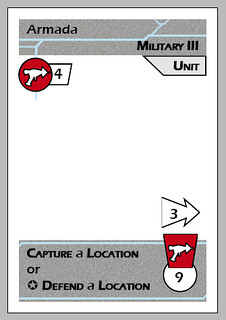
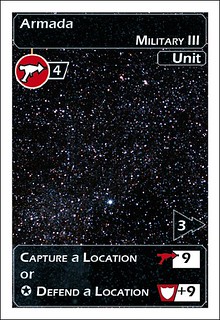
In the meantime, any feedback on the new Eclipse iPad game-inspired level three art? Old version first, with the new version below:


Last attempt at 2100s artwork
New design for 2100s artwork

Monday, July 15

Come Join Us Playtesting in the North East

Since moving back to Newcastle in the north-east of England a couple of years ago, I've played a lot of games. Which is obviously a Good Thing™. But I've tended to play a small subset of my medium sized collection.


Since starting playtesting Codename: Vacuum in earnest last October I've played a lot of games of that too. Also a good thing. But almost all of them have been on a lunchtime at work with Chief and/or Dave.


Don't get me wrong, both of those things are awesome, but for a designer to florish he needs to be exposed to lots of different games to get ideas, and for a prototype to florish it needs to be exposed to lots of playtesters to get a wider range of feedback and ideas.


I've been toying with the idea of hosting a semi-regular playtesting night at my house, but to be honest it would be the same people coming who come to my weekly Games Night, and not all of them are up for playtesting, or enamoured of Codename: Vacuum.


Newcastle has a great games club that meet twice a month on a Saturday afternoon / evening: Newcastle Gamers, but due to family commitments and visiting/visits by friends and family I've only managed to get there a handful of times in the last couple of years. I managed to make it along a couple of weeks ago where I met a couple of other board game designers: Dan and MichaƂ. Dan was keen to set up some kind of playtesting session, and had been speaking to Rob Harris of Playtest London about possibly setting up a Newcastle franchise to complement their existing regular London and Cambridge meetups. Playtest London have been running for the last 3 years, more recently branching out into Cambridge as well. They've test hundreds of games, and playtest members themselves have had some notable successes: recently Matt Dunstan's game Relic Runners has been picked up by Days of Wonder, and Brett Gilbert's Divinare has been put on the recommended list for the prestigious Spiel Des Jahres German games award. Playtest are looking to branch out with several new groups starting this year.


Over the last couple of weeks, Dan (with a tiny amount of help from yours truly) has created the Newcastle Playtest meetup, which will convene every first Tuesday of the month in The Bridge Hotel, Newcastle right by the train station from 7pm. If you live in the north-east of England (or fancy a day trip to sunny Newcastle) why not join us for our inaugural session on Tuesday 6th August?

Monday, July 8

Going Off Piste

This week has been a game of two ends, like football (that's soccer for my largely American audience).


In the first half, I've been chatting via email with the two designers I played a prototype with at last week's Newcastle Gamers about setting up a Newcastle playtest meetup once a month at a local pub. Dan seems to be very keen (and far more organised than me!) so this might actually happen, starting next month. I'm going to try to get both a new version of Codename: Vacuum and a version of my new Codename: Proteome idea together for the inaugural session. The Proteome idea is a complete reboot, significantly different from the prototype I made and played once in February last year, although bizarrely uses a very similar set of cards. The Vacuum idea would be a major change as I mentioned last week to separate out the Trade (and to a lesser degree Population) strategy from a dependence on owning locations and hence the Military strategy.


Which leads me on nicely to the second half - Ding, ding! Change ends.


The second half of the week has been all about the Trade strategy of Codename Vacuum. I've been through several ideas in my head some which add extra components, some which add extra complexity and some which simplify everything to the point of making the Trade strategy dull as ditchwater. The Trade strategy as it stands in my current prototype was designed to add another form of direct interaction between players on top of the Military struggle for controlling locations. As it stands it doesn't really succeed - you trade with the neutrals if you can, and the player with the least cash if you can't. There's not a lot of interesting decisions to be had there, or in fact, much in the way of player interaction.


So I've spent my hours walking to and from work thinking of half a dozen new ideas to make Trade interesting again. The constraint being that if you get your arse handed to you in a Military beat down, you can still Trade effectively. I've gone through ideas featuring adding corporations to locations with little discs in the players' colours, taking corporation cards out and into play like locations, adding resource types to locations and a few others. I want try out a few of them, but ideally without coming up with significantly different art/cards until I'm happy with the idea. I played with Chief on Thursday lunchtime, trying one of them out.


Ideally, I want something that: separates Trade from a dependency on locations, adds player interaction, simplifies the game mechanics, doesn't make the locations too similar, oh and I want the moon on a stick. Surely, that's not too much to ask?


The first idea I tried on Thursday: letting players bring the corporations into play like locations, and then getting coins for them every turn with points for the number of corporations you had 'incorporated' at the end of the game. It didn't really seem to work at all, though Chief said he liked the idea. Back to the drawing board I think.


Anyway, all these ideas have got me thinking about significantly changing Vacuum. A fresh injection of ideas can only help at this stage: at best I'll introduce some changes that significantly improve things, at worst I'll try out some ideas and ultimately reject them.

Monday, July 1

It's Back In My Head

Just last week I was bemoaning that I'd not had a chance to play Codename: Vacuum for a couple of weeks. Thankfully I made up for that this week, getting a couple of games in at lunch with Chief. The first one was the first play of a tweaked version of the June rules, tweaked to fix a problem with the Population strategy. It went fine, and the fix seemed to be an improvement. So far so good.


The second game used the same rules. However, this one didn't go so well. I chose the Military strategy, and I crushed Chief underfoot. The Military strategy in Vacuum is a strange one. It's not overly strong in itself, but the Military strategy allows you to capture locations: either neutral ones or one from other players. It's the only strategy that allows you to steal points from other players: all the other strategies are purely cumulative - your points can only increase.


The only defence against a strong military is a strong military (in the basic game, and some advanced ones), so if someone's feeling imperious you need to step up and defend yourself. There are a couple of advanced decks that give you alternatives to defending yourself, but of course there's no guarantee you'll be playing with them. If you choose not to defend yourself then a win is still possible, but there's pretty much only one way to do it.


In the current version, there are five strategies, of which only three will score during any one game: Military, Exploration, Population, Trade and Knowledge. To win the game, you really need to score well in two of the chosen ones.


  • Military rewards you for capturing high-value locations, and a strong military allows you to capture an opponent's locations if they are unable to defend themselves
  • Exploration rewards you for exploring interesting bits of the solar system, it doesn't require you to have any locations at all.
  • Population rewards you for having a large population spread across your locations, and in the current game, unless a particular advanced deck is in play, each location can only support limited population, so you need several locations to score well in it.
  • Trade rewards you for earning lots of money by trading between pairs of locations. You get more money if you control the locations that are trading, so you need some locations to score well in it.
  • Knowledge rewards you for developing advanced technologies, it doesn't require any locations to score well.

So if you don't want to go military at all, your only choice (assuming that the Nationalism and Cold War decks aren't in play which allow you to defend yourself against a strong military without a strong military of your own) is to go Exploration and Knowledge.


Don't get me wrong, I like that the Military strategy is important, being able to defend your territory fits the theme of a space race between competing empires nicely. But I don't want the game to be one where you either do Military or Exploration/Knowledge.


So I've spent the second half of the week thinking of ways to break the dependence of the Population and Trade strategies on controlling lots of locations, so you have more strategies available to you. Population is going to be trickier, but I've an idea in my head for the Trade strategy. Of course, it'll change the game quite a lot, add more components and make it less of a deck-building game. Once I've got it sorted out in my head, I'll need to work out which advanced decks need to change as a result, knock up another prototype and give it a try. It's exciting that the game is still changing so much, but it means I'm further than I hoped from it being 'ready'.


In other news, I managed to get along to Newcastle Gamers again for only the fifth time since I moved back here nearly two years ago. I didn't take Vacuum because of the concerns mentioned above, I just turned up at 8 and started looking for a game. A guy called Dan was loitering, waiting for another table to finish, so I joined him and a guy called Michael in playtesting Michael's restaurant-themed game. Dan also had a prototype he wanted to test later, though sadly I had to head off to bed before they started that. It felt a bit weird to be playtesting a game I hadn't designed - it was the first time I'd done it since the "heyday" of Reiver Games, and for once I wasn't trying to make a decision as a publisher about whether or not to take it further - just giving the designer a chance to try it out and hopefully providing some useful feedback at the end. It was the first time I'd met either Dan or Michael, and it wasn't until halfway through the game that the subject of my history designing and publishing games came up. Dan had heard of Carpe Astra and Sumeria and owned the It's Alive! iPhone app. He called me a 'veteran'!


It was good to hang out with some other designers, Dan was talking about trying to set up a Newcastle spin off of Rob Harris' Playtest UK network of UK game designers. Sounds very interesting, and it would be great to try Vacuum in front of some more people. I'd definitely be up for that (especially if it's in a pub!).

Monday, June 24

I'm Gonna Need Therapy

Jack: Hi, my name's Jack.
Everyone: Hi, Jack.
Jack: It's been two whole weeks since I last playtested Codename: Vacuum. I need help!


Fortunately, that drought should come to an end at lunchtime today. I've a playtest session lined up with my office playtesting group of Chief and Dave, so fingers crossed we'll get our game on in a few hours' time.


It's been a fairly quiet week, we didn't have a chance to test Vacuum this week as I was called into a surprise quality audit (fun!) on the day we'd booked it, and I've not done much in the evenings as I've been hanging out with my family instead, seeing as I was away for the whole week beforehand.


All I have managed is printing, cutting out and inserting some updated cards for the June version of Codename: Vacuum last night and a start on the level 3 card art stolen from inspired by the Eclipse iPad app.


The new cards replace the old population cards, which have remained essentially unchanged for quite some time. The old ones however had some interesting properties:


  • The are the only deck where you can get rid of a weak card and yet still get some benefit from it,
  • They are the only deck where the level one cards aren't pretty much useless by the end of the game (all other level one cards are superseded by the level two and three cards more obviously),
  • They are the only deck where level twos are almost as good as level threes.

It wasn't until I got my arse handed to me a couple of weeks ago in the first game of the June version that I noticed these things in combination made the Population deck a bit broken if you knew how to use it (it didn't help that I thought I did and was show otherwise by Dave!).


Anyway, I'll give the new ones a run out at lunchtime and see if they improve things at all...

Monday, June 17

All's Well That Ends Well

I spent a week in Minneapolis for work as I mentioned here last week. It was a busy trip, attending a conference on Mass Spectrometry and I worked long days and several evenings. But I got two nights off, and rather than spend them cruising the hospitality suites at the conference for free food and beer, I chose to spend them playing games.

In the run up to my trip I posted on BGG, to see if anyone knew of a good gaming venue in Minneapolis, and several people replied suggesting either the Fantasy Flight Games Event Center or The Source. I had no idea that Fantasy Flight were based near Minneapolis, but upon finding out I dropped them an email to see if any of their design team fancied meeting up. I would have liked to have taken Codename: Vacuum, not to hawk it to them (though had they wanted to pick it up that would have been awesome!), but just to get some feedback from some very successful designers. Sadly, other than the brief message from customer care, I didn't hear back from them. It turns out that even if I had, I didn't have room in my suitcase for Vacuum anyway.

The post on BGG led to a couple of offers from gamers who were willing to pick me up downtown and run me over to FFGEC so I could get my game on. The thread quickly devolved into silliness though as they insisted they weren't axe-murderers!

The FFGEC

The first night, Alfredo and his mate Jay who worked downtown offered to meet me at my hotel and then drive me to FFGEC via a look at The Source. We got the light rail to where Alfredo had parked his car, then swung by Arby's for some dinner (apparently an authentic American dining experience :) ). We had a quick look at The Source, a huge store, the likes of which I've not seen in the UK - seriously, it was enormous! Then we rocked up to FFGEC. Ahead of time, I'd had a look through Alfredo's 700-odd games listed on BGG and offered to teach him the ones it looked like he hadn't played, but I knew well: The Bridges of Shangri-La, Aqua Romana and Hey! That's My Fish! In the end, we played those three games and Alfredo and Jay enjoyed Shangri-La and Fish, though Aqua Romana not so much. It was a great evening and Jay and Alfredo were great company.

The next night, Fred picked me up from my hotel and drove me out to Brasa, a nice little restaurant serving food which I can't categorise, but thoroughly enjoyed along with nice beer :) Fred even offered to buy my dinner, but it was on expenses :) We got to FFGEC where we looked at the library and I picked out a few things I could teach: X-Wing minis, Lords of Waterdeep, Race for the Galaxy and Lost Cities. They had a decent library of games: at least a hundred, and not just stuff they made themselves, games from a wide range of publishers. The games cost $3 to hire, but for some unknown reason were free that night. We started with a game of X-Wing, during which I provided rules support for the guys playing on the table next to us too! FFGEC had a range of play mats, a couple of space ones, plus one of the Death Star trench run, which was all moulded and looked awesome! After that we played a couple of games of Race. Fred enjoyed both games and, in fact, bought X-Wing at the end of the night to play with his kids. I also bought a couple of things: the X-Wing minis dice pack that I've been after for ages and the extra wonders expansion for 7 Wonders - which includes Stonehenge :). I could just fit them in my suitcase!

In addition to the two nights of cardboard gaming I took our iPad with me and spent the time at airports, on planes and in hotel rooms playing a variety of board games on it. I played Carcassonne, Hey! That's My Fish!, Ra Through the Desert and Eclipse; some solo, some with my boss Ian, a Games Night regular and my travel companion. I am particularly impressed with the iPad version of Eclipse, I bought it for the trip so it was new to me and it's very slick. It's also given me an idea for the level three Codename: Vacuum art. I've recently knocked the level one art up a notch, and I like the clean, webpage inspired level two art, but I didn't like what I've done for level three, and had no real idea how to improve it. Until I saw the Eclipse iPad version. Time for some plagiarism, sorry, I mean imitation.

I enjoyed my trip a lot, especially getting to meet gamers from across the pond and introduce them to some of my favourite games. It's a testament to the BGG community that I had two adventures that began with 'I met a guy on the Internet, he picked me up in his car and drove me to an out of town location...' and they both ended with a convivial evening of food and games, not a headline on national news!

Monday, June 10

Minneapolis: Work and Play

Hello from sunny Minneapolis!

I'm over in the US for a week to attend a conference for work. It's going to be a long week, I'm working morning till night three days and all day for two more (no time for sight-seeing!), but I'm not letting that stop me get some gaming in. My boss, Ian and I flew over together. Ian is a Games Night regular, so I brought my iPad loaded up with games and we play a few on the way over. I imagine we'll play a few on the way back too.

But that's still not enough, no, no. So I've arranged with a couple of guys on BGG to head over to the  FFGEC on Tuesday and Wednesday nights for some more gaming! It's alright, they both promise they are not axe-murderers.

I dropped Fantasy Flight an email to see if any of their design team fancied meeting up, but I've not heard anything since a 'I've forwarded your message on' email from their Customer Care team, so I'm assuming that's not going to happen.

Clearly, I'm developing a gaming problem again.

In other news, we tried out the new version of Codename: Vacuum one lunchtime last week. I want to make some more changes (as with the last new version a couple of months ago, the first stab at major changes often needs some early changes to fix unintended behaviour). But, in essence, the new, more complex, bits work. One of my playtesters was very excited about them. But then, he is quite excitable!


Monday, June 3

I Take It All Back

It's been a busy week at ex-Reiver Towers. We were away last weekend with all my family and on our return The Daughter came down with a stinking cold, followed by a stomach bug. This weekend has also been our first weekend with all of us at home without any guests for nearly two months, so we've been trying to catch up on a few things while washing the sick out of everything we own :(


Anyway, back on topic! Next weekend I'm off to America for a week with work so I'm trying to make some Vacuum progress before I go. Last week I had a game at lunchtime with Chief, trying out a couple of new rules that I'd thought of following Tim's feedback. They worked. I'm not yet sure that they are better, but they are interesting. I'll try them a few more times before making a call whether to stick with the old ones or switch to the new ones. The new ones work with the current version as well as the next one, so I tried them out with the current version, pending the new version being constructed.


The new version, is now complete on the computer, ready for printing and cutting out - it's just waiting for me to find the time to get it manufactured. I've got another playtest session on Wednesday lunchtime - in an ideal world, I'll get the game made in time for that session. I've got two nights, it might be possible, fingers crossed ...


To the subject of this post, I was talking a few weeks ago about having Vacuum pretty much working and now needing to focus on simplifying things. Scratch that. It's time to knock it up a notch. BAM! One of the endgame conditions that you can try to score is for exploring the Solar System. In the current version exploration is pretty bland: you get points for exploring locations based on their range - the further away they are the more points you get. But all the ones at a given range give you the same points. Therefore, you always explore at the furthest range you can, but other than that it doesn't really matter which location you explore. Bland. Beige. Neutral. Tim spotted that it was boring. My playtesters at Beer and Pretzels spotted it, but I was clearly too close to it to spot it myself. When I started hearing 'boring' from multiple playtesters, it obviously needed some thought. So I've gone back on my word and started making things more complicated. I've given each location an exploration score that they will give the person who explores them. They generally increase with range, but at each range there are multiple options - so there's an incentive to explore early, and to choose one location over another. In fact, the locations are also being upgraded in other ways to make them even more interesting. Of course, until I try these ideas out I don't know whether they'll make things more interesting or just more complicated. Hence the need for testing and getting the next version made.


With all the trips away we've had over the last few months, I've had this version on the cusp of ready for a few weeks now, if I don't get it ready this week, then I've got to wait another two weeks until my return from the US. The suspense is killing me. I need to get it done in time for Wednesday!

Monday, May 27

Beer and Pretzels

Last weekend I went to Beer and Pretzels, a games convention in Burton on Trent in central England. The convention is held in the Town Hall, a grand old building, and fills the main hall and a couple of other function rooms. There's a cafeteria serving hot and cold food and a bar serving drinks (including beer) and the organiser, Phil who owns the Spirit Games FLGS in Burton puts some pretzels on each table.


I had attended B&P twice before in, I think, 2008 and 2009. Those times I treated it as business as I was running Reiver Games at the time, so I arranged in advance to co-opt a table (and bless him Phil gave me a good one at the entrance to the bar/cafe) where I sat during the day trying to find people to demo my games to and then hopefully close a sale. I spent the evenings just hanging out playing games though, and then spent the night at a pub nearly which had single rooms over the bar for £20 a night!


This time things were very different, I had nothing to sell or demo so I was just there to play games and catch up with people from my Reiver Games past. Instead of two carrier bags full of stock I was hoping to sell, I took only one game: Codename: Vacuum for playtesting and showing to anyone who was interested, but I wasn't on a hard-sell mission, it was available if people were up for it.


I decided to push the boat out and stay in the Holiday Inn up the road (if I'm away from The Daughter, the last think I want is a night's sleep broken by the sounds of drunken revelry from the bar below!) and at the penultimate minute I heard the my friend Terry from Bedford would be attending too - a great opportunity to catch up - I'd not seen him since last July.


Saturday morning I was woken by The Daughter at 5:30 (bless her cottons), and was just about to drag my sorry carcass out of bed when The Wife asked: 'Are you taking the car?'. 'Yes...?', I replied lsightly quizzically. 'Can you not?'. 'Yes', I confirmed slightly pained. Cue 45 minutes of frantically running round trying to get ready, organise a taxi to the station, find out train times and pack a bag.


Aside: After taking a couple of short holidays with an eight-month old baby, there is something really liberating about going away with a washkit, a change of clothes, a laptop, a game prototype and nothing else. You really appreciate travelling light once you have kids.


I spent the three hour train journey working on a new version of Codename: Vacuum inspired by feedback from my friend Tim the weekend before. On arrival I did a quick lap and said hello to a few people (including Phil who I'm pretty sure didn't remember me) and was just settling down to a game of Race for Adventure with Paul when Terry arrived. Terry joined us, and so every game I played all weekend was with Terry (and others).


Saturday ended up being a marathon 12 hours of gaming, featuring 9 games, five of which were new to me: Race for Adventure, Police Precinct, Terra Mystica, Tzolk'in and Snowdonia. I enjoyed them all, but Snowdonia was my favourite new game - a fairly quick worker placement game with an unusual theme and some nice ideas and mechanisms. In addition, Patrick, who worked for a company that my previous employer (Travis Perkins) bought out while I was there, came and found me and wanted to try Codename: Vacuum, so we gave that a 5-player run through. Patrick and his friend Rob seemed to enjoy it (Patrick's wife Jo less so) and even 5-player, with three new players it only lasted about 1 hour 45 mins which wasn't too bad.


Sunday was a shorter day as I needed to get a 4pm train back, but I still managed to squeeze in another five games including another Snowdonia, the new-to-me Love Letter and another game of Vacuum with Steve and Neil (and Terry). This Vacuum play was over amazingly quickly. I'd explained something badly, so Steve raced to finish the game expecting to score something that he couldn't. I was just getting going and it suddenly came to an end. I still managed to win, but it was Steve and Neil's first play and only Terry's fourth so that's not that surprising. It lasted 35 minutes. One of my goals for Vacuum is a short play time, so I've got to see what I can get from that game to help me speed it up - a recent game with three experienced players lasted over an hour by comparison.


As ever I enjoyed B&P, it was great to catch up with people who I'd not seen for 4 years or so and Terry who I'd not seen for several months. It's rare for me to play games that aren't in my collection (which usually only contains games I know and like before purchasing), so it was also great to try a few games that I'd not played before.


The return journey was split between more graphic design on the next Vacuum and writing last week's blog post. All in all a great weekend :).

Monday, May 20

The Joys of Critical Feedback

And I'm not being sarcastic!


So last weekend as I mentioned last week, my mate Tim was up for a long weekend with his family. During the day we all hung out together and entertained the kids, but once the sun had set and the kids were in bed it was gaming time. We played a few games with our wives and then, later on, just Tim and I burnt the candle at both ends. Included in that were a couple of games of Codename: Vacuum.


We discussed the game and how it was taking shape, but by that point it was very late and some beer had been consumed, so I asked Tim to let his plays sink in and send me some feedback via email in a few days once he'd had a chance to pause and reflect.


I've known Tim since we were fifteen, we were best men at each other's weddings. He knows me well enough to let rip without fear of offending me, so it was great when an email arrived on Wednesday lunchtime with a brief note about how he liked the game, it had some novel elements that made it interesting and then two or three pages of criticism of the bits he didn't like and some ideas of how to address them :).


The current version of Vacuum has been un-changed for over a month, I've played it ten or fifteen times, it works, it's reasonably good and I was beginning to get stuck in a rut. It seemed reasonable, there were no glaring problems or imbalances and I had no idea what I could do to help it progress from reasonably good game to frickin' awesome game of legendary-ness (that's a word right?). Nothing. I was drawing blanks.


Tim's email fixed all that. He sent me some ideas and his criticism has given me some more. I've spent the two train journeys to and from Burton on Trent for Beer and Pretzels doing the next version of Vacuum that will encorporate some of those ideas. I'm firing on all cylinders again. Thanks, Tim!


On the subject of Beer and Pretzels, it was a great weekend. My friend Terry from down south made it at the last minute so it was great to catch up with him, plus all the other people I knew there: Steve, Neil, Paul, Nick and Patrick. It was also nice to meet some new faces: Barry, Nick, Richard and Jo. I think I'll post a proper convention report next week...

Monday, May 13

Short Term Goals

A brief post this week as we've had friends up for a long weekend, so I've not had much time to write this - too busy playing games :).


Next weekend I'm attending my first games convention in three or four years - I'm off to Beer and Pretzels in Burton-on-Trent. It'll be my third time attending B&P, so it'll be a great opportunity to catch up with the friends I made there while running Reiver Games. It'll also be nice to be there without a 'day-job' of demoing the games I was trying to sell, though I will have Codename: Vacuum with me for testing on some more hardcore gamers.


I've got just under a week before the convention, and only three free evenings: Tim, one of the Best Men at my wedding, and his family have been visiting for the weekend and head off home tomorrow morning and then there's Games Night on Thursday. In fact, it'll be less than three free evenings as I desperately need to catch up on some sleep after a few late nights! I'm hoping to get a new version of Codename: Vacuum printed and cut out to take with me. I had wanted to try to get Codename: Proteome done too, but there's no chance :(.


The main difference for Vacuum is some new artwork (see below), a couple of wording tweaks to the strategy cards and some changes to differentiate the locations from each other. Proteome would have been a complete re-write since the version I made over a year ago, so I really don't have time for that too. It's destined to be a small filler card-game in the vein of 6 Nimmt! but with a tenuous science theme.


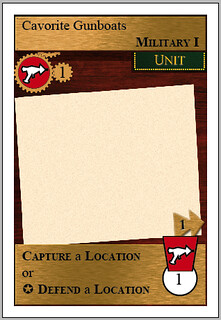
Here's the new 1900s card art for Codename: Vacuum. What do you think? It's still a word in progress - I want to improve the paper area in the middle further.


New style 1900s cards

Update: It turns out that after sorting out a few things that got put off over the weekend I've only got one free night before B&P, and there's a bunch of things I'd like to go into the next Codename: Vacuum, so I'm going to try to get Codename: Proteome knocked out on Friday instead. The best laid plans and all that.

Monday, May 6

Winning Against The Odds

There are a few things I like to see in a game:


  • The most experienced player usually wins - the game rewards time invested in it as an experienced player will learn the available strategies and play them better than a newbie
  • It's not clear from early on who the winner is - it's no fun playing a long game if you know in the first ten minutes you're gonna get hosed
  • A spirited after-game conversation - if the game was fun you'll want to discuss what went well or badly or how you could have done better if you'd made different decisions

I've been getting a good feeling about the latest version of Codename: Vacuum for a number reasons related to the points above. In this version, there are five possible end game scoring conditions:


  • Conquest: Points awarded for capturing or otherwise absorbing locations into your empire
  • Exploration: Points awarded for exploring the solar system
  • Reproduction: Points awarded for the size of your population at the end of the game
  • Greed: Points awarded for having amassed wealth through trading
  • Knowledge: Points awarded for developing futuristic technologies

In each game, the players pick which three of those they wish to score in that game. In an ideal world, each player would score their chosen strategy - but it's always three that are scored. That has a few implications:


  • In a two-player game, one player will chose more conditions that their opponent
  • In a four- or five-player game, some players will not get their chosen strategy scored
  • There's a race of sorts to ensure the strategies you want are scored, which curtails game time

The biggest worry I've had about this is that if your chosen strategy isn't scored, you've lost. Game Over. But recent evidence hasn't borne out that fear. We've played a few games where the person who choose the fewest conditions has won!

  • A few weeks ago I play a two-player game with Dave, my chief playtester. I raced ahead and chose two of the three conditions, while he mopped up the third one. In the very last turn of the game he made a gambit for some extra bonus points and pulled it off (with slight luck of the draw) and ended up winning the game by a point :)
  • At the last two of my Games Nights I've played a game with Hoops and Gav, both of whom have a few plays under their belts. In both games I won, despite choosing none of the conditions!

After the last of those games, the whole of the Games Night crew had a fairly long discussion about winning strategies and how I'd pulled a win out of the bag (I was still fairly sure I'd lost going in to the final scoring).

These games have also been fairly tight score-wise (a good thing in my book) and if I'm playing against anyone other than Dave (who has played about 25 games) I (who have played about 50) almost always win. So the most experienced player thing is panning out nicely too. Dave has a win ratio of about 50% against me, or possibly even slightly higher.

It's results like these that give me a good feeling about the current balance of strategies and cards. The next step is to simplify things further without ruining that balance and find the certain je ne sais quoi that moves it from being a reasonably good game into an awesome one.

Monday, April 29

Holidays! Yay!

I'm back now from my week's holiday in Norfolk (which it turns out is a very long way from Newcastle when you've got a baby in the car!).


We went with the entirety of my in-laws, which was great as my brother-in-law, my sister-in-law and her husband are all often up for games. We played a lot of 7 Wonders (including my 100th play!), plus Thunderstone (including my 75th play!), Carcassonne the Castle and I finally got my teeth into all the X-Wing Miniatures stuff I'd bought at the beginning of the year :) I also got a couple of late night games of Codename: Vacuum in with my sister-in-law's husband (aside, is he a brother-in-law too? A brother-in-law²? Something else? I've no idea).


I was keen to play Vacuum of course, and he's a big steampunk fan, so I thought the theme would appeal to him. He plays games less than my regular playtesters, he'll play games when I'm around but doesn't attend a regular weekly Games Night, so I thought he'd be an ideal candidate for trying out the simple, first-play rules I had in mind.


One of the main criticisms I'm getting at the moment is that the first few times you play Codename: Vacuum you're not really sure what to do or why - it's too complex. There are thirty different cards available to you in a standard game of Codename: Vacuum. Like most deck-building games some of those are constant and available in every game, but some change from game to game. There's a lot to take in, and the second time you play, there's a lot more. Confusing.


I thought a way to simplify the game for the first time you play would be to reduce the number of cards. Just keep the twenty that are in every game, and not use the additional ten that change from game to game. But I had no idea whether it would work, or whether it would feel anything like the real game. So I turned my brother-in-law? into a human guinea pig.


The good news was that it felt like the real thing, and Matt picked it up quite quickly (he even won that first game). He then requested a second, and we played the full game which he also seemed to pick up quite quickly. Good stuff. I won that game (good stuff too ;) ).


Matt enjoyed it, it's a reasonably good game. Now I need to do the work required to make the jump from good to awesome. Still aways to go.


In other news, I've started tweaking the border artwork a bit more. I'm starting with the first age cards, trying to make them look a bit more steampunky.


In still further news, through judicious application of wicca, neuro-linguistic programming, voodoo, jedi mind tricks and hypnotism, I've managed to get The Wife to arrange to a weekend pass swap. Which means I get to go to Beer and Pretzels in three weeks time. It's a games convention in Burton-on-Trent in May each year. I've been two or three time before while I ran Reiver Games. I'd spend the day demoing and trying to sell copies of my games and then the evenings on general gaming. This time I get to do the general gaming all day (and evening :) ). It'll be good to catch up with people I knew back in the day, and also get to try out some new games. We play my games on Games Night, and I don't often buy games without trying them, so new games often pass me by.

Monday, April 22

I Need To Buy This Game!

Aside: I'm on holiday at the moment. I've posted this automatically and I'll respond to comments on my return.


Back to the matter at hand. 'I need to buy this game!' is how the exposition for a game should make you feel. The exposition of a game is what I'm calling the short description of the setting and mechanics that you use to summarise a game.


When I ran Reiver Games I used the exposition for many purposes:


  • A brief summary of the game at the beginning of the rulebook
  • A description of the game on the back of the box
  • The first paragraph on the game's webpage
  • The summary of the game on its BGG page
  • On posters at conventions
  • In adverts in trade magazines
  • Sellsheets to send to shops and distributors

If I decide to KickStart it, the exposition would be the first paragraph of the KickStarter page too.


Clearly, it's important. I've agonised over the exact wording of each of my games' expositions. They've been through several drafts trying to get them to a honed sharpness of hook. The exposition should leave you thinking:


That sounds fricken' awesome! I need that game. So badly that I'm willing to sell my family to fund its purchase.

Writing them is very hard. I'm not a copy-writer, or a master wordsmith. I'm just a software engineer and occasional board game designer. Moulding the English language to my will does not come naturally. I did an average job on the Reiver Games ones (scroll down a bit in the links below to read the Description sections):


They're functional, but not particularly exciting. They didn't work very well either. The number of you who sold your families to buy the games was considerably less than the number of games I bought from the manufacturers.


For Codename: Vacuum, I've got an early draft that tries to cover the steampunk to sci-fi transition and the deck-building nature of the game. But it's not very exciting yet:


It’s 1897 and the discovery of the anti-gravity metal Cavorite has the world powers are poised on the edge of a Space Race to claim the Solar System. Lead your nation to victory by building a deck of strategy cards that will shape your empire for 300 years. What will be the defining features of humanity at the dawn of the 23rd century? Conquest? Exploration? Reproduction? Greed? Technology? Choose a strategy. Advance your technologies. Race to ensure your choice is scored.

Upon reading that, I'm decidely meh. My family are safe. Needs some work methinks!

Monday, April 15

An Interesting Conversation

It's been a busy week at Pope Towers. We had a friend's wedding (Chief, one of my core Codename: Vacuum playtesters), The Wife's birthday and then a busy weekend of among other things homebrewing. Despite all that, I've managed to get a game of Vacumm in, and made some more changes.


The April version of Codename: Vacuum is proving... transient. The last couple of versions have lasted a month or so without any changes, but my attempts to simplify things (addressing a common criticism) have been fairly sweeping, and fairly bad. I've tried a couple of things and they've come out incredibly un-balanced. I've had to quickly swap them out with new versions that rein them back in. Having said all that, I'm now feeling fairly confident about this new third version of the April edition - I think this one might be the best version yet. And, I think, the simplification attempts are bearing fruit too.


So anyway, to the subject of this post.


At Chief's wedding I was having a conversation with Gav (another Codename: Vacuum playtester). I don't remember exactly what we said, but I think I can piece together enough of the conversation (corrected for drunken blathering and weak memory). Gav was chatting to me about Games Design (my hobby) and iOS app design (his). He asked me a couple of interesting questions:


Is the Games Design itself what you enjoy or is the goal of a published game what drives you?

It's an interesting question and one that I answered in a more drunken, slurred version of this: I really enjoy the design. I love spending time crafting the hand-made prototypes and doing the layout and graphic design on the computer. I loved making the hand-crafted versions of Border Reivers and the first edition of It's Alive! - it was great being able to look at those finished copies and know that I'd made them, from scratch. Having said all that, I've given myself some goals and I'm working to get Codename: Vacuum finished. I want to get a game on the shelves, an awesome game that people will sing songs about in years to come. I want to be able to look at it and know that it brings hundreds or thousands of people pleasure. Which brings me on to the second question:


Why don't you think Codename: Vacuum is an awesome game yet?

Gav has played Codename: Vacuum five or six times. He seems to enjoy it, but he's not clamouring to play it. For him it's not gaming crack. And that's true of most of the other people who've played it too. They enjoy it. But they'd not play it for forty-eight hours without sleep or food. It's alright, not awesome. I think it's getting towards a good game (which is a curse in itself), but there's still a way to go before it's awesome. That's brought us on to the subject of why Gav is not clamouring to play it. As far as my hazy memory recalls, Gav said that he enjoyed it, but it found it hard to spot where he went wrong in a game and how to improve for next time, hampered further by the fact that each time he's played the game has been different with new cards and tweaked rules. There were aspects of the game he loved (like being really excited to take his next turn after the last one finished and the way your shape your strategy by crafting your deck and play area), but even after several games he didn't feel like he knew how to play better or what he did wrong.


I'm hoping that the newer simplified versions will go some way towards alleviating this problem and that if or when Gav plays again, things will have improved to the point that he can craft a strategy and then see what could be improved next time, or how someone beat him with a better strategy (not just the un-balanced game favouring someone else's strategy). Maybe what we need to have is a dedicated playtesting night when we can play it a few times to really get a feel for it without changes in between. I'll have to try and arrange one for after our upcoming holiday.


But also, I want to introduce Gav to some other deck-building games so he can see what Vacuum is competing against and note that the bits of the game he loves are not anything original or unique, others got there first. On that note, we're going to play Thunderstone (one of my favourite games) at my next Games Night on Tuesday.


P.S. Gav: I hope my poor memory and correcting for drunkeness haven't misrepresented you!

Monday, April 8

Moving the Goalposts

Back at the beginning of the year, I set myself some goals. My next major target according to those goals is to get copies of Codename: Vacuum to playtesters around the world by the end of May. Which is just over a month away.


That's not going to happen. Not even close. The last couple of weeks we've had my parents up for a week and now my father-in-law up for a week. In two weeks time we're off on a family holiday for a week and we've another long weekend family holiday at the end of May. For the last couple of weeks I've not made much progress on Codename: Vacuum for all these reasons (excuses again!) and it's clear to me now that I'll not get those playtest copies ready by the end of next month. In fact, after the rulebook disaster, I'm not even sure I'll manage to get the rulebook re-written by the end of May, let alone the playtest copies constructed.


So, I'm moving the goalposts. I've got a work trip to the US in June, so it's unlikely to be done by June either, but maybe July is achievable. In the meantime, I've just printed the April version for myself which I now need to cut out and I'll need to make update packs for Terry and Paul who have the March version. I can also be making boxes and box inserts for the playtest copies already. The other components will change between now and the end of July, but the boxes won't so I can make them ahead of time.


The other thing I need to be thinking about is who gets the playtest copies. I want people who can give really good feedback, people who like deck-building games and people who are prepared to play it several times to make the cost of sending them a copy worthwhile. I've a few ideas, friends I made during my Reiver Games days. But I think I want to send out maybe fifteen copies, so I'll need to find a few more playtesters. I feel a BGG post coming on, nearer to the time...


In other news, I've been having some more ideas about Codename: Proteome. Maybe it's time to make another version of that and get that tested too.

Monday, April 1

TableTop Day @ Newcastle Gamers

I moved back to Newcastle about a year and a half ago. We'd lived here for three years between 2001 and 2004 and ever since we left we'd being saying to each other 'I loved Newcastle, we ought to move back there at some point'. Since we moved back things have been pretty busy. The first two months I was here on my own during the week, then going home to the south on weekends, then The Wife joined me. We rented a house for six months, and spent a decent amount of time trying to find one to buy. Then we moved house again. And on top of moving house twice, we had a baby seven months ago.


All these excuses go some way, I hope, to explain why in the eighteen months since I moved back to Newcastle I've been to Newcastle Gamers (which is on twice a month) not 36 times, but 3. That's right, I've been less than 1/10th of the available opportunities. Can I refer you again to the excuses at the beginning of this blog post?


The third of those attendances was this Saturday just gone. Newcastle Gamers usually runs from 4:30pm until late, but since someone had declared Saturday International TableTop Day, Newcastle Gamers started at 10:00am, which coincided nicely with a kids birthday party The Wife was taking The Daughter to, so I got a pass!


I took Codename: Vacuum along, hoping to playtest it with a few strangers and get some feedback not coloured by personal affection. On arrival I was invited to join a game of Munchkin with Gareth and a few others. Gareth used to run Newcastle Gamers and used to come to my Thursday Games Night too, until he moved down south. I wasn't expecting to see him there, so it was a nice opportunity to catch up, and it made Munchkin a little bit more bearable (I'm not a fan!).


Afterwards, Gareth wanted to play Codename: Vacuum, so the two of us sat down to a quick game. I had to leave before too long, so we didn't have time for a learning game for 5 people, so the other players of Munchkin started another game and Gareth and I just did a two-player game. Gareth hadn't played before, and was keen to try it out. We set off after a brief explanation (which I hope makes more sense than the dreadful rulebook that I still haven't gotten round to re-jiggering) and got cracking. Gareth is a proper gamer, so despite the fact that he's a friend and so won't be able to give entirely un-biased feedback, his feedback will be very useful. He's much more experienced than the mates I've been playing it with at Games Night and at work, so his knowledge of other games will be useful as a yardstick to compare it with.


As it was, Gareth seemed to enjoy the game, and I'm hoping he'll get a chance to give me some more considered feedback once his play has sunk in. He said some very positive things and gave me a few nice ideas to work on.


After Vacuum, I had very little time left, so we had a quick game of The Boss, which was new to me and reminded me of Brett Gilbert's Divinare. Interesting.


Seeing as I've not been to Newcastle Gamers in ages, I wasn't expecting to know many people there and for there to be little knowledge of who I was or Codename: Vacuum. As it was, I recognised more people than I expected, and knew a couple of them very well. Plus someone (whom I'm sorry to say I didn't know/remember, or think to ask his name) came over and asked if we were playing Codename: Vacuum! When I said yes, he asked about progress on the new rulebook! Apparently, he lurks here! I'm famous! Yay! (Anyway, please introduce yourself, dear lurker, to make up for my poor manners/memory!).


It was a nice trip, and my first Games Club visit since I went to Beyond Monopoly last summer. It reminds me that I need to get out more!

Monday, March 25

Streamlining

Not a huge amount to report this week, I've had my parents up for the week plus I was away for a couple of days on a work trip. As a result I've not made much progress on Codename: Vacuum.


It's not stood still though. I had a playtest game at lunch time one day last week and I've got the first session report from my playtesters in Bedford. As I mentioned last week, they had some issues with the first draft rulebook, but they managed to overcome my inept rulebook writing and played it last week. They've found a bunch more small errors in the cards and rulebook which I'll correct this week. Their game was a long one. There were four players, all new to the game and they were learning it from the (crap) rulebook and it ended up lasting over two and a half hours. It's always the case that a learning game with rules explanation and rule looking up will take longer, but that's still significantly north of what I was hoping for. Having a more structured rulebook that more clearly explains things will help, but the game will need simplifying too. I was hoping for more of a Race for the Galaxy play time than Twilight Imperium. Since Codename: Vacuum doesn't have simultaneous play it'll never be quite as fast as Race, but it can play fairly quickly, and with my experienced players at work we can usually get a game done in under 20 minutes per player. We even got a five player game with one new player done in 1 hour 40 minutes a couple of weeks ago.


Still, the feedback is reminding me that my design ethos definitely is make a complicated game and then simplify it, rather than starting with a simple game and expanding it. Vacuum isn't intended to be a streamlined euro like Sumeria, but there's definitely a lot of scope to simplify things. I'm trying to focus now on re-writing the rules to clarify things, and at the same time, work on those rules that are complicated to write or explain or ones that people often get wrong to try and streamline the game. The simpler it is, the easier it'll be to teach or pick up for the first time. Of course, while doing this, I've got to be careful not to rip out the heart of the game!


In other news, I was contacted a few weeks ago by a previous Reiver Games customer who was interested in playtesting Codename: Vacuum at a convention in Australia. I've been working to get a print-and-play copy ready for him, but in the light of the feedback about the rules quality, I've had to turn him down. I feel bad about letting him down, but I'd rather give him a hand-made copy later (even with the shipping cost to Australia) than provide a poor quality version now.

Monday, March 18

Epic Fail

The week before last I sent two copies of Codename: Vacuum to my friends Paul in York and Terry in Bedford. In both cases the games arrived in time for their Thursday Games Night, and that Thursday Vacuum got played at my Games Night - I was excited that it could be getting simultaneously by three groups at the same time!


Paul, who had played it once before about nine months ago, emailed me to let me know he'd received it and it all seemed fairly self explanatory, he just had one query - the rules contradicted themselves - which bit was right? It was an artefact of me creating a new 'simpler' version of the rules at the last minute, I let him know which bit was right and fixed the other bit straight away so the next printing wouldn't have the problem.


A week passed, still no word from Terry. Then last Friday I got an email from Andrew (who plays games with Terry, was also one of my key Reiver Games playtesters in my Bedford days and who accompanied me to my second Essen show in Germany). It turns out that my attempt at writing the rules had been an epic fail. Terry, Andrew and Stewart (all three very experienced gamers who regularly learn new games from their rulebooks) had set up Codename: Vacuum to play the previous week, read through the rules and then put it away! After reading through the rules, three very experienced gamers were so confused that they just packed up and played something else instead. That is a legendary rulebook failure. In the end, Andrew took the prototype home and has tried to work through it solo to get his head around it enough to explain it to the others.


Clearly, the rulebook needs a lot of work. The fact that Paul had played the game once before gave him enough of a frame of reference for the rulebook to work for him, but for both playtesting and game sales, the rulebook needs to be clear enough that you can learn the game from the rulebook. This was the first attempt at a proper rulebook for Codename: Vacuum, and the first attempt at a blind playtesting, where you learn the game from the rulebook. The rulebook as it stands fails to pass muster. I need to restructure it to give a better sense of how the game is played, what you are trying to achieve and how to achieve it. The rulebook was a fairly last minute thing done when trying to get the prototypes out the door. It needs more effort than that!

Monday, March 11

Just Collating Data As They Say

After each game of Codename: Vacuum I record a bunch of information, about who played, how long it took, who scored what in which category, etc. I've not made much use of the information yet - the game changes too frequently, so I don't have enough information about any one version to draw any useful conclusions.


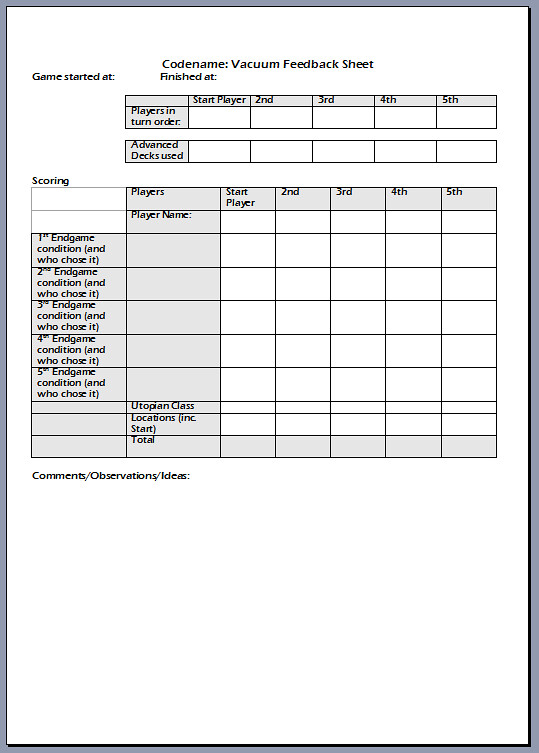
Last week though, I sent out a couple of playtest copies to some previous gaming buddies who used to be my core Reiver Games playtesters. In the package with their copy of the game were a handful of feedback sheets, so they could record the bits of the game I am most interested in.


So what am I looking for? I'm trying to find the particular biases and unbalanced areas that the game is bound to be full of. The game has 15 decks of cards, 8 possible starting territories and five (or fifteen!) endgame scoring conditions. I've played it nearly forty times and that is nowhere near enough times to sort out all the balance issues between that number of variables, especially as I bring out a new version every month or so and so I effectively have to start again from scratch at that point.


Now that there are multiple copies of the game in circulation, I can get more feedback about each version and hopefully start doing something useful with it. Data analysis! Science!


The areas I'm most interested in to begin with are:


  • Is there a first player bias
  • Is there a last player bias
  • Strong vs. weak endgame scoring conditions
  • Strong vs. weak starting territories
  • Strong vs. weak decks

Hopefully, getting my playtesters to fill in one of these will help me find those problems, so I can fix them:


The feedback sheet

Click the image to see a full size one


P.S. Award yourself 10 points if you recognised the Firefly quote in the title!

Monday, March 4

Honestly I'm Not Normally A Deviant, But ...

I'll get to the subject of that provocative title in a minute! Aside: this is my 666th blog post. Make of that what you will.


Just a brief update on progress this week, and a review of my card purchases.


At the beginning of the year I set myself some goals. Seeing as one of them was a deadline for last Thursday, I figured it'd be a good time to take stock of how I'm progressing against those goals. The deadline was to get initial playtest copies out to some close friends who were key Reiver Games playtesters by the end of February. I missed it, but only by a couple of days (I got them ready over the weekend, so they are ready for posting today). It was close, so I'm going to count that as a goal met! The only other goals relevant at this point are the blog ones. So far I'm on track for those too, I've blogged every Monday this year, the page views are above the target of 20,000 views this year and I've two new followers since the start of the year too. All good :-)


Setting the goals has really focussed me, I've worked quite hard the last few weeks to the get playtest copies ready, spending my evenings after The Daughter goes to sleep printing, cutting and collating to get the copies assembled. The biggest stumbling block was the rulebook, which I had to write from scratch in Adobe InDesign since the previous one was written in Microsoft Word, had no examples and was hideously out of date. The last minute change to simplify things that I thought of last week didn't help as that made changes necessary close to the wire.


Still, I consider myself on track so far this year :-)


As another aside, I recently read an article on BGG by Lewis Pulsipher, designer of Britannia among others, stating that to be taken seriously as a designer you need to be working on multiple games at once. One game makes you look like a dilettante apparently. I consider myself focussed, rather than a dilettante, but maybe others feel differently. Anyway, I've a family now and they come first, with limited time available the only way I can make any progress is to focus on a single game.


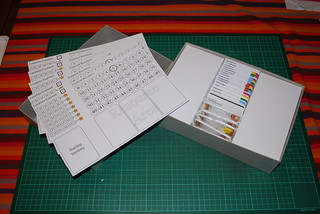
In other news, in making these prototypes I mentioned above, I've finally got around to using some of that card I bought a couple of weeks ago. I bought it from PaperCutz a supplier I'd not used before, so I thought I'd review the purchase briefly. I've used the card extensively in the prototypes: the box insert, deck dividers, cards and player mats are all printed on and made from the new card.


The prototypes in all their glory

PaperCutz were pretty easy to deal with, I ordered over the internet, the card arrived in a couple of days. The card was fairly well wrapped and then boxed, but regardless both the 300gsm and the 240gsm were slightly dinged on one corner, probably as a result of exuberance on the part of the courier. It's not a problem, since I cut at least 10mm from each edge as part of the construction and I can feed the dinged corner into the printer last so it doesn't throw the printer out of whack, but still slightly disappointing.


I bought 25 sheets of the 300gsm for making box inserts and 250 sheets of the 240gsm for the cards, dividers and player mats. That's enough to make 15 games :-). Or at least it was until I fell in love with the 300gsm stuff. Honestly I'm not normally a deviant, but the silky smooth, unblemished exterior coupled with a firm core that kinks pleasingly when you caress its surface with a craft knife totally got me. I've used it for the box inserts as intended, but also for the dividers and player mats, so now I've enough card to make 3 more games. I need more. I'm going to get another 100 sheets of the A3 300gsm, which I'll use for the dividers and player mats and I'll also get 25 sheets of a more voluptuous SRA3 (a slightly bigger size) for the box inserts. It turns out that I can't do maths to save my life, and the calculation I'd done in my head which lead to the decision that A3 would be big enough for the box inserts was way out. SRA3 isn't big enough! But it's close enough and will do. After those purchases I'll have enough to make another 15 copies - so I should be sorted for the next wave of prototypes in the summer too :-).

Monday, February 25

Why Critical Feedback Is Crucial

As I mentioned a couple of weeks ago, I've finally got round to asking for some structured feedback from the mates who I've been testing Codename: Vacuum on.


I really don't want to be that guy who keeps nagging his mates to play his game that they'd rather pluck their own eyes out with skewers than play. I don't want them playing it to avoid hurting my feelings; I want them playing it if they want to play it.


Playtesting is different to gaming. You play a game that's often crap or broken, each time you play it the rules or components are different, sometimes you have to abandon a game halfway through because it doesn't work and then after all that you're expected to give feedback and constructive criticism. Not all gamers enjoy playtesting - and with good reason.


So the system I came up with to avoid being that guy, was to invite people to play Vacuum with me once. If they wanted to play, they had to email me. If they wanted to play again, they had to email me again. No nagging, no guilt, just helping out if they felt like it and enjoyed it.


Seven of my mates at work are on the Games Night email list (though not all of them come) so I invited them and left it at that. All of them took me up on the offer. Most of them have played between two and five times, a couple only once. Two of them want to play pretty much every week.


What I was most interested in was: why do the five who don't want to play every week not want to play every week? What is it about Codename: Vacuum that has left them feeling cold?


Most of them are Software Engineers like me, so they understand the value of critical feedback. I asked them for answers to a simple questionnaire, and for them to be critical in particular - no sugar-coating!


By far the biggest criticism that came back from everyone was that the learning curve was steep and the wealth of available strategies overwhelming. At the moment the game has five 'standard' decks which you play with every time and ten 'advanced' decks of which you play five per game. Each deck has an end-game scoring condition which represents a valid (though not yet balanced!) strategy. In any one game there are ten available, each time you play half of those change (and in fact for my playtesters, they pretty much all change every time they play as the game evolves).


People are finding it hard to take in the options and judge which ones are strongest for the given combination of available decks. It's bewildering. I understand all the scoring conditions, but then I wrote all the cards and think about them incessantly. My chief playtester Dave has got it (he recently royally owned me in a game!) but he's played it more than ten times. No one else has really.


I guess I had seen this in action most times I've tried the game out, but I'd chalked it up to learning games and beginners confusion without really paying any particular attention to it. Getting these written answers to the questionnaires has really brought it into focus and flagged it up. If you are too overwhelmed the first time you play a game, then there's not much likelihood of you playing it a second time and any hope of a hit game and good sales have gone straight out of the window.


But the concrete feedback has given me something to latch onto, and last week I had an idea in the shower. I going to try only five scoring conditions, one per standard deck. They'll be the same every game, and because there's only five of them, they can be simpler and easier to grok. The advanced decks will still exist, but they'll be there to help you in one or more of the standard scoring conditions.


Thinking about it, this simplification might help with a few other things:


  • forcing players to diversify their decks since the standard scoring conditions are all quite different from each other
  • it should make it easier to balance the game as I only need to consider those five scoring conditions
  • it should also make the multi-player game a bit quicker, since you would play to fewer conditions

Time to try it out and see if it behaves like I expect. I've a playtest session on Monday lunchtime with a couple of mates from work.


Another advantage of coming up with it at this point is that I hope to get copies to my friends in York and Bedford in the next week or so. I can give them both versions (before and after this simplification) and get them to compare and contrast.

Monday, February 18

Rule book

Sooner or later, our children must fly the nest and strike out on their own. My daughter is only six months old so, thankfully, that day is a long way off for her, but for Codename: Vacuum it's much closer. Until now, every single game of it has been played with my copy, with me playing and explaining the rules. As a result, the rulebook has been fairly simplistic, and for the last three months or so, quite out of date.


After 15 months of internal development, it's time for Codename: Vacuum to see the light of day. The first stage of this is to run it by a few of my key playtesters from my Reiver Games days: my friends Paul in York and Terry, Andrew and Graham in Bedford. Knocking up a couple of prototypes isn't too onerous: just a couple of hours per copy. The big difference however is the rulebook. If I'm sending them a copy and they have to play it from the rulebook, then the rulebook has to be:


  • complete
  • up to date
  • well-written
  • comprehensive
  • illustrated
  • with examples

Sadly, until a week or so ago, none of these were true of the Codename: Vacuum rulebook :(. My focus now is on getting it ready, so I can send games complete with rulebooks.


First problem is that writing rules is hard. You need to be both complete, clear and unambiguous and also concise. You need to provide examples of anything that could be unclear, you need to expect that people reading it will get the wrong end of the stick. You need to have good grammar and the whole thing mustn't look like a dictionary.


Sumeria rulebook

Making this visibly aged me


It's really hard. When I ran Reiver Games I had my friend Mal proof-read the rulebooks for me, and I got people to play the games from the rulebook and then tell me what they thought was unclear so I could improve that section. I got more feedback from people who translated the rules into other languages, and still at the end of all that there are plenty of people playing the games wrong or asking for clarification on BGG. And these were simpler games than Codename: Vacuum.


This first draft of the rulebook won't be playtested before the guys down south get their hands on it (they are inadvertently doing the playtesting for me :) ) and it won't be proof-read, which just makes me more paranoid about getting it right. It'll be light on examples and illustrations too, but it's a step in the right direction.


As a general rule I try to structure a rulebook like so:


  • Front cover
  • Inside cover: contents list
  • Exposition: A brief description of the setting and a very high-level overview of the game
  • Aim of the Game: What the players are trying to do to win
  • Setup: How to get ready for a game
  • Play: Rules of the game
  • End of the Game: when it occurs and under what circumstances
  • Scoring: How the winner is determined
  • Acknowledgements: Thanks to playtesters, proof-readers, etc.
  • Credits: Artists, translators, etc.
  • Back cover: Quick rules overview

For Codename: Vacuum I'm thinking of adding a description of all of the decks and cards between the scoring and acknowledgements covering exactly what you can and can't do with them and answering some FAQs.


My aim is to get the playtest copies ready by the end of the month. This week is my quarterly hospital trip which involves four hours on trains, so I should be able to make some progress and maybe even build up a backlog of blog posts. But even with the train trips I've got my work cut out!

Monday, February 11

Stationery Woes

For the last few months I've been making a new prototype of Codename: Vacuum roughly once a month. I'd play the last version a few times, come up with some new ideas to try out and then make those changes on the computer. Then it was time to realise it in physical form. I bought a Canon Pixma iX6550 last year and I've been very pleased with it. When printing cards for games I lay the cards out in a 5x5 grid on a sheet of A3 card. So, clearly, I need some A3 card. Codename: Vacuum is a deck-building game with 350 cards. So I need a lot of card.


For the last few months I've been nipping to Ryman Stationery or Hobbycraft to get more card. They both sell A3 white card in packs of 25, so with the 17 sheets of card per copy of the game, I'm getting through quite a lot of packs! Hobbycraft has been my preferred stockist, their packs are £5 and are 210gsm card - which feels a reasonable thickness and weight for prototype game cards. Ryman's conversely are £6 and only 160gsm which feels cheap and flimsy by comparison.


So why do I ever go to Ryman? Because Hobbycraft are often out of stock - Ryman has been my fallback position if I need card at short notice and Hobbycraft have failed me yet again.


Since I need almost a full pack per game and I'm making roughly a game a monthly, trips to Hobbycraft for the inevitable disappointment of no stock followed by a trip into town to get the flimsy Ryman offering are regularly required.


As I mentioned at the beginning of the year I'm hoping to get playtesting copies to friends this month and more out in the summer - I'm going to be making a lot of copies. It doesn't make sense to continue to buy lots of these little packs when I need sheets a hundred or more at a time.


Time to man up:


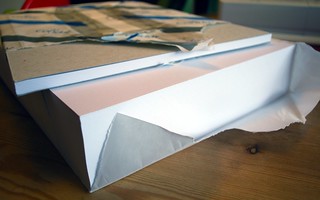
The card I ordered online

3 inch thick pile of card! Manly.


I placed an order online with PaperCutz for 250 sheets! I've also gone with a heavier weight than even Hobbycraft sell: 240gsm. Having such a large stock will mean I don't need to keep making these disappointing trips and mean that when I'm ready to make a new copy I've got enough card to print it straight away. I also ordered 25 sheets of really heavy 300gsm card making for box inserts. If you're going to do a job - might as well do it properly :).

Monday, February 4

More Visual Changes

After my very unpopular question for artists a few weeks ago (which nevertheless is now one of my ten most popular posts of all time!) I've been making a few changes to the layout off my own back.


The last version (which was wheeled out for the first time at the beginning of the year) had a few changes to the cards, a few changes to the rules and quite a lot of changes to the design. I'm now working on another version which I hope to get to the table this week (assuming I can find some card on which to print - I went to Hobbycraft to get some more on Saturday and for the second time it was out of stock :( ). This latest version further adds to the graphic design as well as trying out some very new card ideas and trying to streamline the rules a bit.


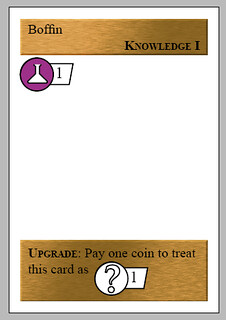
The first thing I've done on the design front is to try to differentiate between the three levels of strategy card. These levels theoretically correspond to 1900s, 2000s and 2100s technology, so I wanted the cards to have a flavour of that. Previously with the slight exception of a number representing the level in the top-right corner, the cards all looked the same.


Since the game starts in an alternative steampunk universe, I wanted the first set of cards to look steampunky. I'm no artist, so I've kept it simple, just a brass effect in the background of the card:


A boffin card

The Boffin steampunky 1900s card


It would be nice if this was a bit more steampunky, with cogs and leather and copper tubes, but I have to admit my limitations and keep it simple.


Next up are the modern day cards, around 2000s technology. Again, I've tried to keep this simple, I've a clean, modern webpage design in my head as the guideline:


A Consumerism card

The webpage-themed Consumerism card


The latest version, yet to make it into physical form also includes some border art for the futuristic 2100s cards. This is the weakest of the three to my mind, but hopefully feels vaguely futuristic!


An Armada card

A futuristic Armada card


So, you can see why I wanted an artist a few weeks ago - this is not my strong suit! But hopefully, this basic graphic design/border art gives a flavour of the three ages of cards.


I'm also trying to streamline the game a bit with this new version. One of the things that has been in the game for at least six months is that you have to pay upkeep on population above and beyond the basic population that a location comes with when you acquire it. At the end of every turn, you had to pay some coins if you'd settled extra population on any of your location cards. Despite this having been in the rules for ages, and having personally designed the game this was something I kept forgetting to do, let alone my poor playtesters, who also have to cope with a new set of rules and cards every time they play. I've taken it out in this version, in favour of limiting the number of cards you can settle on a location - I figure it's easier to remember a restriction on things you can do at the point you do them, then remember a little thing at the end of every turn for the rest of the game!


In other news, Mal suggested in the comments of the artists post that I approach the design school at the local uni to see if they'd be interested in offering the graphics design of Codename: Vacuum as a degree project. I think it's an excellent idea, now I just need to pull my finger out and get in contact!

Monday, January 28

Tax Return :(

In the UK, when starting your own small company you have a choice between forming a Limited Company (known as Company Name Ltd.) which is a separate legal entity (I assume very similar to the LLC in the US) or you can set up as a self-employed person (either as a sole trader or in a partnership) where the company is actually just yourself earning some money under a trading name.


When I set up Reiver Games back in July 2006, after getting some advice from Business Link, a now defunct government scheme to give free advice to new businesses, I chose the sole trader route - technically, Reiver Games was: Jackson Pope trading as Reiver Games.


Since at the time I was only setting up the business to try and sell 100 copies of Border Reivers that I was going to lovingly craft by hand, I wanted to keep things as cheap as possible. Setting up a limited company required paying someone to incorporate it, and then paying every year for employees liability insurance and to get an accountant to audit your books. All costs I could do without.


Setting up as a sole trader was much easier: open some bank accounts, create a website and tell HMRC (our equivalent of the IRS) that I was now self-employed as well as an employee and job done. As a self-employed person I would also have to start filling in a tax return every year. In the UK if you are just an ordinary wage-slave, paying taxes straight out of your pay cheque every month (PAYE) you don't need to file a tax return, but self-employed people do.


We have to file our tax returns by the end of January the year after the tax year we're filing for. So at the end of this month I have to file a tax return for the tax year from 6th April 2011 to the 5th April 2012. Reiver Games ceased trading in July 2011 and I finally closed all the bank accounts in November 2011, so this is the last time I'll have to file a tax return I hope.


While I was running Reiver Games (especially during the period when I was doing it full-time) I tried to keep on top of doing my books as I went along, then filing a tax return wasn't too onerous: read some numbers of the annual totals and that was pretty much it. Once I went back to work and Reiver Games was clearly going down the pan it was a bit harder to summon the enthusiasm for staying on top of my books, so filing a tax return turned into frantically catching up on the books, then filing a tax return at the last possible minute. It was like that last January and again this year. I've been doing it during the evenings over the last week or two after The Baby had gone to bed and finally finished and submitted it last night. Theoretically, HMRC will notice I've ceased being self-employed and remove the need to fill in a tax return, though they might need some prodding...


Needless to say, on top of the books, I've got pretty much nothing done on Codename: Vacuum the last couple of weeks, but I've still been having lots of ideas to try out. Now these damn books and tax return are out of the way I'll have to give them a whirl.

Monday, January 21

Codename Vacuum: Belatedly Getting Feedback

I had the idea for Codename: Vacuum about fifteen months ago now. It got its first proper play at Games Night during February last year then nothing really until July when I played it with my friend Paul whose Games Night I attended twice a week for most of our five year sojourn in York. Since October last year it's been played at least once a week as I try to iron out the kinks and fix the balance issues.


The first play was, to my mind, disastrous: the game lasted many hours and the play was dragged out by numerous discussions about things that could be changed about it, most of which would have completely changed it, certainly radically altering it from the game I first had (and still have) in mind. The second went much better with my friend Paul who had been one of my key playtesters during my Reiver Games days.


Since then, I've tried to focus on playing the game a lot with friends at work and at Games Night (there is a large overlap between those groups of people). The focus has been on teaching people the game and me personally working out which decks/cards are weak. Every month or so I've printed out a new version of the game incorporating potential fixes to the problems I've found.


Wary of the wealth of wildly restructuring ideas I had at the first public test, I've not been asking my playtesters for much in the way of feedback - I've just been using them as opponents to enable me to test the game and spot potential problems/weaknesses.


Obviously, this is a pants way to proceed, but it got me over the hump of not playing the game and has allowed me to make three or four complete revisions of the game, each of which I think is slightly better than the last. But playtesting is not just for playing the game - it's also for gathering feedback and I've been doing very little of that.


My current playtest crew for Vacuum is a core of four people who seem genuinely keen to play it. Dave has played it getting on for ten times I think, and gives me a good run for my money, winning as many (if not slightly more!) games than I do. The other three have probably played two or three times each, and I don't think any of them have beaten me yet (though I might be remember that wrong!). I'm now asking these core guys for really critical feedback after games in the hope I can use this information to hone the game still further and address the weaknesses of the game as a whole.


Possibly more interesting and useful would be feedback from the five or six people who've played it once or twice and don't seem particularly keen to play it again. What is it about the game that they don't like or do they have any ideas what it is about the game that doesn't excite them? I need to gather that feedback too, but I need to do it without seeming to be pulling them up for their lack of interest. How to do that, I'm not sure yet.


The other thing about my process that's changing is that I'm going from making a new version every month or so to just tweaking a card or a deck and re-print those out for testing. Printing and cutting out a whole new copy is about an hour and a half's work, but I can do a single deck pretty quickly (especially since I changed the form factor of the artwork - why oh why didn't I do that earlier?). It feels like the game is coming on nicely and I'm still having plenty of new card ideas - at this rate it's going to have an expansion's worth before I'm ready to publish/hawk it!


Setting my goals for the year a few weeks ago has really focussed my mind on moving things forward - I'm driven now to get a couple of copies out to my previous gaming groups in York and Bedford (both populated by Reiver Games playtesters!) by the end of February, but before I do that I want to improve the game still further.


I also need to create a rulebook that's complete enough to learn the game from, but time is tight, especially as I have to do a Self-Assessment Tax Return for the last year of Reiver Games before the end of this month :(

Monday, January 14

What's in a Name?

For many years I've been referring to new games by a codename that stands as a working title while the game is in development. It's Alive! was Codename: Monster, Carpe Astra was Codename: Network and Sumeria was Codename: Ancient before their official names were chosen or announced. And now I'm working on Codename: Vacuum.


If I decide to hawk it to publishers, job done, I can send it with the codename, since the publisher will almost certainly want to chose the name (and the artist and tweak the rules) themselves. However, if I decide I self publish again I'll need a real name for it at some point.


I've been toying with a couple of ideas (one of which I posited here to a conspicuous silence!), and it got me thinking about what makes a good game name.


Lots of euro games go for the place name option, e.g.: Goa, Macao, Cuba, Santiago, Puerto Rico; while more themed games chose something a bit more involved: e.g.: Twilight Imperium 3rd Edition, Race for the Galaxy, Space Hulk.


I would want something that gives you a flavour of the game, but it also needs to meet certain criteria:


  • There can't be an existing game with the same or a similar name
  • It's got to Google well
  • Ideally there's not a book/film/computer game with the same name
  • It's got to sound enticing
  • It ought to evoke the gameplay or setting

So Race for the Galaxy is out (taken) and Race for the Solar System is out (too similar). Sol is out (taken by a 2011 game, a forthcoming film plus brings back hundreds of BGG hits). Empire of the Sun is a film and book, Solar Empire is a 2012 game. So you can see there's a lot of competition!


Making up a word works in a lot of ways (it should be unique in the BGG database and should Google well), but it be awkward for searchers to guess the 'correct' spelling, plus it's difficult to evoke the theme, concept or mechanics of a game with a word that by definition doesn't mean anything.


I've been thinking about 'Full Steam to the Stars' or 'Steam to the Stars' for Codename: Vacuum. They both have a few things going for them:


  • No competition: a BGG search of 'steam stars' brings back no hits and Google doesn't find anything with that phrase in the first page
  • They both evoke the Steampunk initial setting of the game and the sci-fi finish with a sense of the transition in between
  • Full Steam gives a hint of the race to ensure that your target victory conditions are ones that get scored

Of course, the downside is that I'm too close to them so I've no idea whether they sound rubbish or not. The name has to be interesting enough that if you saw it on a shelf you'd pick up the box or if you saw it in the BGG Hotness you'd click the link. I'm not sure either of those have that kind of appeal.


For Carpe Astra I ran a BGG competition to choose a name (the winner got a mention in the rules and, I think, a free copy of the game). I could do the same thing here, but it's a bit of a wasted effort if I hawk it to publishers and they call it something else.


What do you all think of (Full) Steam to the Stars? Got any better ideas?

Monday, January 7

Setting Some Goals

It's a time of year traditionally dedicated to proudly proclaiming a set of Resolutions about how you will improve yourself that inevitably fall by the wayside by the end of January as things settle back to normal after your Christmas blowout.


Rather than set myself some New Year's Resolutions in that vein, I've decided instead to set myself some Games Design Goals instead. I'm not promising anything, I'm not changing the way I live my life (no matter how short-lived!), I'm just going to state for the record what I hope to achieve with Codename: Vacuum this year. I might achieve them, I might not, but I'll certainly try and it'll be interesting at the end of the year to look back and see how successful I've been in meeting them.


Creation and Play Goals


My goals are pretty simple for Creation and Play, now I'm back, I'd like to establish myself as a regular blogger again. The aim is to blog once a week on a Monday morning. I expect to miss a few due to holidays and illness/laziness, but I'd like to blog at least 45 times this year. I've hit 60,000 page views for the blog now over its 3 year history of stats. I'd like to get above 80,000 by the end of this year with a few extra followers to boot.


Codename: Vacuum Goals


I'm really pleased with the progress I'm making on Codename: Vacuum, the next stage is to get it out in the world. I'd like to get copies to my previous gaming buddies in York and Bedford by the end of February and then several copies to blind playtesters by the end of May. I hope that I'll be able to incorporate their feedback and have a print-ready game (sans artwork) by the end of November, when I need to decide whether the game is good enough to publish and if it is, what route to take to market.


There's a fair amount or graft needed to reach those goals, but if you don't set yourself something challenging you'll just fanny on interminably. Wish me luck!